
iReady Diagnostic Scores by Grade Reading 2025-2026 [i-Ready Score Chart]
By Stephanie Smith · Updated July 2026 · Data: i-Ready Diagnostic National Norms (applied 2025–2026). Do you have a question about the test? Email me at [email protected].
iReady Diagnostic Reading Scores Charts 2025-2026.
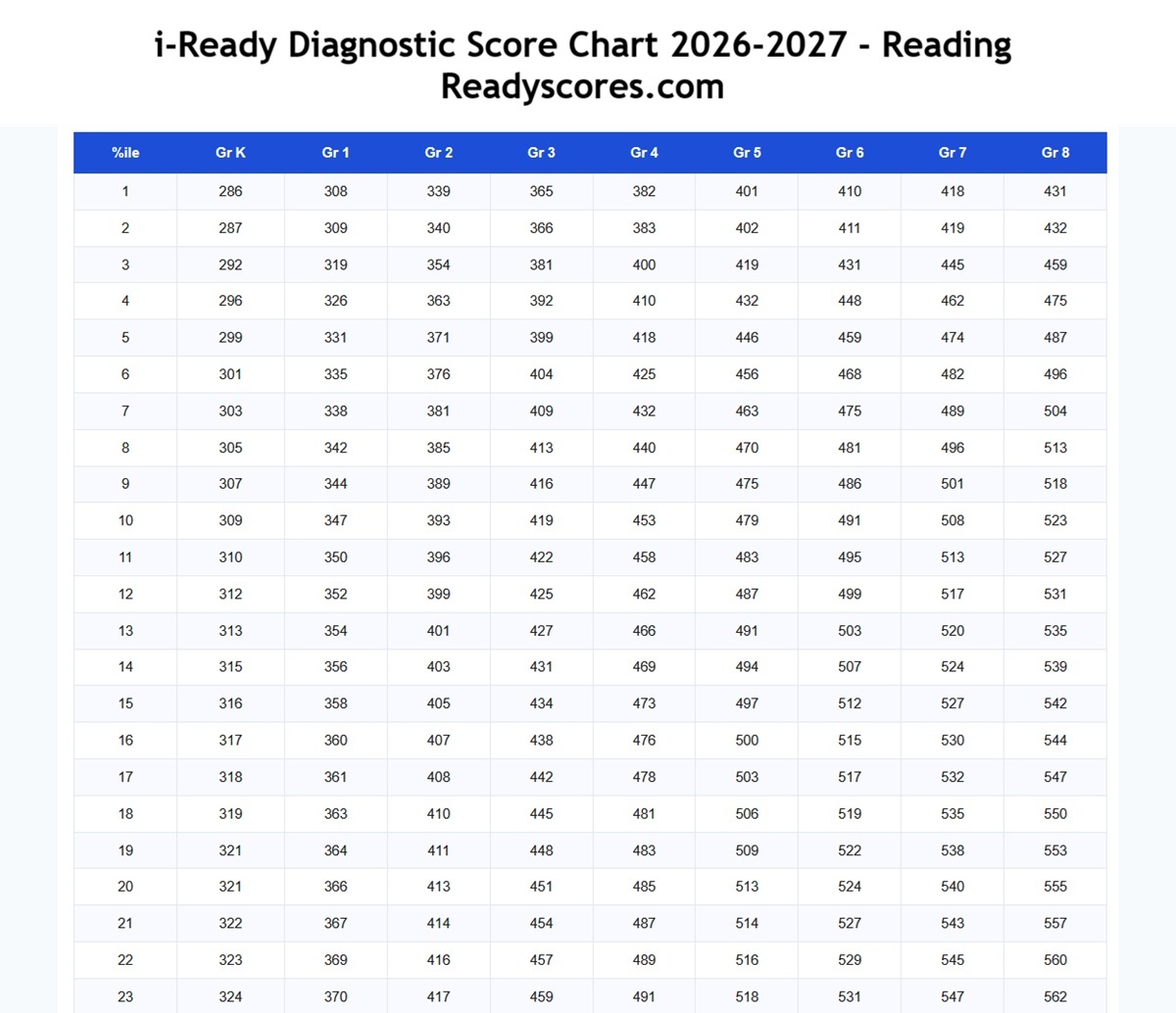
This page contains the official iReady Diagnostic Reading Scores by Grade Level for 2025–2026 and 2026–2027, including the complete i-Ready Reading Score Charts with percentiles for Fall, Winter, and Spring (Grades K–8).
The tables below show nationally normed iReady Inform (formerly iReady Diagnostic) Reading scores for every percentile from 1 through 99, helping parents and students compare Reading performance by grade level.
Includes the full Fall, Winter, and Spring iReady Reading Score charts for Grades K–8 with all percentiles from 1 to 99, updated for the 2025–2026 and 2026–2027 school years.
Definition: iReady Diagnostic Reading Scores are nationally normed scale scores used to measure Reading performance and growth by grade level. The percentile charts on this page show how a student’s score compares with students nationwide.
iReady Diagnostic Reading Scores 2026: Fall Score Chart with Percentiles (Grades K–8)
Test window: Start of school year through November 15 · Also known as: iReady Inform Reading Scores, Fall (2026–2027 name)
To use this chart: find your child’s grade column, scan down to find their scale score, and read the percentile from the left. The highlighted row at the 50th percentile shows the national average for each grade in Fall.
iReady Diagnostic Reading Scores 2026 — Fall norms, start of school year through November 15. Blue highlighted row = national median (50th percentile). Source: Curriculum Associates official norms (2022–2023 data, applied 2024–2025 and 2025–2026). Full 1–99 percentile detail: rows 21–24 and 26–49 and 51–64 and 66–74 and 76–84 and 86–89 and 91–94 available in the official norms table linked below.
iReady Diagnostic Reading Scores 2026 — Winter Score Chart with Percentiles (Grades K–8)
Test window: November 16 through March 1 · Norms are higher than Fall — do not compare Fall and Winter percentiles directly
Winter norms are calibrated to the middle of the school year. Expect your child’s scale score to be notably higher than their Fall result if they are growing on track. The 50th percentile (highlighted) shows what’s nationally average for each grade in Winter.
iReady Diagnostic Reading Scores 2026 — Spring Score Chart with Percentiles (Grades K–8)
Test window: March 2 through end of school year · Spring norms are the highest of the school year and reflect expected end-of-grade performance
Spring percentile norms measure where a student performs nationally at the end of the school year. Students who are growing on track should typically score substantially higher than they did in Fall or Winter. The highlighted 50th percentile row shows the national average Spring score for each grade.
Fall norms. Blue-highlighted 50th percentile column = national average. At or above average means your child is performing at or better than the national median for their grade in Fall.
In this guide:
- What is the iReady Diagnostic Reading Test?
- What Your Child’s iReady Reading Report Shows
- iReady Reading Levels: AA through H Explained
- How Scores Change Through the School Year (Fall, Winter, Spring)
- iReady Diagnostic Reading Scores 2026 — Fall Score Chart (All Percentiles)
- iReady Diagnostic Reading Scores 2026 — Winter Score Chart (All Percentiles)
- iReady Diagnostic Reading Scores 2026 — Spring Score Chart (All Percentiles)
- What Is a Good iReady Reading Score by Grade?
- Sample Reading Questions by Grade Level
- How to Improve iReady Reading Scores
- iReady Diagnostic → iReady Inform: The 2026 Rebrand
- 30-Question FAQ
What Is the iReady Diagnostic Reading Test?
Welcome. The iReady Diagnostic for Reading is an adaptive assessment used in K–8 classrooms across the United States. Created by Curriculum Associates, the test adjusts in real time based on how your child answers each question. Answer correctly and the next question gets harder. Struggle and it gets easier. This adaptive design is the key to what makes iReady different from most school tests: it finds your child’s actual reading level, not just whether they can pass a fixed grade-level test.
Rather than a pass/fail result, the iReady Diagnostic Reading assessment produces a scale score, a percentile rank, a placement level, and a domain breakdown. Together, these four pieces of information give teachers — and parents — a complete picture of where a student stands in reading and what they should focus on next.
The reading test covers four core domains:
| Reading Domain | What It Measures | Key Grades |
|---|---|---|
| Phonological Awareness & Phonics | Letter-sound relationships, decoding, word recognition | K–2 (primary focus) |
| Vocabulary | Word meaning, context clues, figurative language | K–8 |
| Comprehension: Literature | Story elements, character, theme, inference in fiction | K–8 |
| Comprehension: Informational Text | Main idea, text structure, evidence in nonfiction | K–8 |
Students are tested up to three times per school year — in Fall, Winter, and Spring — giving teachers three separate snapshots of reading growth throughout the year.
What Your Child’s iReady Reading Report Shows
Most parents receive their child’s iReady results through school portals like PowerSchool, ParentVUE, Infinite Campus, or Aeries. The report may feel overwhelming at first glance — numbers, colors, labels — but each element means something specific.
📄 What’s on your child’s iReady Reading Report:
- Scale Score (100–800): The main number. Tracks growth over time across all grades on a single continuous scale.
- Percentile Rank (1–99): How your child compares to a national sample of same-grade peers who tested in the same season.
- Placement Level: A label (e.g., “On Grade Level,” “Early On Grade Level”) showing performance relative to current grade expectations.
- Domain Scores: Separate scores for Phonics, Vocabulary, Comprehension (Literature), and Comprehension (Informational Text).
- Growth Data: Comparison of Fall, Winter, and Spring scores to show progress over the year.
- Typical Growth Target: The scale score gain considered “on track” for a student at that grade and starting level.
The scale score is not a percentage. A score of 460 does not mean your child got 46% of questions right. It is a position on a consistent measurement scale designed to track growth from kindergarten through Grade 8 and beyond. A 460 in Grade 2 Reading means something very different from a 460 in Grade 6 — always use the iReady Reading Score chart for the correct grade and season.
The percentile is a comparison, not a grade. A 50th percentile score means your child is at the national median — exactly average. That is not a bad score. A 70th percentile means your child outperformed 70 percent of their national peers in that grade and season. The percentile is your best tool for quick context.
iReady Reading Levels: AA Through H Explained
Within the iReady online learning platform (separate from the Diagnostic test itself), reading lessons are organized into levels that correspond roughly to grade levels. When your child’s report mentions a level label, here is what it means:
| iReady Level | Approx. Grade Equivalent | Reading Focus at This Level |
|---|---|---|
| AA | Pre-K / Kindergarten | Letter recognition, phonemic awareness, early sight words, basic listening comprehension |
| A | Grade 1 | Phonics, CVC words, simple sentences, beginning decoding and fluency |
| B | Grade 2 | Blends, digraphs, early fluency, short passages, basic comprehension |
| C | Grade 3 | Reading fluency, main idea and details, story elements, beginning inference |
| D | Grade 4 | Longer texts, vocabulary in context, character motivation, text structure, summarizing |
| E | Grade 5 | Theme and central idea, figurative language, compare/contrast across texts |
| F | Grade 6 | Author’s purpose, argument and evidence, complex informational texts |
| G | Grade 7 | Point of view, analysis, evaluating claims, close reading of complex texts |
| H | Grade 8+ | High-complexity texts, synthesis across sources, rhetorical analysis, college-readiness skills |
Note: A student can be assigned lessons at a level above or below their enrolled grade. This is normal and reflects their current instructional need, not a label on their overall ability.
Read the detailed iReady Level page here.
How iReady Reading Scores Change Through the School Year
This is one of the most important things to understand about iReady Diagnostic Reading Scores 2026, and it’s where most parent confusion comes from. The norms — the benchmark for what’s “average” — change with every testing season. Fall norms, Winter norms, and Spring norms are completely separate. A score that puts your child at the 60th percentile in Fall will map to a different percentile in Winter or Spring, even if the scale score is identical.
Why? Because students are expected to grow throughout the year. The national comparison group also grows. So “average” in Spring is a higher scale score than “average” in Fall. A child who stays at the exact same scale score across all three tests is actually falling behind relative to peers — because everyone else grew.
📆 The three iReady Reading testing windows:
- Fall / BOY (Beginning of Year): Start of school year through November 15. Establishes a baseline. Fall scores are always lowest — this is normal and expected.
- Winter / MOY (Middle of Year): November 16 through March 1. Shows whether instruction since Fall is working. Scores should be notably higher than Fall.
- Spring / EOY (End of Year): March 2 through end of school year. Shows full-year growth. Used to plan for the following year and assess overall progress.
Example of healthy growth for a Grade 4 Reading student:
| Season | Scale Score | Percentile | What It Means |
|---|---|---|---|
| Fall | 533 | 50th | Exactly at national average |
| Winter | 548 | 50th | Still at national average — grew 15 points |
| Spring | 558 | 50th | Maintained national average — grew 25 points over the year |
Notice that a student can stay at the 50th percentile all year while their scale score grows by 25 points. That growth is real and meaningful. The key takeaway: always look at scale score growth alongside percentile, not instead of it.
Sample iReady Reading Questions by Grade Level
Understanding what the test actually asks helps both parents and students feel less anxious about it. Here are representative examples of the types of reading questions your child will encounter at each grade level. These are illustrative examples — exact wording will vary.
📚 Kindergarten (Level AA) — Phonological Awareness & Basic Comprehension
“The cat sat on the mat. What did the cat sit on?” — Tests basic sentence comprehension and listening. Students also complete phonics tasks: “Which word starts with the same sound as ‘dog’? — door, cup, hat.”
📚 Grade 1 (Level A) — Phonics & Early Decoding
“Ben has a pet fish. He feeds it every day. Why does Ben feed his fish?” — Tests simple cause/effect and comprehension of short passages. Phonics: “Which word rhymes with ‘cake’? — lake, look, kick.”
📚 Grade 2 (Level B) — Fluency & Comprehension
Short passage about an animal, then: “What is the main idea of this passage?” and “Which detail best supports the main idea?” Students select from multiple-choice options. Vocabulary: “The word ‘enormous’ in the sentence means ___.”
📚 Grade 3 (Level C) — Main Idea, Story Elements & Inference
A 2-paragraph story about a character facing a problem, then: “How does [character] feel at the end of the story? What clues from the text support your answer?” Students must select the best inference, not just an obvious fact.
📚 Grades 4–5 (Levels D–E) — Text Structure, Vocabulary & Theme
A nonfiction passage with headings, then: “What is the author’s main purpose in this text?” and “How does the author support the central idea in paragraph 3?” Figurative language: “What does the phrase ‘raining cats and dogs’ mean in this context?”
📚 Grades 6–8 (Levels F–H) — Argument, Evidence & Analytical Reading
An argumentative passage, then: “Which evidence from the text best supports the author’s claim?” and “How does the author’s point of view affect the way information is presented?” Students may also be asked to compare two related texts by different authors on the same topic.
How to Improve iReady Reading Scores
Good news: reading skills can be meaningfully improved with consistent, targeted practice. The domain breakdown on your child’s iReady Reading report is the most actionable information — it tells you exactly where to focus. Here’s how to use it:
| If This Domain Is Weak… | Try These At-Home Strategies |
|---|---|
| Phonics / Phonological Awareness | Word family games, rhyming activities, phonics apps (Phonics Hero, Starfall), read-aloud with emphasis on sounding out words |
| Vocabulary | Read widely across topics, use a “word of the day,” discuss meaning of unknown words during reading, play vocabulary games |
| Comprehension: Literature | Ask “who, what, where, why, how” during story reading; discuss characters’ feelings and motivations; summarize books together |
| Comprehension: Informational Text | Read nonfiction books, magazines (Nat Geo Kids, TIME for Kids), news summaries; practice finding the main idea and supporting details |
💡 Top 5 proven ways to improve iReady Reading scores:
- Read every day for 20–30 minutes — at a comfortable level, not always at the top of their range
- Complete iReady lessons consistently — 30–49 minutes per week of iReady lesson time is the recommended target
- Focus on the weakest domain — use the report to find the specific skill area to target
- Discuss what you read — conversation about books builds comprehension and vocabulary simultaneously
- Talk to the teacher — they can provide specific strategies matched to your child’s data
iReady Diagnostic Is Becoming iReady Inform in 2026–2027
On November 4, 2025, Curriculum Associates officially announced that the i-Ready Diagnostic will be renamed i-Ready Inform, beginning with the 2026–2027 school year. If you’ve seen both names in school documents, report cards, or parent portals — that’s why. The transition is gradual through 2025–2026 and becomes fully official in 2026–2027.
Why the name change? The word “Diagnostic” only describes part of what the test does. Educators have long used it to inform instruction, guide grouping decisions, set growth targets, and communicate with families. Curriculum Associates CEO Kelly Sia explained that “iReady Inform” better reflects the assessment’s purpose: providing teachers, students, and families with the information they need to drive learning forward. A shorter test format is also being introduced in 2026–2027, responding to years of educator feedback that less time on testing means more time on teaching.
What the rebrand means for iReady Reading scores:
- 2024–2025: No change. iReady Diagnostic, same norms, same scale scores.
- 2025–2026: Transition year. Both names may appear. Score scale and norms remain the same and fully comparable to prior years.
- 2026–2027: Full iReady Inform branding. Shorter test option available. Scale scores, percentiles, and placement levels remain consistent — historical growth data is preserved. New iReady Inform norms will be published as they become available.
The bottom line for parents: the name changes, but the scores do not reset. A score your child achieved in 2024 is directly comparable to a score in 2027. Readyscores.com will publish updated iReady Inform norms for Reading as soon as they are released by Curriculum Associates.
iReady Diagnostic Reading Scores FAQ — 30 Questions Answered
Answers to the most common questions from parents, students, and teachers about iReady Diagnostic Reading scores and the assessment in general.
What’s a Good iReady Reading Score?
A good iReady Reading score is one at or above the 50th percentile for your child’s grade and the testing season — meaning they are performing at or above the national average. More importantly, a “good” score pattern shows consistent growth across Fall, Winter, and Spring, regardless of where the starting point is. Steady improvement is more meaningful than a single impressive number.
What Is a Good iReady Diagnostic Score for 1st Grade in Reading?
For 1st grade Fall Reading, the national median (50th percentile) is 403. A score of 422 or above puts a 1st grader in the top 25 percent nationally, while 456 or above is the 90th percentile. If your 1st grader scores between 373 and 403 in Fall, they are in the bottom half nationally but not significantly behind — consistent daily reading practice makes a big difference at this stage.
What Is a Good iReady Diagnostic Score for 2nd Grade in Reading?
The 2nd grade Fall Reading national median is 460. Scoring 496 or above (75th percentile) indicates strong reading performance nationally, while 524 and above is the 90th percentile. Grade 2 is a pivotal year for reading development — students transition from learning to read to reading to learn, so scores in this range directly predict readiness for the heavier text demands of Grade 3 and beyond.
What Is a Good iReady Diagnostic Score for 3rd Grade in Reading?
For 3rd grade Fall Reading, 502 is the national median. Reaching 534 places a 3rd grader at the 75th percentile, and 558 reaches the 90th percentile. Grade 3 is when state reading assessments often begin, so 3rd grade iReady scores are particularly important as an early predictor of state test performance — many districts use this data when considering reading support services.
What Is a Good i-Ready Diagnostic Score for 4th Grade in Reading?
The 4th grade Fall Reading national median is 533. A score of 564 reaches the 75th percentile and 588 the 90th. Fourth grade is when reading demands increase significantly — longer texts, more complex vocabulary, and multi-paragraph informational passages become standard. If your 4th grader is below 495 (25th percentile) in Fall, focused support in vocabulary and comprehension is strongly worth discussing with their teacher.
What Is a Good i-Ready Diagnostic Score for 5th Grade in Reading?
For 5th grade Fall Reading, the national median is 558. Scoring 588 or above (75th percentile) is strong, while 616 represents the 90th percentile. Grade 5 students who score at or above 558 in Fall are well-positioned for the transition to middle school reading expectations. Students in the 40th–60th percentile range should be considered on track — not in need of intervention, but benefiting from continued enrichment reading.
What Is a Good iReady Diagnostic Score for 6th Grade in Reading?
The 6th grade Fall Reading national median is 573. Scoring 607 (75th percentile) or above is excellent for a 6th grader, while 632 reaches the 90th percentile. Middle school iReady Reading scores increasingly reflect academic literacy — the ability to read complex informational texts and analyze arguments — which matters for performance across all content areas, not just English class.
What Is a Good iReady Diagnostic Score for 7th Grade in Reading?
For 7th grade Fall Reading, the national median is 590. Reaching 626 (75th percentile) is strong, and 648 reaches the 90th percentile. A 7th grader scoring at or above 590 in Fall is performing at or above the national average. Students who score in the 90th percentile range (648+) are reading at a level that typically exceeds grade expectations and may benefit from advanced coursework or independent extended reading projects.
What Is a Good iReady Diagnostic Score for 8th Grade in Reading?
The 8th grade Fall Reading national median is 607. Scoring 636 (75th percentile) or above represents strong performance for an 8th grader nationally, while 663 reaches the 90th percentile and 696 and above places a student in the top 1 percent. 8th grade scores are particularly meaningful because they reflect readiness for high school-level reading expectations — complex literary and informational texts, sustained argumentation, and analytical writing.
What Is a Good iReady Diagnostic Score for 9th Grade in Reading?
The standard iReady Diagnostic (now iReady Inform) is designed primarily for Grades K–8, though some districts extend it into Grade 9. Older norms tables published by Curriculum Associates do include Grades 9–10 in some versions. As a general guide, a 9th grader reading at the 8th grade 50th percentile level (607 or above) would be considered on track for high school reading demands. For Grade 9-specific norms, check with your child’s school — some districts use extended iReady norms tables for high school.
What Is a Good iReady Diagnostic Score for 10th Grade in Reading?
iReady Diagnostic was not designed primarily for Grade 10, and official national norms for 10th grade are not included in the standard K–8 norms tables. Some older Curriculum Associates publications include extended norms through Grade 10, with the 50th percentile for 10th grade Reading typically falling in the high 600s. If your high school uses iReady, ask the teacher for grade-specific interpretation guidance, as the standard K–8 charts do not apply directly.
What Do iReady Reading Scores Mean?
iReady Reading scores tell you where a student performs on a continuous national scale, how they compare to same-grade peers nationally (percentile), and whether their performance meets grade-level expectations (placement level). They do not measure intelligence, effort, or potential — they measure demonstrated reading skills at a specific point in time. The most meaningful reading from iReady data is growth: a student who moves from 460 to 490 over the year has made real progress, even if their percentile remains the same.
What Are the Reading Levels in iReady?
iReady uses letter-based levels (AA through H) that correspond roughly to grade levels from Pre-K/Kindergarten through Grade 8+. Level AA is for beginning readers in Kindergarten, Level A is Grade 1, Level B is Grade 2, and so on through Level H which corresponds to Grade 8 and above. A student assigned lessons below their enrolled grade is receiving instruction where they are, not where the calendar says they should be — this is the whole point of adaptive learning.
What Is I-Ready Reading?
i-Ready Reading refers to both the Diagnostic assessment and the online learning platform for reading, developed by Curriculum Associates. The Diagnostic (now being rebranded as iReady Inform) tests students adaptively and produces scores, percentiles, and placement levels. The learning platform then assigns personalized lesson pathways based on Diagnostic results, helping students practice the specific skills they need most. Together they form a connected assessment and instruction system used in K–8 classrooms across the United States.
What Are the 4 Levels of Reading?
In educational research, the four levels of reading are often described as: (1) Elementary reading — recognizing words and basic sentence meaning; (2) Inspectional reading — quickly identifying the main point of a text; (3) Analytical reading — deep understanding of a text’s structure, arguments, and meaning; and (4) Syntopical reading — comparing and synthesizing multiple texts on the same subject. iReady Reading assesses skills across all four levels depending on grade, with younger grades focusing on levels 1–2 and upper grades emphasizing levels 3–4.
What Grade Level Is a 630 on iReady Reading?
A Reading scale score of 630 corresponds to approximately the 75th–80th percentile for a 7th grader in Fall, or roughly the 60th–65th percentile for a 7th grader in Spring. For a 6th grader in Fall, 630 is well above the 90th percentile. Generally speaking, a score of 630 in Reading represents strong upper-middle school level reading performance — roughly equivalent to a 7th or 8th grade instructional reading level. Use the charts above and the correct grade/season to get the precise percentile for your child’s situation.
How Does iReady Determine Grade Level?
iReady determines grade level through its adaptive algorithm, which adjusts questions based on each answer until it can precisely identify the student’s instructional level. The resulting scale score is then compared to national norms to produce a percentile and compared to grade-level cut scores to produce a placement label. Placement levels reflect whether a student’s score meets the criteria expected for students in their enrolled grade at that point in the year — these criteria are set by Curriculum Associates based on research into what typical grade-level performance looks like.
What Is a Good iReady Math Diagnostic Score?
For iReady Math, the national median (50th percentile) in Fall for Grade 5 is 470 and for Grade 8 is 501. Generally, a score at or above the 50th percentile for your child’s grade and season is considered on-track. For a complete Math score chart and percentile guide, visit our dedicated iReady Diagnostic Scores Math page.
Is It Possible to Get 800 on iReady?
The iReady scale theoretically extends to 800, but achieving a score of 800 is essentially impossible for a K–8 student. The adaptive test adjusts to each student’s level and stops before reaching a practical ceiling that would be needed to achieve 800. In reality, even the top 1 percent of 8th graders in Fall Reading score around 696 or above — meaning 800 is many standard deviations beyond what any current student is realistically assessed at.
What Grade Level Is a 700 on iReady?
A Reading score of 700 is extremely high and falls above the 99th percentile for any grade K–8 in any season based on current norms. The highest documented iReady Reading percentile benchmarks top out at 696+ for 8th grade Spring 99th percentile. If a K–8 student reports a score near or above 700, they are reading at a level significantly beyond their grade’s curriculum expectations. This level of performance may qualify a student for gifted and advanced programming, depending on the district.
What Grade Is 400 on iReady Reading?
A Reading scale score of 400 corresponds to approximately the 50th percentile for Kindergarten in Fall (national median: 341) — so 400 would be well above average for Kindergarten, and around the 75th–85th percentile for Grade 1 in Fall. For Grade 2, a score of 400 is below the 25th percentile in Fall (median: 460). Context is everything — always use the chart for the correct grade and season.
What Happens If You Fail i-Ready?
There is no failing iReady. The Diagnostic is not a pass/fail test — every student receives a score that reflects their current reading level. If a student’s score indicates they are significantly below grade-level expectations, the school uses that information to provide targeted support and personalized instruction. The iReady system is specifically designed to help students who are below grade level, not to penalize them.
What Does Level D Mean in iReady?
Level D in iReady corresponds to 4th grade content. Students working at Level D in Reading are focusing on comprehension of longer texts, understanding vocabulary in context, analyzing character motivation, summarizing, and identifying text structure in both fiction and informational texts. A student enrolled in Grade 6 who is assigned Level D reading lessons is working on 4th grade skills — this signals a specific area of need that the teacher can address with targeted instruction.
What Is Level E in iReady Diagnostic?
Level E in iReady corresponds to 5th grade content. In Reading, Level E focuses on theme and central idea in literature, figurative language, comparing and contrasting texts, and analyzing how authors use structure and perspective. If a 5th grader is assigned Level E lessons, they are working at exactly their grade level — this is the expected placement for a student who is on grade level.
Is Level E Good on iReady for 5th Grade?
Yes — Level E is exactly the expected level for a 5th grader on iReady. Being assigned Level E lessons means your child is working at grade-level content in Reading. It is neither remedial nor advanced — it is the “on grade level” placement for a 5th grader. A 5th grader placed at Level F or above would be considered above grade level in their reading placement.
What Is the iReady Reading Grading Scale?
iReady Reading does not use a traditional grading scale (A/B/C or percentages). It uses a scale score from approximately 100 to 800, a national percentile rank from 1 to 99, and a placement level (Early On Grade Level, Mid On Grade Level, Late On Grade Level, One Grade Level Below, or Two or More Grade Levels Below). These three data points together give a more complete picture than any single number or letter grade.
Can My Child Prepare for the iReady Reading Test?
The iReady Diagnostic is an assessment tool, not a curriculum test — so cramming specific content won’t help. However, students can improve their performance by reading widely and consistently before the test, practicing vocabulary, and engaging in reading discussions. The best “test prep” for iReady Reading is sustained daily reading throughout the school year. Students who read regularly for pleasure tend to build all four reading domains measured by iReady naturally over time.
Why Did My Child’s iReady Reading Score Go Down?
Score declines between seasons — especially between Spring and the following Fall — are extremely common and are largely explained by the “summer slide”: learning loss over summer break when students are not in school. A modest drop from Spring to Fall is expected for most students. If your child’s score dropped significantly within the same school year (Fall to Winter, or Winter to Spring), it’s worth talking to the teacher to understand whether test conditions, effort, or a genuine skill gap may be contributing.
How Long Does the iReady Reading Diagnostic Take?
The iReady Reading Diagnostic typically takes 45–60 minutes for most students, though younger students (K–1) may finish faster and students who are more methodical may take longer. The test is untimed, so students should not rush. Starting in 2026–2027, a shorter test format is available as part of the iReady Inform rollout. Both versions provide reliable diagnostic data — the shorter test simply reduces the time burden while maintaining accuracy.
How Are iReady Reading Norms Updated?
Curriculum Associates reviews iReady norms annually and updates them when the data indicates that national student performance has shifted enough to warrant a change. The current norms applied to the 2024–2025 and 2025–2026 school years are based on 2022–2023 student performance data — a significant update from the previous norms, which were based on pre-pandemic 2018–2019 data. This means percentile rankings today may differ from rankings in prior years for the same scale score, reflecting real shifts in national student performance post-pandemic.
Where Can I Find the Official iReady Reading Score Charts?
The official iReady Diagnostic national norms tables are published by Curriculum Associates and are available to educators through their iReady platform. For parents seeking clear, verified, and easy-to-use versions of all three seasonal Reading score charts — Fall, Winter, and Spring — for Grades K–8, Readyscores.com maintains updated charts based on the official norms. This page includes Fall, Winter, and Spring charts for the 2025–2026 and 2026–2027 school years. New iReady Inform norms will be added here as soon as they are officially published.
🔗 More iReady Score Resources on Readyscores.com
Readyscores.com is your trusted source for iReady Diagnostic Score charts, norms, and percentile interpretation — updated for 2025–2026 and 2026–2027.
📑 iReady Diagnostic Reading Scores — All Grades, All Seasons
📑 iReady Diagnostic Math Scores — Complete Fall, Winter & Spring Charts
Sources: Curriculum Associates official iReady Inform (formerly iReady Diagnostic) national norms tables; Curriculum Associates press release November 4, 2025; Curriculum Associates CEO Kelly Sia statement; iReady Inform program documentation at curriculumassociates.com; 2022–2023 norming data applied to 2024–2025 and 2025–2026 school years. Score tables verified against official published norms. This page is maintained by Readyscores.com and is not affiliated with or endorsed by Curriculum Associates.
Sources:
Curriculum Associates
iReady Login
i-Ready on Wikipedia
Other i-Ready Resources
i-Ready Diagnostic Scores by Grade
i-Ready Reading Scores by Grade
i-Ready Math Scores by Grade
Complete i-Ready Diagnostic Scores Guide
i-Ready Frequently Asked Questions
i-Ready Score Calculator
i-Ready Growth Tracker
i-Ready Levels AA–H Explained
i-Ready Placement Levels Explained
What Is a Good i-Ready Score?
How to Understand an i-Ready Score Report
What to Do When an i-Ready Score Is Below Grade Level