I Got My Child’s iReady Score Report and They Are Below Grade Level. Now What?
My Child Got a Below Grade Level iReady Score. Here Is Exactly What to Do Next.
By Stephanie Smith, M.Ed. · Updated 2026 · 8 min read
Jump to any section. Reading time approximately 8 minutes.
I have sat across the table from hundreds of parents who got their child’s iReady score report and felt their stomach drop. The words “one level below grade level” or “two levels below grade level” land hard. I know. I spent 18 years coordinating assessments at the school and district level, and I watched that moment happen over and over.
So let me say the thing I always said to those parents first: this report is not a verdict. It is a starting point. A precise, specific starting point that tells you and your child’s teacher exactly where to focus. That is actually useful. Much more useful than a vague feeling that something might be off.
Here is exactly what to do with it.
Step 1: Read the Report Correctly Before You Do Anything Else
Most parents look at the level label, feel worried, and stop reading. That is the worst thing you can do with an iReady report because the level label is actually the least useful number on the page.
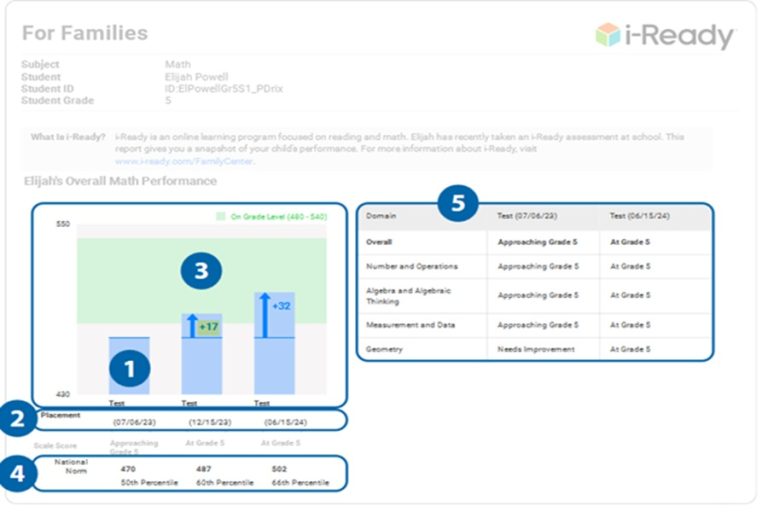
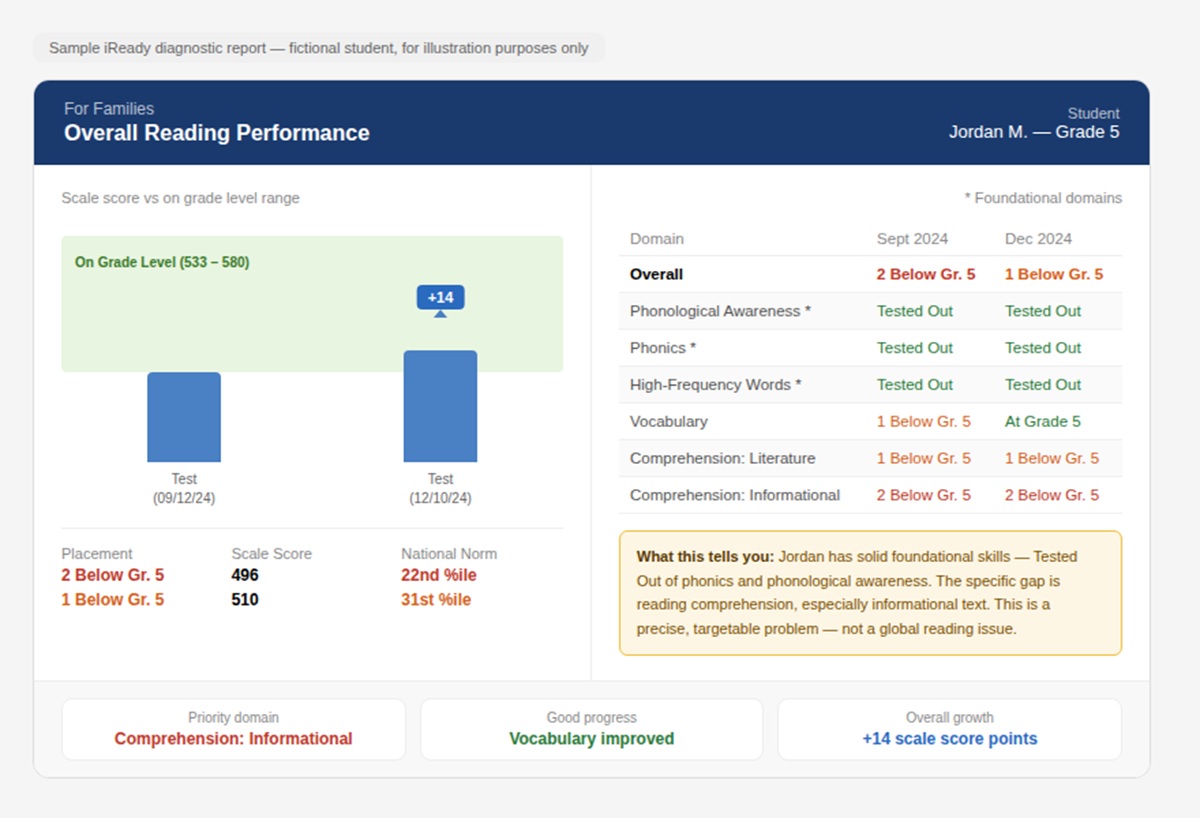
Your child’s report has three distinct pieces of information and they mean different things.
The scale score is a number roughly between 100 and 800. This is the most honest measure of where your child actually is on the learning continuum. It is what you compare at the next testing window to see if growth happened. A scale score of 480 in Math this Fall compared to 495 next Winter means real, measurable progress — regardless of what the level label says.
The percentile compares your child to a national sample of students in the same grade who tested in the same season. A 40th percentile score means your child outperformed 40% of peers nationally. That is below average, yes. It is not alarming. It is a number that tells you where to focus.
The level placement tells you which instructional content your child has been assigned. This is derived from the scale score and it is where parents get most anxious. But it is actually the least nuanced piece of data on the report.
A child who is “one level below in Math” but whose domain breakdown shows strong multiplication and weak fractions has a very specific, solvable problem. That is not the same as being generally behind in Math. Find the domains before you do anything else. For a full explanation of what each level means by grade see our iReady Diagnostic Scores guide.
Step 2: Contact the Teacher – Email or Meeting?
Yes, you should contact the teacher. Yes, soon. But the way you do it matters.
If your child is one level below grade level: A thoughtful email is completely appropriate. Teachers appreciate a parent who comes with specific questions rather than general anxiety. Request a brief response and let the teacher know you want to work together.
If your child is two or more levels below grade level: Request a meeting. Not because it is an emergency, but because two or more levels below means there are meaningful skill gaps that need a real conversation, not a three-sentence email exchange.
“Hi [Teacher name], I received [child’s name]’s iReady diagnostic results and I wanted to connect with you about them. I can see they are placed at Level [X] in [Reading/Math] and I noticed [specific domain] seems to be an area of focus. I have a few questions I’d love to discuss when you have a moment: which skill areas are the priority right now, what support is already in place at school, and what I can do at home that would actually complement what you are teaching. Would you be able to reply briefly or let me know if a short call or meeting would work better? Thank you.”
Exactly What to Ask the Teacher
Come prepared with these questions. Write them down before the meeting or email so you actually get answers to all of them.
- Which specific domains are weakest and which are strong? Get granular. “Below level in Math” is too vague to act on.
- What is already happening at school in response to this result? Is the child in a small intervention group? Are they receiving any additional support?
- What specific skills should I focus on at home right now? Not general practice — ask for the exact skill area that matters most this week.
- Are there school-provided materials or resources I can use at home? Many schools have access to platforms parents do not know about.
- What does expected growth look like between now and the Winter diagnostic? Get a number or a range so you have something to measure against.
- Is there a reading specialist or math interventionist already working with my child? If not, is one available? How do we access that support?
- At what point would you recommend a formal evaluation? This is worth asking clearly if the gap is significant, especially if it has persisted across multiple diagnostics.
What the School Should Already Be Doing
Most schools use something called RTI (Response to Intervention) or MTSS (Multi-Tiered System of Supports). This is a framework where students who are identified as below grade level receive additional targeted support beyond their regular classroom instruction. If your child is significantly below grade level and nobody has mentioned intervention support, it is completely appropriate to ask about it directly.
Ask: “Is my child currently receiving any Tier 2 or Tier 3 support through the school’s intervention program?” If the answer is no and the gap is meaningful, ask what the process is to access it. You are not being difficult. You are being the parent your child needs.
Step 3: Free and Low-Cost Practice Resources That Actually Work
I am going to give you real ones. Not a generic list — resources I have actually seen work with students at different levels.
Khan Academy (free, khanacademy.org) – This is the single best free resource available and it maps closely to the skill domains iReady assesses. Go to the grade level the diagnostic identified, not your child’s enrolled grade. Start there. Khan Academy’s Math and Reading/Writing pathways by grade are detailed, sequential, and genuinely effective for targeted practice.
Khan Academy Kids (free, ages 2-8) – For students at Level AA and Level A, this app covers early literacy and numeracy in a game-based format that young children will actually engage with voluntarily.
IXL (ixl.com) – Paid subscription but offers a small number of free daily questions. IXL is organized by skill rather than grade, which makes it excellent for targeting the exact weak domain the teacher identifies. Worth the cost if you can manage it — it closely mirrors the types of skills iReady assesses.
Prodigy Math (free, prodigygame.com) – Game-based math practice that students in Grades 1 through 8 find genuinely motivating. Less structured than IXL but far more engaging for reluctant learners. Good for consolidating skills rather than introducing new ones.
ReadWorks (free, readworks.org) – Free reading passages with comprehension questions organized by grade level and Lexile band. Excellent for Level C and above where comprehension of informational text is a weak domain. Short passages with targeted questions make this practical for daily use.
CommonLit (free, commonlit.org) – Free literary texts with built-in comprehension support including guided questions and vocabulary help. Best for Level C through Level G. Very well-aligned to the kinds of inference and analysis questions iReady Reading asks.
Starfall (free, starfall.com) – For early readers at Level AA and Level A. Phonics-focused, highly structured, and specifically designed for the skills assessed at the earliest literacy levels.
Epic (free with teacher code, getepic.com) – A digital reading library with thousands of books organized by reading level. Ask your child’s teacher for a class code — most teachers have one and it gives home access. Great for building reading volume at the right level.
Your public library – I always say this and parents always underestimate it. Ask your school or public librarian specifically: “My child is reading at a [Level B/C/D] level in iReady — what books would you recommend at that level?” Librarians know their collections and they will find books your child will actually want to read. Reading volume at the right level is one of the most evidence-supported ways to improve both reading skill and score.
Step 4: What Actually Helps at Home (By Level)
Fifteen to twenty minutes of targeted daily practice beats two hours on a Saturday. Consistency is everything. Here is what to focus on based on where your child is placed.
Level AA and A (Kindergarten and Grade 1 content): Daily phonics practice with letter sounds and simple word families. Sight word flashcard games — make it fast and fun, not drill. Read aloud to your child every single day even if they can read independently. Count objects around the house. Play simple addition and subtraction games with dice or cards.
Level B and C (Grades 2-3 content): Read short books together and ask “why” questions after — not just “what happened” but “why did the character do that?” and “how do you know?” Practice multiplication facts daily, but through games rather than rote drill. Times table card games and apps work well. Encourage your child to retell what they read in their own words — this builds the comprehension skills tested at Level C.
Level D and E (Grades 4-5 content): The biggest skill gaps at these levels are usually fractions in Math and inference in Reading. For fractions, use real objects — pizzas, measuring cups, folded paper. For inference, after reading anything together ask “what does the author want you to understand that they did not say directly?” Real-world math problems help too: cooking measurements, calculating change, splitting costs.
Level F, G, H (Grades 6-8 content): At this level your best home support is discussion rather than worksheets. Read a news article together and talk about whether the argument is convincing and what evidence supports it. Khan Academy is your best friend for pre-algebra and algebra gaps. Ask your child to explain what they are learning at school — the act of explaining consolidates understanding faster than re-reading notes.
Before You Worry Too Much: Was It a Bad Day?
Here is something I always told parents before we even looked at a score together: the iReady diagnostic is a long test. For a 2nd or 4th grader, it typically runs 45 to 60 minutes per subject in Reading and Math – meaning a child could be sitting in front of a screen for up to two hours total. For a Kindergartner, testing usually happens across three 20-minute sessions. For 1st graders, it is often two sessions per subject. That is a significant cognitive demand for a young child, and it matters more than most people realize when interpreting results.
The test is also untimed and computer-adaptive – it adjusts difficulty in real time based on each answer, which means a student who loses focus and clicks randomly for even five minutes can send the algorithm in completely the wrong direction. The adaptive system is only as accurate as the student’s engagement in that moment.
Things that can produce an inaccurate result without any underlying learning problem:
- Testing fatigue – especially if both subjects are done back to back in one sitting
- A bad night’s sleep or illness on testing day
- Anxiety about the test itself – some children get visibly stressed by the adaptive difficulty increase and start shutting down
- A classroom environment with distractions, noise, or interruptions during testing
- Rushing to finish – particularly common in children who are competitive or easily bored
- Technical issues mid-session that disrupted concentration
- Testing later in the day when energy is low
Many schools are aware of this and break the test across multiple shorter sessions – some teachers run 15 to 20 minute intervals across several days, allowing students to log out and resume exactly where they left off. But not every school does this, and not every child gets the same testing conditions. It is entirely reasonable to ask the teacher: how was the testing session conducted, and did anything seem off on the day?
One more thing worth knowing: starting with the 2026-2027 school year, Curriculum Associates is transitioning from i-Ready Diagnostic to i-Ready Inform, which features fewer questions than the previous diagnostic format. A shorter test is more efficient but also means each question carries slightly more weight – another reason a student having an off day can produce results that do not fully reflect their ability.
Could This Be a Learning Difference Like Dyslexia?
I want to address this directly because it is the fear sitting behind almost every panicked parent email I ever received. If your child is consistently placed below grade level across multiple iReady diagnostics – not just one – and particularly if Reading is significantly weaker than Math, or if your child struggles with decoding words despite effort and instruction, then yes, it is worth raising the possibility of a learning difference with the school.
Dyslexia and other reading-based learning differences are far more common than most parents realize – affecting an estimated 15 to 20 percent of the population to varying degrees. They are also very well understood, and children with dyslexia who receive appropriate structured literacy instruction make genuine, meaningful progress. A diagnosis is not a ceiling. It is a map.
But – and this is important – one below-grade-level diagnostic result is not evidence of a learning disability. One result, particularly from a single long testing session, could be a bad day, fatigue, anxiety, or a temporary skill gap that targeted instruction will close. Do not catastrophize from a single data point.
How to tell the difference between a bad day and a genuine learning gap:
- Pattern across multiple diagnostics. One low result means little. The same low result across Fall, Winter, and Spring – or across two consecutive school years – is a pattern worth investigating.
- Classroom performance vs diagnostic result. If your child’s teacher describes them as engaged, hardworking, and making progress in class but their diagnostic score is persistently low, ask the teacher directly whether the results feel consistent with what they see day to day.
- Which domains specifically. A child who is consistently weak in Phonics and Phonological Awareness in Reading but average or above in Comprehension of Informational Text may be showing early signs of a decoding difficulty worth evaluating. A child weak across all domains equally is a different profile.
- How the child experiences reading or math. Significant avoidance, frustration, or distress around reading specifically – not just general school reluctance – is worth noting and mentioning to the teacher.
If after two or three consecutive diagnostic windows the gap is not closing despite targeted support, ask the teacher to initiate a referral for a formal evaluation through the school’s special education team. This process is called a Child Study or Student Support Team review in most districts and it is completely free through the public school system. You do not need to wait to be invited – you can request it in writing as a parent and the school is legally obligated to respond.
The key message I want you to take from this section: do not panic from one result, but also do not wait indefinitely if a pattern is emerging. One diagnostic is a data point. Three diagnostics showing the same thing is a signal that deserves a proper response.
Step 5: What to Expect and How to Know It Is Working
iReady tests three times a year: Fall, Winter, and Spring. The Winter diagnostic is your first real checkpoint after the Fall result that worried you. That gives you roughly 10 to 14 weeks of targeted work before the next data point arrives.
Typical scale score growth between Fall and Winter for a student receiving intervention support is roughly 5 to 12 points depending on grade level and starting point. Students in lower grades tend to grow faster in scale score terms. Do not expect a level jump in one window — that is not realistic and it is not the right thing to measure. A scale score that moves meaningfully upward is exactly what you are looking for.
You will also see signs of progress before the Winter diagnostic if practice is working. Your child will make fewer errors on homework in the specific skill areas you targeted. They will start volunteering answers in class in those areas. They will read more willingly. These are real signals even before the number changes.
If Winter arrives and the scale score has not moved at all despite consistent targeted practice and school support, that is when to have a more serious conversation with the teacher about whether a formal evaluation is warranted. One flat result does not mean that. Flat across two or three consecutive windows might.
Useful score resources on Readyscores.com
Use these to look up exactly what your child’s score means as a percentile for their grade and testing season.
📑 iReady Reading Scores by Grade – All Seasons
📑 iReady Math Scores by Grade – All Seasons
📑 iReady Score Chart for 2026 and Full FAQ
📑 iReady Levels Explained – Complete Guide
You Are Already Doing the Right Thing
The fact that you searched for this, read this far, and are thinking carefully about what to do next — that is what your child needs most. Not a perfect study plan on day one. Not a tutor booked before the teacher email is sent. Just a parent who is paying attention and willing to act thoughtfully.
Contact the teacher this week. Find the domain breakdown today. Pick one resource from the list above and start with 15 minutes tomorrow. That is enough to begin.
The Winter diagnostic will tell you if it is working. And I genuinely believe, based on 18 years of watching families do exactly this, that it will.
About the Author
Stephanie Smith is the Lead Writer and Editorial Head of the Readyscores.com Editorial Team. She is a former district-level assessment coordinator and school administrator with 18 years in public education, and a recognized expert in i-Ready Diagnostic scores and NWEA MAP Test scores interpretation. She has trained educators across multiple states in score interpretation, growth analysis, and instructional response to student data.
Disclaimer: This guide is an independent educational resource maintained by Readyscores.com. Readyscores.com is not affiliated with or endorsed by Curriculum Associates LLC. i-Ready and i-Ready Inform are registered trademarks of Curriculum Associates LLC. For official guidance about your child’s specific results, contact your school or district directly.