
STAR Test Scores by Grade Level (2025-2026 Charts): Reading & Math
Star Scores Explained: The Complete Guide to Star Reading and Star Math Results by Grade Level
Renaissance STAR Assessment Guide | Updated for 2025-2026 Norms
Complete Star reading score chart and Star math score chart tables for every grade K-12 are included below.
You just received your child’s Star Test scores. Maybe a printout from school, maybe a portal login. Either way, you’re staring at numbers like “Scaled Score: 847” and “Percentile Rank: 38” and wondering what any of it actually means. This guide covers everything. Star Reading scores, Star Math scores, Star scores by grade level, benchmark categories, what the 2024 norms update changed, how Star testing connects to Accelerated Reader, and how the Star360 platform works.
Star Reading Score Chart by Grade Level: Benchmarks for Kindergarten Through 12th Grade (2025-2026)
The star reading score chart below shows benchmark ranges for fall, winter, and spring testing windows across kindergarten through 12th grade, based on current 2024-2025 Renaissance norms. Parents searching for a star reading scores by grade level PDF will find this table contains equivalent data. Always compare a score to the correct grade and season column. A fall score compared to a spring benchmark will appear much lower than it actually is.
⬤ On Watch
⬤ At/Above Benchmark
⬤ ~90th Percentile
| Grade / Window | Below Benchmark | On Watch | At/Above Benchmark | ~90th Percentile |
|---|---|---|---|---|
| Kindergarten | ||||
| Fall | < 487 | 487 – 529 | ≥ 530 | ≥ 607 |
| Winter | < 534 | 534 – 576 | ≥ 577 | ≥ 648 |
| Spring | < 573 | 573 – 615 | ≥ 616 | ≥ 685 |
| Grade 1 | ||||
| Fall | < 576 | 576 – 629 | ≥ 630 | ≥ 718 |
| Winter | < 637 | 637 – 690 | ≥ 691 | ≥ 773 |
| Spring | < 685 | 685 – 738 | ≥ 739 | ≥ 818 |
| Grade 2 | ||||
| Fall | < 689 | 689 – 746 | ≥ 747 | ≥ 833 |
| Winter | < 744 | 744 – 801 | ≥ 802 | ≥ 880 |
| Spring | < 786 | 786 – 843 | ≥ 844 | ≥ 918 |
| Grade 3 | ||||
| Fall | < 756 | 756 – 812 | ≥ 813 | ≥ 896 |
| Winter | < 800 | 800 – 856 | ≥ 857 | ≥ 934 |
| Spring | < 833 | 833 – 889 | ≥ 890 | ≥ 964 |
| Grade 4 | ||||
| Fall | < 812 | 812 – 867 | ≥ 868 | ≥ 952 |
| Winter | < 847 | 847 – 902 | ≥ 903 | ≥ 982 |
| Spring | < 873 | 873 – 928 | ≥ 929 | ≥ 1004 |
| Grade 5 | ||||
| Fall | < 854 | 854 – 910 | ≥ 911 | ≥ 992 |
| Winter | < 883 | 883 – 939 | ≥ 940 | ≥ 1017 |
| Spring | < 905 | 905 – 961 | ≥ 962 | ≥ 1036 |
| Grade 6 | ||||
| Fall | < 889 | 889 – 946 | ≥ 947 | ≥ 1026 |
| Winter | < 914 | 914 – 971 | ≥ 972 | ≥ 1047 |
| Spring | < 934 | 934 – 991 | ≥ 992 | ≥ 1063 |
| Grade 7 | ||||
| Fall | < 920 | 920 – 977 | ≥ 978 | ≥ 1054 |
| Winter | < 941 | 941 – 998 | ≥ 999 | ≥ 1072 |
| Spring | < 958 | 958 – 1015 | ≥ 1016 | ≥ 1086 |
| Grade 8 | ||||
| Fall | < 946 | 946 – 1004 | ≥ 1005 | ≥ 1078 |
| Winter | < 964 | 964 – 1022 | ≥ 1023 | ≥ 1093 |
| Spring | < 979 | 979 – 1037 | ≥ 1038 | ≥ 1105 |
| Grade 9 | ||||
| Fall | < 969 | 969 – 1028 | ≥ 1029 | ≥ 1100 |
| Winter | < 984 | 984 – 1043 | ≥ 1044 | ≥ 1112 |
| Spring | < 997 | 997 – 1056 | ≥ 1057 | ≥ 1122 |
| Grade 10 | ||||
| Fall | < 990 | 990 – 1050 | ≥ 1051 | ≥ 1118 |
| Winter | < 1003 | 1003 – 1063 | ≥ 1064 | ≥ 1128 |
| Spring | < 1015 | 1015 – 1075 | ≥ 1076 | ≥ 1138 |
| Grade 11 | ||||
| Fall | < 1008 | 1008 – 1069 | ≥ 1070 | ≥ 1133 |
| Winter | < 1019 | 1019 – 1080 | ≥ 1081 | ≥ 1142 |
| Spring | < 1030 | 1030 – 1091 | ≥ 1092 | ≥ 1150 |
| Grade 12 | ||||
| Fall | < 1023 | 1023 – 1085 | ≥ 1086 | ≥ 1146 |
| Winter | < 1033 | 1033 – 1095 | ≥ 1096 | ≥ 1154 |
| Spring | < 1042 | 1042 – 1104 | ≥ 1105 | ≥ 1160 |
Source: Renaissance Star Reading national norms 2024-2025. At/Above Benchmark = 40th percentile. On Watch = 25th-39th percentile. Below Benchmark = below 25th percentile. ~90th percentile figures are approximate and for gifted/advanced screening reference only. Star reading scores by grade level PDF equivalents available through the Renaissance Help Center.
Star Math Score Chart by Grade Level: Benchmarks for Kindergarten Through 12th Grade (2025-2026)
Star Math benchmark thresholds differ from Star Reading at every grade. Grades 9 through 12 share unified Star Math benchmark ranges. Parents searching for a star math scores by grade level PDF will find this table contains the equivalent data. As with Star Reading, always match your child’s score to the correct grade and testing window column.
⬤ On Watch
⬤ At/Above Benchmark
⬤ ~90th Percentile
| Grade / Window | Below Benchmark | On Watch | At/Above Benchmark | ~90th Percentile |
|---|---|---|---|---|
| Kindergarten | ||||
| Fall | < 481 | 481 – 523 | ≥ 524 | ≥ 596 |
| Winter | < 521 | 521 – 563 | ≥ 564 | ≥ 635 |
| Spring | < 555 | 555 – 597 | ≥ 598 | ≥ 667 |
| Grade 1 | ||||
| Fall | < 567 | 567 – 607 | ≥ 608 | ≥ 678 |
| Winter | < 610 | 610 – 650 | ≥ 651 | ≥ 718 |
| Spring | < 646 | 646 – 686 | ≥ 687 | ≥ 752 |
| Grade 2 | ||||
| Fall | < 658 | 658 – 696 | ≥ 697 | ≥ 762 |
| Winter | < 693 | 693 – 731 | ≥ 732 | ≥ 795 |
| Spring | < 723 | 723 – 761 | ≥ 762 | ≥ 823 |
| Grade 3 | ||||
| Fall | < 726 | 726 – 763 | ≥ 764 | ≥ 828 |
| Winter | < 755 | 755 – 792 | ≥ 793 | ≥ 854 |
| Spring | < 780 | 780 – 817 | ≥ 818 | ≥ 876 |
| Grade 4 | ||||
| Fall | < 775 | 775 – 812 | ≥ 813 | ≥ 874 |
| Winter | < 801 | 801 – 838 | ≥ 839 | ≥ 897 |
| Spring | < 824 | 824 – 861 | ≥ 862 | ≥ 918 |
| Grade 5 | ||||
| Fall | < 817 | 817 – 854 | ≥ 855 | ≥ 914 |
| Winter | < 839 | 839 – 876 | ≥ 877 | ≥ 934 |
| Spring | < 858 | 858 – 895 | ≥ 896 | ≥ 951 |
| Grade 6 | ||||
| Fall | < 842 | 842 – 879 | ≥ 880 | ≥ 938 |
| Winter | < 861 | 861 – 898 | ≥ 899 | ≥ 955 |
| Spring | < 877 | 877 – 914 | ≥ 915 | ≥ 969 |
| Grade 7 | ||||
| Fall | < 862 | 862 – 899 | ≥ 900 | ≥ 956 |
| Winter | < 879 | 879 – 916 | ≥ 917 | ≥ 971 |
| Spring | < 893 | 893 – 930 | ≥ 931 | ≥ 983 |
| Grade 8 | ||||
| Fall | < 879 | 879 – 916 | ≥ 917 | ≥ 971 |
| Winter | < 894 | 894 – 931 | ≥ 932 | ≥ 983 |
| Spring | < 907 | 907 – 944 | ≥ 945 | ≥ 994 |
| Grades 9-12 (unified range) | ||||
| Fall | < 901 | 901 – 937 | ≥ 938 | ≥ 990 |
| Winter | < 914 | 914 – 950 | ≥ 951 | ≥ 1001 |
| Spring | < 925 | 925 – 961 | ≥ 962 | ≥ 1010 |
Source: Renaissance Star Math national norms 2024-2025. Star Math grades 9-12 share unified benchmark ranges. ~90th percentile figures are approximate and for gifted/advanced screening reference only. Star math scores by grade level PDF equivalents available through the Renaissance Help Center.
Star Early Literacy Score Chart: Benchmarks for Pre-K Through Grade 3 (2025-2026)
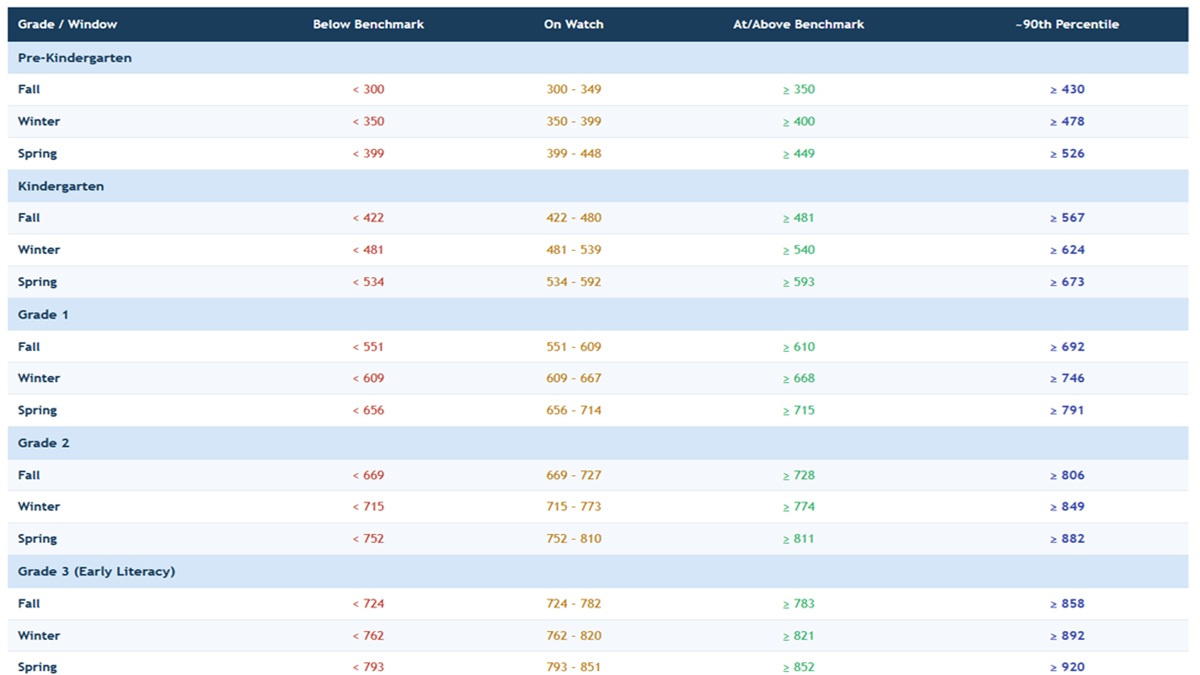
Star Early Literacy uses a unified scale from 200 to 1100. Designed for students in pre-K through early 3rd grade who are still developing foundational literacy skills. Students transition to Star Reading when scores reach approximately 600-650, or when teacher assessment indicates readiness for independent reading assessment.
⬤ On Watch
⬤ At/Above Benchmark
⬤ ~90th Percentile
| Grade / Window | Below Benchmark | On Watch | At/Above Benchmark | ~90th Percentile |
|---|---|---|---|---|
| Pre-Kindergarten | ||||
| Fall | < 300 | 300 – 349 | ≥ 350 | ≥ 430 |
| Winter | < 350 | 350 – 399 | ≥ 400 | ≥ 478 |
| Spring | < 399 | 399 – 448 | ≥ 449 | ≥ 526 |
| Kindergarten | ||||
| Fall | < 422 | 422 – 480 | ≥ 481 | ≥ 567 |
| Winter | < 481 | 481 – 539 | ≥ 540 | ≥ 624 |
| Spring | < 534 | 534 – 592 | ≥ 593 | ≥ 673 |
| Grade 1 | ||||
| Fall | < 551 | 551 – 609 | ≥ 610 | ≥ 692 |
| Winter | < 609 | 609 – 667 | ≥ 668 | ≥ 746 |
| Spring | < 656 | 656 – 714 | ≥ 715 | ≥ 791 |
| Grade 2 | ||||
| Fall | < 669 | 669 – 727 | ≥ 728 | ≥ 806 |
| Winter | < 715 | 715 – 773 | ≥ 774 | ≥ 849 |
| Spring | < 752 | 752 – 810 | ≥ 811 | ≥ 882 |
| Grade 3 (Early Literacy) | ||||
| Fall | < 724 | 724 – 782 | ≥ 783 | ≥ 858 |
| Winter | < 762 | 762 – 820 | ≥ 821 | ≥ 892 |
| Spring | < 793 | 793 – 851 | ≥ 852 | ≥ 920 |
Source: Renaissance Star Early Literacy national norms 2024-2025. Scale: 200-1100 (unified Star scale). Students typically transition from Star Early Literacy to Star Reading when scaled scores reach approximately 600-650.
What Is the Star Test?
Star testing is a suite of computer-adaptive assessments developed by Renaissance Learning. When schools refer to “Star tests” or “Star Renaissance,” they mean one or more of three core assessments: Star Reading, Star Math, and Star Early Literacy. These all sit within the Star360 platform, which also includes Accelerated Reader. Some districts additionally administer Star CBM and Star Spanish.
The star reading test runs from kindergarten through 12th grade. Star Math covers the same range. Star Early Literacy serves pre-kindergarten through early 3rd grade, specifically for students still developing foundational literacy skills before independent reading. All three are computer-adaptive. Each question adjusts in real time based on the previous answer. Correct responses trigger harder questions. Wrong answers pull the next question slightly easier. This design measures students across a wide skill range in 15 to 25 minutes per subject.
Schools administer Star tests three times per year. Fall, winter, and spring. That structure is deliberate. Three data points build a growth trajectory, not just a snapshot. And growth is where the most useful information lives.
The 2024 Norms Update: What Changed and Why It Matters
This is something most widely cited articles on Star scores do not mention. It matters. If your child’s school distributed a star scores by grade level PDF or chart predating the 2024 school year, those benchmark thresholds are no longer current. Because student performance nationally declined somewhat in the post-pandemic years, the benchmarks adjusted accordingly. More students now fall into the At/Above Benchmark category compared to pre-2024 charts. The current star reading scores by grade level PDF and star math scores by grade level PDF equivalents are available through the Renaissance Help Center for school administrators.
The Five Types of Star Scores
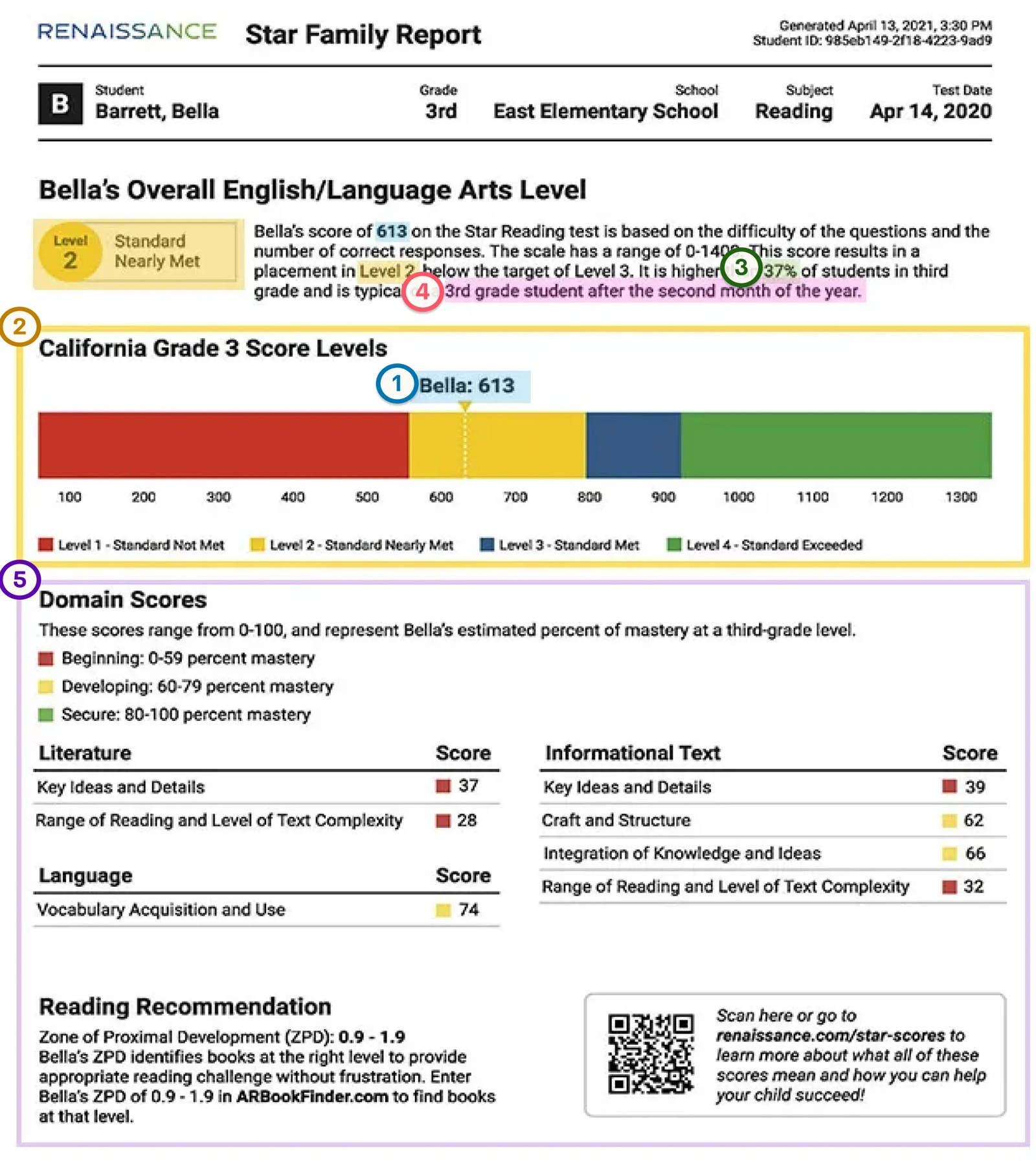
Every Star score report includes multiple numbers. Parents typically fixate on the scaled score or percentile rank because they are the most prominent. There are five score types on a full report. Understanding all five changes how you read the data.
1. Scaled Score (SS)
The foundation of all Star scoring. For Star Reading and Star Math, the unified scale runs from 0 to approximately 1400. For Star Early Literacy, the scale runs from 200 to 1100. The Star Unified Scale connects all three assessments on one consistent continuum, which means a score in kindergarten on Star Early Literacy sits on the same progression as a score in 8th grade on Star Reading.
Scaled scores are the most reliable number for tracking progress over time. A Star Reading scaled score of 756 in fall rising to 812 in spring represents 56 real points of growth. That growth is meaningful regardless of how it compares to national norms. Teachers use scaled scores when discussing whether a student is actually growing across windows.
2. Percentile Rank (PR)
The percentile rank compares a student to others nationally in the same grade who took the same assessment during the same window. A percentile rank of 65 means the student scored higher than 65 percent of students nationally. Fifty is exactly average.
One fact most parents do not know: Renaissance sets the At/Above Benchmark threshold at the 40th percentile. Not the 50th. A student at the 40th percentile is meeting grade-level expectations by Renaissance’s national standard. This surprises parents who assume on-grade-level means average. It does not. Star test scores percentiles are useful for context. They are a comparison tool, not a growth tool.
3. Student Growth Percentile (SGP)
The most underused number on the report. SGP measures how much a student grew compared to peers who started at the same scaled score. An SGP of 50 means average growth among academic peers. An SGP of 70 means the student grew more than 70 percent of students who started at the same point.
A child starting 3rd grade at a Star Reading score of 720 who ends the year at 810 might have an SGP of 75. That means they grew faster than 75 percent of students who also started at 720. Impressive. Even if they remain below the 50th national percentile. SGP high? The instruction and support are working. That is the number worth celebrating.
4. Grade Equivalent (GE)
The grade equivalent shows the grade level and month where a student performed similarly to an average student at that point. A GE of 5.3 means performance comparable to an average student in the third month of 5th grade. This is the number that causes the most confusion and the most anxiety.
A 3rd grader with a GE of 5.3 is not ready for 5th grade placement. That is not what the score means. It is a comparison point, not a recommendation. Schools use GE for context. For secondary students especially, districts rely far more on scaled score, growth data, and course performance than grade equivalent when making instructional decisions.
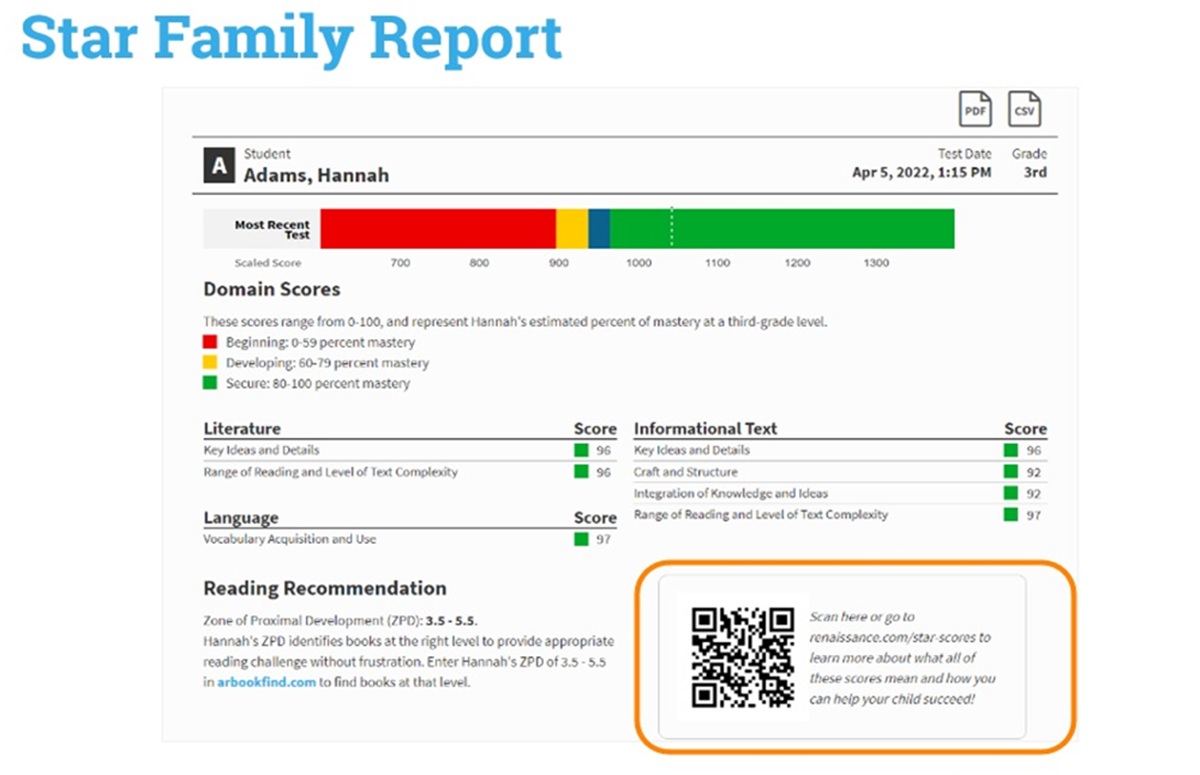
5. Domain Scores
Domain scores show performance in specific skill areas rather than overall. Star Reading domains include Literary Text, Informational Text, and Vocabulary/Language Use. Star Math domains cover Number and Operations, Algebra and Algebraic Thinking, Measurement and Data, and Geometry.
This is where the most actionable information lives. A student might be At Benchmark overall in Star Reading while showing a real weakness specifically in Informational Text comprehension. That does not appear in the headline scaled score. The domain breakdown reveals it. Domain scores are not the same as benchmark categories. A student can be At Benchmark overall while scoring lower in one specific domain. That simply identifies where targeted practice would help most. Look at the domains every single time.
Star Benchmark Categories Explained
Star scores fall into four benchmark categories. Some schools add an informal fifth for gifted-level performance, though this is not an official Renaissance designation.
40th percentile and above. Meeting or exceeding grade-level expectations. Scaled scores in this range indicate solid foundational skills at or beyond the current grade level.
25th to 39th percentile. Close to grade-level expectations but showing signs that targeted practice would help. The school should monitor progress carefully each window.
10th to 24th percentile. Below grade-level expectations. Schools typically respond with small-group instruction or targeted skill-building. Ask for a specific support plan.
Below the 10th percentile. Intensive, immediate support is needed. Schools may develop a formal learning plan. Contact the teacher this week, not next month.
Renaissance does not publish an official gifted cut score. Scores at or above the 90th percentile are frequently used in gifted program screening by schools and districts. Some programs set the threshold at the 95th. The star reading score chart and star math score chart tables below include approximate 90th percentile thresholds by grade for reference.
One important note on Urgent Intervention. The label causes real alarm. It means a student needs substantial support right now. It does not mean a learning disability is present, it does not predict long-term outcomes, and it is not permanent. Students move from Urgent Intervention to At/Above Benchmark. It happens regularly with the right targeted support in place. The category tells schools and parents what to do next. Nothing more.
What Is a Good Star Score by Grade Level?
A good Star Reading score at any grade is a scaled score at or above the At/Above Benchmark threshold for that grade and testing window. That threshold is set at approximately the 40th national percentile. In specific terms: a 2nd grader at 747 or above in fall is At/Above Benchmark. A 5th grader needs 911 or above. A 7th grader needs 978 or above in fall. Each grade’s full breakdown appears in the star reading score chart above.
For Star Math, benchmarks differ by grade. A 3rd grader at 764 in fall is At/Above Benchmark for Star Math. By 6th grade that threshold rises to 880. The star math score chart above shows every grade and season. Scores at or above the 75th percentile are strong. At or above the 90th percentile is generally considered advanced and is frequently used as a gifted screening threshold by schools and districts, though this varies by program.
The FAQ section at the bottom of this page answers “what is a good Star Reading score for [grade]” for every grade from kindergarten through 12th grade, with specific scaled score thresholds for both Star Reading and Star Math.
How Star Testing Connects to Accelerated Reader
Star testing and Accelerated Reader are both part of the Renaissance Star360 ecosystem. They work together in a way many parents do not fully understand. When a student completes a Star Reading test, the score generates a Zone of Proximal Development, or ZPD. This is a book reading level range expressed in grade format, such as 4.0 to 6.5. The ZPD marks the difficulty range where a student can read independently and still be challenged enough to grow. Too easy and there is no development. Too hard and comprehension collapses.
Accelerated Reader uses that ZPD to recommend books. Students who read within their ZPD range and take AR quizzes build vocabulary, comprehension, and fluency in a structured way that feeds directly back into Star Reading scores over time. The Instructional Reading Level (IRL) on Star Reading reports is slightly different. It reflects where a student reads with at least 80 percent accuracy in classroom instruction. For book selection at home, the ZPD range is the more practical guide. Ask the teacher for the current ZPD. It is the most actionable number that comes out of Star testing, and it is consistently underused.
What Is Star360 and How Schools Use It
Star360 is Renaissance’s full platform. Not just an assessment system. It integrates Star Reading, Star Math, Star Early Literacy, Accelerated Reader, myON, and Renaissance’s reporting and planning tools under one system. When a school refers to “Renaissance” or “Star tests” or a student’s “reading level on the computer,” they are almost certainly referring to some part of the Star360 ecosystem.
After each Star testing window, teachers access class-level reports showing where every student sits relative to benchmarks, which skill domains show weakness across the class, and which students are growing at expected rates versus falling behind. This data drives small-group instruction decisions, whole-class skill review priorities, and identification of students ready for advanced material. At the district and state level, Star testing data feeds into accountability reporting. Several states use Star assessments to satisfy federal progress monitoring requirements under IDEA or state literacy laws. The three-window testing structure exists precisely because fall, winter, and spring data points meet both instructional and compliance needs simultaneously.
How Accurate Is the Star Reading Test?
Quite accurate for what it is designed to do. Less useful when misapplied. Star testing is a screening and progress-monitoring tool. It provides teachers with a quick, reliable snapshot of where a student is and whether they are growing. For that specific purpose, the research backing Star assessments is strong. Renaissance has published extensive technical manuals demonstrating high reliability and validity for screening use.
Where frustration arises is when scores jump significantly between windows or appear inconsistent with how a student performs at home. A student who gets anxious and rushes early questions can land in a substantially different range than their actual ability level. Noisy testing environments, fatigue, or illness can all affect scores. One parent on a gifted education forum described their child’s Star scores jumping four grade levels within a single school year, with teachers giving contradictory messages about accuracy depending on whether the score was high or low. That experience is real. Star testing is one data point. Always interpreted alongside classroom performance, teacher observation, and other assessments. No single assessment tells the whole story. Growth trends across multiple windows are more reliable than any individual score.
How to Improve Star Test Scores
The most effective home intervention for Star Reading is not a workbook. It is consistent reading combined with conversation about what is being read. Star Reading scores respond to genuine reading growth more reliably than to test format familiarity. Volume and variety matter. The Star Reading test draws from literary and informational text types equally. Students who read primarily fiction often show lower Informational Text domain scores. Nonfiction books, science magazines, and current events writing for young readers build informational comprehension that fiction-only reading does not develop.
For Star Math, look at the domain breakdown on the report. Targeted practice in the specific weak domain outperforms general review every time. If Number and Operations is the gap, that is where practice should focus. Khan Academy provides free, grade-level-specific instruction organized by domain. For Star Early Literacy, phonics games, read-alouds, and rhyming activities build the foundational skills the assessment measures. The research on early literacy is consistent: explicit phonics instruction combined with rich read-aloud experience produces the fastest foundational skill growth.
One practical step before any Star testing window: explain to the student how the adaptive format works. Questions will get harder as they answer correctly. That is the test doing its job, not the student failing. Students who understand this go into the assessment with lower anxiety and more patience on difficult questions. Both factors measurably improve performance.
Renaissance Star Login: How to Access Scores
Login access differs by user role. Here are the correct URLs for each.
Parents access Star scores and Accelerated Reader progress through the Renaissance Family Portal.
https://fp.renaissance.com
Login codes are provided by the school. Contact the classroom teacher or technology coordinator if not received.
Students log in to take Star assessments and access Accelerated Reader quizzes.
https://global-zone61.renaissance-go.com
Credentials are provided by the classroom teacher and are school-specific.
Teachers and administrators access Star360 reporting and assessment management.
https://www.renaissance.com/login
District administrators may have a custom login URL from their Renaissance account manager.
For technical issues, password resets, or score report questions.
https://star-help.renaissance.com
Schools outside the United States access Star assessments at:
https://dashboard.starassessments.co.uk/system/login/
Common Questions Parents Have After Receiving Star Scores
After years of sitting in parent conferences and curriculum nights, I have heard the same questions hundreds of times. Here are the ones that come up most often, with honest answers.
My child’s score dropped from last testing window. Should I be worried?
Small drops happen. Star testing is adaptive and a single session can be affected by how your child was feeling that day, whether they rushed, or whether they were in a noisy room. Look at the pattern across three or more testing windows. A drop in one window followed by growth in the next is typically just normal variation. A pattern of declining scores across two or more consecutive windows is worth a conversation with the teacher.
My child reads great at home but scored low. What’s going on?
This comes up constantly. A few explanations. First, the Star Reading test is timed and computer-based, which is very different from reading at home with a book and no pressure. Second, Star Reading measures a specific set of comprehension and vocabulary skills, not fluency or expression. A child who reads aloud beautifully might still struggle with the inferencing and vocabulary questions that Star Reading emphasizes. Third, test anxiety is real. Some kids genuinely perform below their ability level on any computer-based assessment.
Can my child study for the Star test?
Not in the traditional sense. Because it’s adaptive, there’s no fixed question bank to memorize. The best preparation is genuine reading growth, not test prep drills. That said, familiarizing your child with the format of computer-adaptive questions reduces anxiety and can improve performance. Renaissance offers sample questions through the Star360 platform.
My child scored in the 90th percentile. Does that mean they qualify for gifted services?
Not automatically. Some schools use Star scores as one criterion for gifted screening, but almost all gifted programs require multiple data points including teacher recommendation, cognitive assessments, and classroom performance. A high Star score is a positive signal that a gifted evaluation might be appropriate, but it’s not a gifted qualification on its own.
The complete FAQ section below covers 50 specific questions including what counts as a good Star Reading score at every grade level from kindergarten through 12th grade, common specific score questions, how to interpret percentiles, and everything about login and access.
Where can I find the Updated Star Test Scores Charts for 2025-2026 by Grade Level?
The Star Test Scores Chart for 2025-2026 by Grade Level can be found at: https://readyscores.com/star-test-scores-chart-reading-math. The Star Scores on this page include the Star Math scores by grade level (Chart), the Star Reading scores by grade level (Chart), and the Star Literacy Score Chart.
Star Scores FAQ: 50 Questions Answered
The questions below cover everything parents, students, and teachers ask about Star test scores, Star Reading, Star Math, Star scores by grade level, login access, and how to interpret results. Per-grade answers cover every grade from Kindergarten through 12th grade for both Star Reading and Star Math.
What Are Star Scores?
What are Star test scores?
Star test scores are standardized assessment results that measure a student’s academic performance in reading, math, and early literacy using Renaissance Learning’s adaptive testing platform. They include several score types: a Scaled Score, Percentile Rank, Student Growth Percentile, Grade Equivalent, and Domain Scores, each providing a different lens on performance and progress.
What does a Star score mean?
A Star score shows where a student currently performs on a national scale in reading or math compared to peers in the same grade. No single number tells the whole story. A scaled score combined with growth data and domain scores gives the most complete and useful picture of where a student is and whether instruction is working.
What is a Star Reading test?
The Star Reading test is a computer-adaptive reading assessment developed by Renaissance Learning, used in K-12 schools across the United States. It adjusts question difficulty in real time based on each student’s answers to find a precise reading level, typically completing in 15 to 20 minutes per session.
What is Star testing?
Star testing refers to the suite of computer-adaptive assessments published by Renaissance Learning, including Star Reading, Star Math, Star Early Literacy, and Star CBM. Schools administer Star tests typically three times per year to track student growth and identify students needing support or enrichment, all within the Star360 platform.
What is Star Renaissance?
Star Renaissance refers to the full ecosystem of Star assessments published by Renaissance Learning, the education technology company that also produces Accelerated Reader, myON, and a suite of instructional tools connected to Star score data. The platform schools use to manage all of these together is called Star360.
What is Star360?
Star360 is Renaissance Learning’s integrated platform that brings together Star Reading, Star Math, Star Early Literacy, Accelerated Reader, and Renaissance’s reporting and instructional planning tools under one system. Schools use Star360 to administer assessments, analyze student and class data, monitor growth over time, and connect assessment results to book reading practice.
Good Scores: General
What is a good score in Star Reading?
A good Star Reading score is one that falls at or above the At/Above Benchmark threshold for a student’s specific grade and testing window, which sits at approximately the 40th national percentile. Beyond benchmark status, consistent positive growth from one testing window to the next matters more than any single data point.
What is a good score in Star Math?
A good Star Math score follows the same logic as Star Reading: At/Above Benchmark for the current grade and testing season, corresponding to the 40th national percentile or higher. Scores at or above the 75th percentile indicate strong performance, and scores at or above the 90th percentile are generally considered advanced or gifted-level by most school screening criteria.
What is the average Star Reading score?
The average Star Reading score falls at the 50th percentile for each grade level. A 3rd grader at the 50th percentile in fall has a Star Reading scaled score of roughly 830 to 840, while a 7th grader at the same percentile scores around 990 to 1000 in fall. Average varies significantly by grade, subject, and testing window, which is why grade-specific benchmark tables are essential.
What is the average Star Math score?
Average Star Math scores sit at the 50th percentile by grade and season. A typical 3rd grader at the 50th percentile in fall scores approximately 760 to 770 on Star Math, while a 6th grader at the same percentile scores around 895 to 905. Star Math averages grow more slowly per year than Star Reading averages in the later middle grades as content difficulty increases faster than typical growth rates.
What is the maximum Star Reading score? What is the highest Star Reading score?
The Star Reading scaled score scale runs from 0 to 1400 on the unified Renaissance scale. In practice the highest scores seen in K-12 assessment fall in the 1380 to 1400 range and represent performance far beyond 12th grade level. A score of 1200 or higher is exceptional at any grade and would place a student in an extremely high percentile even among 12th graders.
What is the highest Star Math score?
Star Math also uses the unified scale with a maximum of approximately 1400. Top Star Math scores for high school students in advanced mathematics can approach 1300 to 1400. For context, a 12th grade At/Above Benchmark threshold sits at 962 in spring, so scores above 1100 on Star Math represent genuinely exceptional performance well above grade-level expectations for any grade.
How accurate is the Star Reading test?
Star Reading is well-validated as a screening and progress-monitoring tool with strong reliability data published in Renaissance’s technical manuals. It is designed to give a quick, accurate snapshot of reading level for instructional planning, not to replace comprehensive diagnostic assessment. Scores can vary somewhat between sessions due to test anxiety, rushing, or testing environment conditions, which is why Renaissance recommends interpreting growth trends across multiple windows rather than reacting to any single score.
Is a Star Reading score of 850 good?
It depends entirely on the grade and testing window. A score of 850 in fall places a 3rd grader solidly At/Above Benchmark. That same score for a 5th grader in fall falls in the On Watch range. For a 4th grader in spring, 850 falls below the At/Above Benchmark threshold of 929. Always compare any scaled score to the appropriate grade and season column in the Star Reading score chart above.
Is a Star score of 1000 good?
A Star Reading score of 1000 is strong for most grades. For a 6th grader tested in spring it falls above the At/Above Benchmark threshold of 992. For a 9th grader in fall it falls below the At/Above Benchmark threshold of 1029 and sits in the On Watch range. Context by grade and season is essential for interpreting any specific score correctly.
Good Star Reading Scores by Grade
What is a good Star Reading score for Kindergarten?
For Kindergarten, a good Star Reading score in fall is 530 or higher (At/Above Benchmark), 577 in winter, and 616 in spring. Scores at or above approximately 685 in spring represent advanced performance near the 90th percentile for Kindergartners. Star Early Literacy is more commonly used in Kindergarten; Star Reading is appropriate once a student demonstrates emerging independent reading skills.
What is a good Star Reading score for 1st grade?
A good Star Reading score for 1st grade is 630 or higher in fall, 691 in winter, and 739 in spring to be At/Above Benchmark. Scores around 818 in spring indicate advanced performance near the 90th percentile. Students scoring below 576 in fall are Below Benchmark and would benefit from targeted reading support focused on phonics and early decoding skills.
What is a good Star Reading score for 2nd grade?
Star reading scores for 2nd grade: At/Above Benchmark starts at 747 in fall, 802 in winter, and 844 in spring. A score of 918 or higher in spring places a 2nd grader near the 90th percentile. Second grade typically shows some of the most significant Star Reading score growth as decoding becomes automatic and fluency accelerates.
What is a good Star Reading score for 3rd grade?
A good Star Reading score for 3rd grade is 813 or higher in fall (At/Above Benchmark), 857 in winter, and 890 in spring. Scores above approximately 964 in spring represent 90th percentile performance. Third grade is a critical literacy transition year when students shift from learning to read to reading to learn, making the domain score breakdown particularly important at this stage.
What is a good Star Reading score for 4th grade?
For 4th grade, At/Above Benchmark requires 868 or higher in fall, 903 in winter, and 929 in spring. A score of 1004 or higher in spring represents approximately 90th percentile performance. Star reading scores for 4th graders below 812 in fall signal Below Benchmark status and indicate a need for structured intervention, particularly in comprehension and vocabulary which become critical as content-area reading increases.
What is a good Star Reading score for 5th grade?
Good Star Reading scores for 5th grade are 911 or above in fall (At/Above Benchmark), 940 in winter, and 962 in spring. Scores of 1036 or higher in spring indicate advanced performance near the 90th percentile. Many 5th grade students who score below benchmark show informational text comprehension weaknesses specifically, since nonfiction reading demands increase significantly across content areas at this grade level.
What is a good Star Reading score for 6th grade?
For 6th grade Star Reading, At/Above Benchmark starts at 947 in fall, 972 in winter, and 992 in spring. Scores around 1063 in spring represent 90th percentile performance. Sixth grade marks the start of middle school for most students, and Star Reading scores at this level increasingly reflect academic vocabulary and complex informational text comprehension across multiple subjects.
What is a good Star Reading score for 7th grade?
A good Star Reading score for 7th grade is 978 or higher in fall, 999 in winter, and 1016 in spring to be At/Above Benchmark. Scores around 1086 or higher in spring place a 7th grader near the 90th percentile. Seventh graders with Star Reading scores below 920 in fall are Below Benchmark and may benefit from both targeted reading support and content-area vocabulary instruction across all subjects.
What is a good Star Reading score for 8th grade?
For 8th grade, At/Above Benchmark begins at 1005 in fall, 1023 in winter, and 1038 in spring. Scores at approximately 1105 or above in spring represent 90th percentile performance. By 8th grade, Star Reading scores correlate meaningfully with readiness for high school coursework, making these benchmarks relevant not just for current support decisions but for high school preparation planning.
What is a good Star Reading score for 9th grade?
A good Star Reading score for 9th grade is 1029 or higher in fall (At/Above Benchmark), 1044 in winter, and 1057 in spring. Advanced 9th grade readers score approximately 1100 or higher in fall near the 90th percentile. Students entering 9th grade below 969 are at risk of struggling with the reading demands of high school coursework and may benefit from targeted literacy support alongside regular instruction.
What is a good Star Reading score for 10th grade?
For 10th grade Star Reading, At/Above Benchmark is 1051 or higher in fall, 1064 in winter, and 1076 in spring. Scores at approximately 1118 or above in fall represent advanced performance near the 90th percentile. At this grade level Star Reading scores have predictive validity for performance on college readiness assessments including the PSAT and SAT reading sections.
What is a good Star Reading score for 11th grade?
Good Star Reading scores for 11th grade are 1070 or higher in fall, 1081 in winter, and 1092 in spring (At/Above Benchmark). Scores of approximately 1133 or higher in fall indicate advanced reading performance near the 90th percentile. By 11th grade many schools use Star Reading data as one component of college readiness planning and SAT preparation prioritization.
What is a good Star Reading score for 12th grade?
For 12th grade, At/Above Benchmark requires 1086 or higher in fall, 1096 in winter, and 1105 in spring. Scores around 1146 or above in fall represent approximately 90th percentile performance. The maximum meaningful Star Reading score is around 1400, representing reading performance comparable to advanced college-level text, which is exceptionally rare at any grade level.
Star Test Scores by Grade Level Star reading score chart 2026 2027: The STAR Norms above are the 2024-2025 Norms, and these are expected to be used for the 2025-2026, 2026-2027 and 2027-2028 school years.
Good Star Math Scores by Grade
What is a good Star Math score for Kindergarten?
For Kindergarten, a good Star Math score is 524 or higher in fall (At/Above Benchmark), 564 in winter, and 598 in spring. Advanced Kindergarten math performance near the 90th percentile falls around 596 in fall and 667 in spring. Kindergarten Star Math focuses on early number sense, counting, and basic operations, and this early data is particularly useful for identifying students who may need enrichment or additional foundational support.
What is a good Star Math score for 1st grade?
A good Star Math score for 1st grade is 608 or higher in fall (At/Above Benchmark), 651 in winter, and 687 in spring. Scores around 678 in fall and 752 in spring indicate advanced performance near the 90th percentile. First grade Star Math measures foundational addition, subtraction, and place value skills that directly predict readiness for more complex operations in later grades.
What is a good Star Math score for 2nd grade?
Good Star Math scores for 2nd grade are 697 or higher in fall (At/Above Benchmark), 732 in winter, and 762 in spring. Scores around 762 in fall and 823 in spring indicate advanced performance near the 90th percentile. Star Reading scores for 2nd grade are frequently compared alongside Star Math scores to identify students who are strong in one area and may need additional support in the other.
What is a good Star Math score for 3rd grade?
For 3rd grade Star Math, At/Above Benchmark is 764 or higher in fall, 793 in winter, and 818 in spring. Scores around 876 in spring indicate 90th percentile performance. Third grade math introduces multiplication, division, and fractions, and Star Math domain scores at this grade are particularly useful for identifying foundational gaps in number operations before more complex content arrives in 4th grade.
What is a good Star Math score for 4th grade?
A good Star Math score for 4th grade is 813 or higher in fall (At/Above Benchmark), 839 in winter, and 862 in spring. Scores around 874 in fall and 918 in spring represent advanced performance near the 90th percentile. Fourth grade is when multi-digit multiplication, division, and fraction concepts solidify, making the domain breakdown on Star Math especially valuable for identifying specific instructional gaps early.
What is a good Star Math score for 5th grade?
A good Star Math score for 5th grade is 855 or higher in fall, 877 in winter, and 896 in spring (At/Above Benchmark). Scores at approximately 951 in spring represent advanced performance near the 90th percentile. Fifth grade math includes decimals, fraction operations, and introductory ratio concepts, and the domain breakdown at this grade is especially useful for pinpointing where pre-algebra readiness gaps are forming.
What is a good Star Math score for 6th grade?
For 6th grade Star Math, At/Above Benchmark is 880 or higher in fall, 899 in winter, and 915 in spring. Scores around 938 in fall and 969 in spring indicate advanced performance near the 90th percentile. Sixth grade introduces ratio and proportion, negative numbers, and early expressions, and Star Math domain scores at this grade are particularly useful for identifying students who need pre-algebra reinforcement before 7th grade.
What is a good Star Math score for 7th grade?
A good Star Math score for 7th grade is 900 or higher in fall (At/Above Benchmark), 917 in winter, and 931 in spring. Scores around 956 in fall and 983 in spring represent advanced performance near the 90th percentile. Seventh grade math covers proportional relationships, inequalities, and early geometry, and students falling below benchmark at this stage may face compounding challenges as algebra content accelerates in 8th grade.
What is a good Star Math score for 8th grade?
For 8th grade Star Math, At/Above Benchmark is 917 or higher in fall, 932 in winter, and 945 in spring. Scores around 971 in fall and 994 in spring indicate advanced performance near the 90th percentile. Eighth grade is typically the year formal algebra instruction begins, and Star Math scores at this stage reflect readiness for high school mathematics pathways.
What is a good Star Math score for 9th through 12th grade?
Grades 9 through 12 share unified Star Math benchmark ranges. At/Above Benchmark is 938 or higher in fall, 951 in winter, and 962 in spring. Scores around 990 in fall and 1010 in spring represent advanced performance near the 90th percentile for high school students. Star Math at the high school level reflects mastery of algebra, geometry, and data concepts depending on course placement and instructional focus.
How Star Testing Works
How do you know your Star Reading level?
A student’s Star Reading level appears on the Star Family Report or through the Renaissance Family Portal as a Scaled Score, Grade Equivalent, and Instructional Reading Level. The Instructional Reading Level shows the grade level where a student reads with at least 80 percent accuracy, making it the most practical number for book selection. Students and parents can ask the teacher for access to the Renaissance portal to view current reading level data.
How is Star Reading used by teachers?
Teachers use Star Reading scores to identify students below benchmark who need additional reading support, to form instructional groups, to select appropriate reading materials based on each student’s Zone of Proximal Development, and to monitor growth across the school year. In schools using the full Star360 system, Star Reading data automatically feeds into Accelerated Reader book recommendations aligned to each student’s current level.
How to pass the Star Reading test?
Star Reading does not have a pass or fail score. It is a screening and progress-monitoring assessment designed to find a student’s actual reading level, not to test preparation or memorized knowledge. The most effective way to improve Star Reading performance over time is to read widely and consistently, mixing fiction and nonfiction texts. Familiarizing students with the computer-adaptive format reduces test anxiety, and Renaissance provides sample questions through the Star360 platform.
What does a Star reading level mean?
A star reading level refers to the Grade Equivalent or Instructional Reading Level on a student’s Star Reading report. A reading level of 4.5 means the student’s performance matches what would be expected of an average student in the fifth month of 4th grade. This is useful for choosing appropriately challenging books and for understanding where a student sits relative to national grade-level norms, but it is not a placement recommendation.
What is a star rating on Star assessments?
In the context of Star assessments, benchmark status sometimes appears as a visual indicator such as colored bands or level labels on the Star Family Report. This is different from Accelerated Reader star ratings, which indicate points earned through reading books and taking AR quizzes. Both systems are connected through the Star360 platform but serve different purposes within the Renaissance ecosystem.
Star Scores and STAR TEST SCORE Percentiles
What do Star test scores percentiles mean?
Star test scores percentiles compare a student’s performance to students in the same grade nationally. A percentile rank of 72 means the student scored higher than 72 percent of students in the same grade who took the same test. Percentiles are useful for understanding relative standing but do not show growth. The Student Growth Percentile is a separate and equally important score that specifically measures growth over time.
What percentile is considered gifted on Star tests?
There is no single official gifted percentile threshold in the Star assessment system. Most gifted programs that use Star scores as one criterion look for scores at or above the 90th percentile, though some programs set the threshold at the 95th. Star scores alone rarely qualify a student for gifted services. Most programs require multiple data points including teacher recommendation, cognitive assessment, and documented classroom achievement evidence.
What is the Student Growth Percentile (SGP) on Star?
The Student Growth Percentile measures how much a student grew compared to others who had the same starting scaled score. An SGP of 60 means the student grew more than 60 percent of students who began at the same point. This score is often more meaningful than the overall percentile rank because it directly shows whether a student is gaining ground, staying even, or falling behind relative to academic peers with identical starting points.
Is a MAP score of 240 good?
A MAP score of 240 refers to the NWEA MAP Growth assessment, not the Renaissance Star test. These are two entirely separate assessments with different score scales. On NWEA MAP, a reading score of 240 is quite strong and above average through most of middle school. If a number like 240 appeared on a Star report, that would be an extremely low scaled score since the Star Reading scale runs from 0 to 1400 with typical 3rd grade scores in the 750 to 900 range.
Accelerated Reader and Star Connections
What is Accelerated Reader and how does it connect to Star scores?
Accelerated Reader is Renaissance’s reading practice program where students read books and take comprehension quizzes to earn points. It connects directly to Star Reading because the assessment generates a Zone of Proximal Development, which is the range of book difficulty that best supports each student’s reading growth. Accelerated Reader uses that ZPD range to guide book selection, making the two systems complementary tools within the same Star360 literacy ecosystem.
What is a ZPD range and how do I find my child’s?
ZPD stands for Zone of Proximal Development and represents the reading difficulty range where a student can read independently for optimal growth, expressed in grade level format such as 3.5 to 5.2. Books within this range are challenging enough to build skills while remaining accessible enough for comprehension. Parents can ask the classroom teacher to share the current ZPD range or access it through the Renaissance Family Portal.
Login and Access
How do I log in to see my child’s Star scores?
Parents access Star scores through the Renaissance Family Portal at https://fp.renaissance.com. The school provides a family login code or username and password. If login credentials have not been received, contact the classroom teacher or the school’s technology coordinator, as access is set up at the school level and cannot be provided directly by Renaissance.
Where do students log in for Star testing?
Students log in to take Star assessments and access Accelerated Reader through the main Renaissance student portal at https://global-zone61.renaissance-go.com. Login credentials are provided by the classroom teacher and are specific to each school’s Renaissance account. Students should not share login credentials as each account is tied to individual assessment history.
Where do teachers log in to Renaissance Star?
Teachers and school administrators access Star360 data, class reports, and assessment tools through the main Renaissance platform login at https://www.renaissance.com/login. Some districts have a custom login URL provided by their Renaissance account manager. Teachers can access individual student reports, class-level benchmark summaries, domain breakdowns, and growth tracking tools through this portal.
Is there a different login for Star in the UK or internationally?
Yes. Schools using Star assessments outside the United States access the platform through a separate regional URL at https://dashboard.starassessments.co.uk/system/login/. International Renaissance users should confirm the correct login URL with their school’s technology coordinator, as regional platforms may differ in available features and report formats.
Where can I find help if I cannot log in to Renaissance?
Renaissance’s Help Center at https://star-help.renaissance.com is the starting point for technical issues, password resets, and login problems. For school-specific access issues, contact the classroom teacher or school technology coordinator first, as login credentials and site-specific configurations are managed at the school level and require school administrator involvement to resolve.
Common Parent Concerns
My child scored high at home practice but low on the actual Star test. Why?
Star Reading is a computer-adaptive assessment with a structure that differs significantly from paper practice tests and home reading experiences. Test anxiety, an unfamiliar testing environment, rushing through early questions, or fatigue can all affect scores in ways that do not reflect a child’s true reading ability. Star Reading also emphasizes specific comprehension and vocabulary skills that may differ from what practice materials target. One low score is not definitive. Look at the pattern across multiple testing windows.
My child’s Star score went down from the last window. Should I be worried?
A single-window score drop is common and often reflects normal variation rather than actual academic decline. Star assessments have a standard error of measurement meaning scores can shift somewhat between sessions even without meaningful change in actual skill. If scores decline across two or more consecutive windows that is a pattern worth discussing with the teacher. A single-window drop followed by growth in the next window is typically just normal variation and not cause for alarm.
My child is in the Urgent Intervention category. What does that mean practically?
Urgent Intervention means the student’s Star score is below the 10th national percentile and the school considers immediate intensive support necessary. In practice this typically triggers small-group targeted instruction, possible specialist involvement, and closer progress monitoring. It does not diagnose a learning disability or predict long-term outcomes. Contact the teacher promptly, ask what specific support plan is in place, and ask how the skills being targeted can be reinforced at home.
Can Star scores affect my child’s grade or grade advancement?
In most schools, Star assessment scores are not used directly to calculate grades or determine grade-level advancement as they are screening and progress-monitoring tools rather than summative assessments. However, some states use Star Reading scores as part of 3rd grade reading promotion decisions under state literacy laws. Check state and district policies to understand whether Star scores carry any formal consequences at specific grade levels in a particular area.
Are Star Reading and Star Math scores used in gifted program identification?
Some schools and districts include Star Reading and Star Math scores as one criterion in gifted program screening, typically looking for scores at or above the 90th percentile as a trigger for further evaluation. Star scores alone are rarely sufficient to qualify a student for gifted services. Most programs require a combination of cognitive assessment scores, teacher recommendation, demonstrated academic achievement, and sometimes parent nomination.
How often are Star norms updated?
Renaissance updates Star Assessment national norms approximately every three to five years, though the frequency varies based on changes in educational standards, national student demographics, and assessment methodology. The most recent major update occurred for the 2024-2025 school year based on 2022-2023 national student data. Parents reviewing older star reading score charts or star math score charts from before 2024 should note that benchmark thresholds changed with this update.
What is the difference between Star Reading and NWEA MAP Reading?
Both Star Reading and NWEA MAP Reading are computer-adaptive assessments measuring reading performance and growth in K-12 students, but they are produced by different companies and use different scoring scales. MAP uses a RIT score scale roughly from 100 to 350, while Star Reading uses a unified scale from 0 to 1400. Both are widely used and research-validated. A score from one assessment cannot be directly converted to the other without a formal linking study.
What should I say to my child after receiving Star scores?
Keep the conversation matter-of-fact and focused on next steps rather than on judging the score itself. For younger children, something like “the test showed your teacher what you’re strong at and what we’re going to work on more” is sufficient. For older students, more specific language works well. Avoid framing that assigns permanent identity to a temporary skill level. “Math is what we’re working on this year” is very different from “you’ve always struggled with math,” and students internalize that distinction.