
NWEA FAQ – 2026-2027 – NWEA Map Scores, Norms, Percentiles & Score Interpretation
NWEA MAP Scores FAQ: Reference Resource for Parents, Teachers, and Students
Reference Resource: This NWEA MAP Scores FAQ is a reference resource about NWEA, MAP Growth, MAP test scores, RIT scores, student login pages, teacher login pages, score charts, percentiles, and grade-level expectations.
MAP Growth is designed to show what a student is ready to learn next. A single score should never be treated as a label, a grade, or a complete picture of a child’s ability. The most helpful way to understand MAP scores is to look at the student’s grade, subject, testing season, percentile range, and growth over time.
Explore more NWEA MAP score charts and tools:
📊 NWEA MAP scores overview by grade →
📐 NWEA MAP Math scores by grade →
🔬 NWEA MAP Science score chart →
📖 NWEA MAP Reading scores by grade →
✍️ NWEA MAP Language scores guide →
🧮 NWEA MAP score calculator and meaning →
💡 How to improve after a MAP report →
💡 What parents can do after NWEA MAP results →
📋 MAP score below grade level — next steps →
📋 What to do if your child scored below grade →
📈 NWEA MAP Growth Tracker tool →
📈 Free MAP growth tracking tool →
📋 What is a good MAP score by grade? →
📋 Good MAP scores explained by grade →
❓ NWEA MAP test FAQ for parents →
NWEA Glossary and Definitions
Definition of NWEA
NWEA stands for Northwest Evaluation Association, now part of HMH, and is best known for creating MAP Growth assessments used by schools to measure student achievement and academic growth. NWEA provides assessment tools, reports, norms, and professional learning resources that help teachers understand what students know and what they may be ready to learn next.
Definition of NWEA MAP Growth
NWEA MAP Growth is a computer-adaptive assessment used to measure academic achievement and growth in subjects such as Math, Reading, Language Usage, and Science. The test adjusts question difficulty based on student responses, which helps create a more accurate picture of the student’s current instructional level.
Definition of NWEA MAP Growth Norms
NWEA MAP Growth norms are national comparison data used to interpret a student’s MAP Growth score against students in the same grade and testing season. Norms help parents and teachers understand whether a score is below average, average, above average, or unusually high compared with a broad national sample.
Definition of NWEA Reading Fluency Coach
NWEA Reading Fluency Coach is connected to MAP Reading Fluency and helps students practice reading skills through individualized support. It is mainly used for younger readers and focuses on areas such as oral reading fluency, foundational reading skills, comprehension, and targeted reading practice.
Definition of NWEA Professional Learning
NWEA Professional Learning is training and support for teachers, administrators, and school leaders who use MAP Growth and other NWEA tools. It helps educators learn how to administer assessments, understand reports, use data responsibly, and turn MAP results into classroom instruction.
Definition of the NWEA MAP Test
The NWEA MAP Test usually refers to MAP Growth, a computer-adaptive assessment that measures a student’s achievement level and academic growth. MAP stands for Measures of Academic Progress, and the test is commonly given in Fall, Winter, and Spring to track progress during the school year.
Definition of NWEA MAP Test Scores
NWEA MAP test scores are usually reported as RIT scores, which are scale scores used to measure achievement and growth over time. A MAP score is not a percentage, not a letter grade, and not an IQ score; it is a learning measurement that helps teachers plan instruction.
Definition of NWEA MAP Math
NWEA MAP Math is the math version of the MAP Growth assessment. It measures math readiness in areas such as number sense, operations, algebraic thinking, geometry, measurement, data, and higher-level math skills depending on the student’s grade and test version.
Definition of NWEA MAP Reading
NWEA MAP Reading is the reading version of the MAP Growth assessment. It measures reading achievement in areas such as vocabulary, literary text, informational text, comprehension, word meaning, and reading analysis depending on grade level and state standards.
Definition of NWEA Dashboard
The NWEA Dashboard is the educator-facing reporting and administration area where teachers and school staff can manage testing, view reports, and review student performance data. Educators usually begin from the official NWEA login hub at https://www.nwea.org/logins/ or the MAP Growth educator login at https://start.mapnwea.org/, using credentials provided by their school or district.
Definition of NWEA Student Login
The NWEA Student Login is the student access point used to begin MAP Growth or MAP Reading Fluency testing. Students taking MAP Growth usually go to https://test.mapnwea.org/, while students using MAP Reading Fluency usually go to https://sso.mapnwea.org/auth/studentLogin; students normally need a session name and password or login details provided by their teacher.
Definition of NWEA Teacher Login
The NWEA Teacher Login is the educator login area for MAP Growth, Professional Learning, and MAP Reading Fluency tools. Teachers can start from https://start.mapnwea.org/ and sign in with school or district credentials to access test administration, reports, training, and related tools.
Definition of NWEA UAP Login
The NWEA UAP Login, or User Access Portal, is the secure educator gateway at https://teach.mapnwea.org/ for administering MAP Growth assessments, monitoring student progress, and accessing student performance data. Teachers log in with credentials provided by their school or district, then use the portal to create test sessions, manage students, view reports, and plan differentiated instruction.
Definition of the NWEA MAP Suite
The NWEA MAP Suite is the group of NWEA assessment products that schools use to measure learning, growth, and reading development. It commonly includes MAP Growth, MAP Reading Fluency, reporting tools, instructional connections, and related professional learning resources.
Definition of the NWEA Status Page
The NWEA Status Page is the official system-health page that shows whether NWEA products are operating normally or experiencing outages, slowdowns, or maintenance. You can check it at https://status.nwea.org/ and subscribe to updates if your school needs alerts about MAP Growth, MAP Reading Fluency, or related systems.
NWEA MAP Score Reference Chart
The ranges below are general reference ranges for parent interpretation, not official cut scores. MAP scores must be interpreted by grade, subject, season, district policy, and the student’s previous growth pattern.
| Grade | Below Average Reading | Average Reading | Above Average Reading | Below Average Math | Average Math | Above Average Math |
|---|---|---|---|---|---|---|
| K | Below 135 | 135–150 | 151+ | Below 135 | 135–150 | 151+ |
| 1 | Below 155 | 155–170 | 171+ | Below 155 | 155–172 | 173+ |
| 2 | Below 172 | 172–188 | 189+ | Below 175 | 175–192 | 193+ |
| 3 | Below 188 | 188–202 | 203+ | Below 190 | 190–205 | 206+ |
| 4 | Below 198 | 198–212 | 213+ | Below 202 | 202–218 | 219+ |
| 5 | Below 205 | 205–218 | 219+ | Below 212 | 212–228 | 229+ |
| 6 | Below 210 | 210–223 | 224+ | Below 218 | 218–234 | 235+ |
| 7 | Below 214 | 214–227 | 228+ | Below 222 | 222–238 | 239+ |
| 8 | Below 218 | 218–231 | 232+ | Below 226 | 226–242 | 243+ |
| 9 | Below 220 | 220–234 | 235+ | Below 230 | 230–246 | 247+ |
| 10 | Below 222 | 222–236 | 237+ | Below 232 | 232–248 | 249+ |
| 11 | Below 223 | 223–237 | 238+ | Below 233 | 233–250 | 251+ |
| 12 | Below 224 | 224–238 | 239+ | Below 234 | 234–252 | 253+ |
NWEA Map Scores Chart by Grade 2025-2026 in Reading and Math – Mean and Standart Deviation.
This NWEA Map Score Chart will give you, the parent, an instant understanding of how your child scored compared to the average (Mean) student score nationwide in 2025 (also used for the 2026-2027 schoolyear).
Please visit the NWEA Map Score Charts 2025-2026 page for more charts.
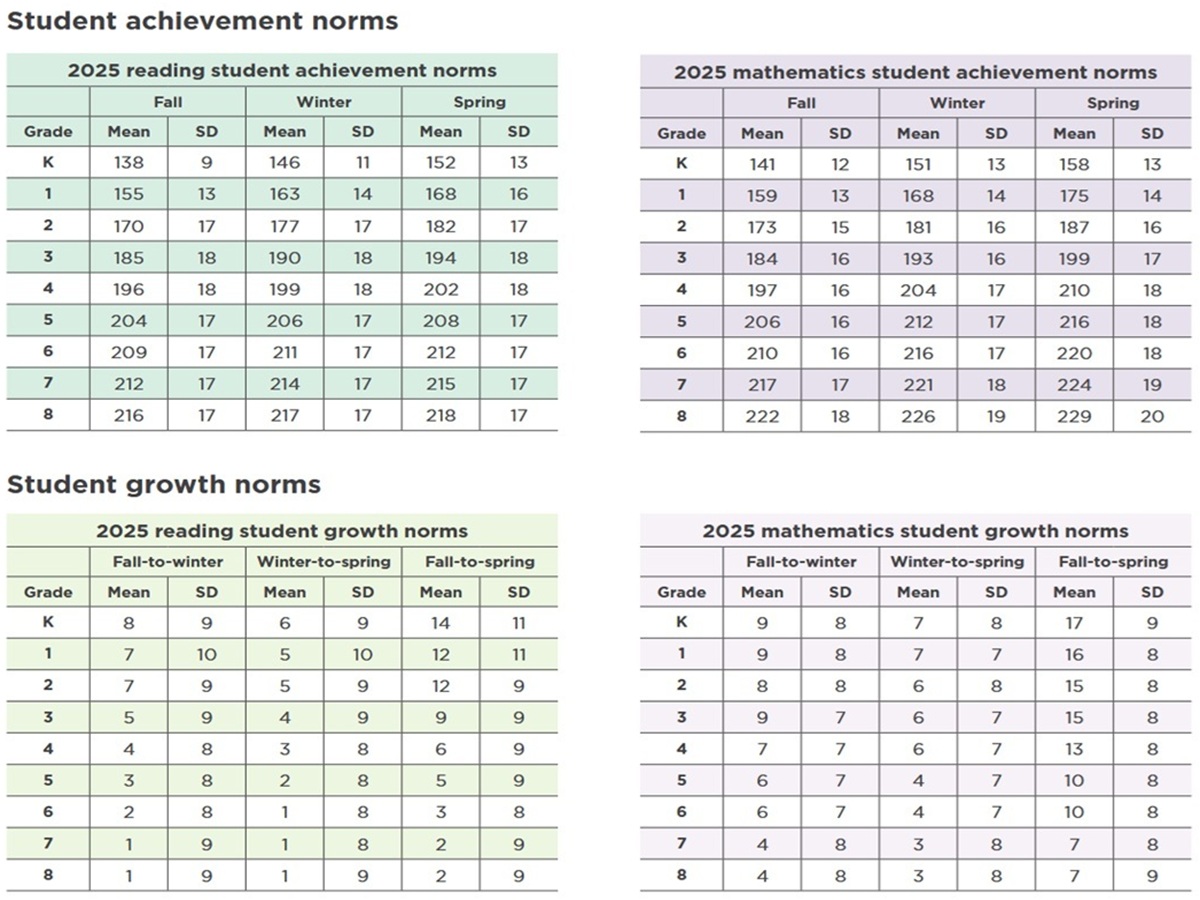
Please visit the NWEA Map Score Charts 2025-2026 page for more charts.
NWEA MAP General FAQ
For NWEA Map Testing Scores Charts, please visit:
What is the NWEA MAP Test?
The NWEA MAP Test is a computer-adaptive assessment that measures student achievement and growth in subjects such as Math, Reading, Language Usage, and Science. It is commonly used by schools to understand what students know, what they are ready to learn next, and how much academic growth they make from one testing season to another.
What is NWEA?
NWEA is an education assessment organization best known for MAP Growth and other learning measurement tools used by schools. Families usually hear the name NWEA when their child takes MAP testing, receives a RIT score, or gets a growth report from school.
What does NWEA stand for?
NWEA stands for Northwest Evaluation Association. The name is still widely used in connection with MAP Growth, MAP Reading Fluency, MAP scores, RIT scores, and school assessment reporting.
How many students use NWEA MAP testing?
NWEA reports that MAP Growth serves more than 13 million students, while NWEA’s broader About page lists 16.2 million students served. The exact number can vary depending on the product, year, and reporting category, but MAP testing is one of the most widely used K–12 assessment systems.
What is MAP Testing Texas?
MAP Testing Texas usually refers to schools or districts in Texas using NWEA MAP Growth to measure student progress. Texas students may still take state assessments separately, so MAP Growth should be understood as an instructional growth test rather than a replacement for every state accountability test.
Where can I find NWEA MAP practice test questions?
You can find NWEA MAP practice resources through school-provided materials, NWEA student resources, teacher review activities, and reputable test-prep websites. Practice should focus on understanding question types, reading carefully, using scratch paper, and building comfort with adaptive testing rather than memorizing answers.
What is the zone of proximal development?
The zone of proximal development is the range between what a student can do independently and what the student can do with guidance. In MAP score interpretation, the idea is useful because teachers use assessment data to find instruction that is challenging enough to promote growth but not so hard that the student becomes frustrated.
Where can I find an updated NWEA MAP score chart for 2026-2027?
You can find an updated NWEA MAP score chart for 2026-2027 at https://readyscores.com/nwea-map-test-scores. That page is designed as a reference resource for MAP scores by grade level, percentiles, subjects, and testing seasons.
What is NWEA growth?
NWEA growth means the change in a student’s MAP Growth score between two testing periods. Growth is often more important than one isolated score because it shows whether the student is progressing over time compared with their own starting point.
What is a good score for NWEA MAP testing?
A good score for NWEA MAP testing is usually a score at or above the average range for the student’s grade, subject, and testing season. A stronger interpretation also considers whether the student is meeting growth goals, improving from previous tests, and performing consistently across Reading, Math, and other subjects.
What is the NWEA MAP?
NWEA MAP usually refers to MAP Growth, which stands for Measures of Academic Progress. It is an adaptive test used by schools to measure achievement and growth in a way that helps teachers plan instruction.
What is the highest score you can get on MAP Growth?
There is no simple universal “highest MAP score” because MAP Growth uses a RIT scale and different tests cover different grade levels and subjects. Very high scores in the 250s, 260s, or above may be exceptional in many school contexts, but the meaning depends heavily on grade, subject, and season.
Is MAP Growth a diagnostic test?
MAP Growth is often used diagnostically, but it is best described as an interim adaptive assessment that measures achievement and growth. Teachers can use MAP results to identify instructional needs, but it is not the same as a full clinical diagnostic evaluation for learning disabilities or cognitive ability.
What is a growth map?
A growth map is usually an informal way of describing how a student’s achievement changes over time on MAP Growth. In practice, teachers look at prior RIT scores, current RIT scores, growth projections, and percentiles to understand the student’s learning path.
Is NWEA the same as MAP testing?
NWEA is the organization or brand associated with MAP assessments, while MAP testing usually refers to the actual assessments students take. In everyday school language, parents often use “NWEA,” “MAP,” “MAP Growth,” and “MAP test” to mean the same testing experience.
What is a normal MAP score?
A normal MAP score is usually a score near the national average for the student’s grade, subject, and testing season. Because MAP uses RIT scores rather than percentages, a normal score for a 2nd grader will look very different from a normal score for an 8th grader.
What are the NWEA MAP Growth norms?
NWEA MAP Growth norms are comparison data that help interpret student achievement and growth relative to other students in the same grade and testing season. Norms make it possible to understand whether a RIT score is around average, above average, below average, or unusually high.
What do the letters NWEA stand for?
The letters NWEA stand for Northwest Evaluation Association. The name is still used for MAP Growth, MAP Reading Fluency, professional learning, reports, norms, and assessment support resources.
What is the NWEA MAP review?
An NWEA MAP review usually means reviewing MAP scores, student reports, practice questions, or test readiness before or after testing. A useful review should explain RIT scores, percentiles, growth goals, subject areas, and how teachers use the results for instruction.
Is NWEA an IQ test?
NWEA MAP Growth is not an IQ test. MAP scores measure academic achievement and growth in school subjects, while IQ tests are designed to estimate cognitive ability using a different type of assessment.
What is a gifted MAP score?
A gifted MAP score is usually a very high RIT score or percentile compared with students in the same grade and subject. Many schools look at scores near or above the 90th, 95th, or 98th percentile for gifted screening, but exact gifted criteria depend on district policy and should not be based on MAP alone.
How should students prepare for the NWEA MAP test?
Students should prepare for the NWEA MAP test by sleeping well, eating normally, reading each question carefully, using scratch paper for math, and taking the test seriously. Heavy cramming is usually less helpful because MAP Growth is adaptive and designed to measure current instructional readiness rather than memorized facts alone.
How many questions are on the MAP Reading test?
The MAP Reading test commonly has around 40 to 43 questions depending on grade level and test version. The exact number can vary, so students should focus on steady effort and careful reading rather than trying to rush through a fixed number of questions.
How many questions are on the MAP Math test?
The MAP Math test commonly has around 40 to 43 questions for many grade-level versions. Some course-specific or school-selected versions may vary, so students should follow the teacher’s instructions and take enough time to work carefully.
What is the NWEA test for 5th grade?
The NWEA test for 5th grade is usually MAP Growth in Reading, Math, and sometimes Language Usage or Science. For 5th grade, MAP scores help teachers understand whether a student is ready for late-elementary skills and how much growth the student is making across the year.
Where can I see the NWEA MAP scores by grade level 2026-2027 with percentiles?
You can see NWEA MAP scores by grade level 2026-2027 with percentiles at https://readyscores.com/nwea-map-test-scores. Use the correct grade, subject, and season when comparing scores because a Fall score and Spring score should not be interpreted the same way.
Where can I find a NWEA MAP Testing Scores Chart for 2026-2027 with percentiles?
You can find a NWEA MAP Testing Scores Chart for 2026-2027 with percentiles at https://readyscores.com/nwea-map-test-scores. A chart is most helpful when it separates Math, Reading, Language Usage, and Science instead of treating all MAP scores as one universal scale.
What is the Ohio State Test scoring guide?
The Ohio State Test scoring guide usually refers to Ohio’s state assessment performance levels and scale score ranges, which are separate from NWEA MAP scores. Families should check Ohio’s official state testing resources for exact current ranges because MAP Growth and Ohio state testing use different score systems.
Is 240 good on a MAP test?
A 240 MAP score is usually a strong score for many middle school students and may be above average in several grade-subject combinations. However, whether 240 is good depends on the student’s grade, subject, testing season, percentile, and prior growth pattern.
What are NWEA RIT scores?
NWEA RIT scores are scale scores used to measure student achievement and growth on MAP Growth assessments. RIT stands for Rasch Unit, and the score is designed to help compare growth over time even when students are in different grades or take the test in different seasons.
NWEA Login and Troubleshooting FAQ
Where is the NWEA MAP student login?
The NWEA MAP Growth student login is at https://test.mapnwea.org/. Students usually need a session name and password from their teacher, and they should not try to begin a MAP Growth test without school instructions.
Where is the NWEA MAP teacher login?
The NWEA MAP teacher login starts at https://start.mapnwea.org/. Teachers use school or district credentials to access MAP Growth, reports, test sessions, Professional Learning, and related educator tools.
Where is the NWEA MAP UAP login?
The NWEA MAP UAP login is at https://teach.mapnwea.org/. The User Access Portal is mainly for educators and administrators who need to create sessions, administer tests, view reports, and manage assessment data.
Where is the MAP Fluency student login?
The MAP Reading Fluency student login is at https://sso.mapnwea.org/auth/studentLogin. Students should use the login details provided by their teacher or school and should ask for help if the browser, microphone, or device setup does not work correctly.
Why can’t I log in to the NWEA MAP Growth student login page?
You may not be able to log in to the NWEA MAP Growth student login page because a pop-up blocker blocked the test window, the test window was moved or minimized, or the test window opened and was accidentally closed. Ask your teacher to help reload the test, find the window, turn off the pop-up blocker, or re-launch the session correctly.
What should I do if the NWEA test window does not open?
If the NWEA test window does not open, ask your teacher to check whether a pop-up blocker is preventing the test from launching. You can also try refreshing the browser, closing extra tabs, using another supported browser, restarting the device, or using the NWEA workstation diagnostic if your school recommends it.
What should I check if my NWEA login password does not work?
If your NWEA login password does not work, check caps lock, extra spaces, copied-and-pasted characters, and confusing letters such as lowercase l versus number 1 or uppercase O versus number 0. If the password still fails, ask your teacher to confirm the session name and password because students usually cannot reset MAP Growth test credentials themselves.
Can VPNs or ad blockers stop the NWEA login from working?
Yes, VPNs, ad blockers, browser extensions, strict privacy settings, or school firewall issues can interfere with the NWEA login or test window. Turn off unnecessary extensions, disable the VPN if allowed, try another browser, or switch to a school-approved device and network before assuming the NWEA system is down.
Can I take the NWEA MAP test on a mobile phone?
Many schools do not recommend taking the NWEA MAP Growth test on a mobile phone because screen size, browser compatibility, pop-ups, and test security can cause problems. Students should use the device and browser approved by their school, especially for official testing sessions.
Can you log in to NWEA from your mobile without Wi-Fi?
It is not practical to log in to NWEA from a mobile device without a stable internet connection because MAP testing requires online access throughout the session. If Wi-Fi is unavailable, the student should ask the teacher or school for approved testing arrangements instead of starting a test on an unstable connection.
What is the NWEA Status page and where can I find it?
The NWEA Status page is the official place to check whether NWEA systems are running normally, degraded, under maintenance, or experiencing an outage. You can find it at https://status.nwea.org/ and use it before troubleshooting individual devices.
Is https://test.mapnwea.org/ down?
To check whether https://test.mapnwea.org/ is down, first visit the official NWEA Status page at https://status.nwea.org/. You can also test access from another network or use third-party tools such as GeoPeeker or IsItDownRightNow to see whether the issue appears local or widespread.
Is https://start.mapnwea.org/ down?
To check whether https://start.mapnwea.org/ is down, start with https://status.nwea.org/ and look for MAP Growth or platform incidents. If the status page looks normal, try another browser, clear cache, turn off VPN, and check from a different device or network.
Is https://auth.nwea.org/adult/login not working?
If https://auth.nwea.org/adult/login is not working, check the official NWEA Status page before assuming your account is locked. If there is no outage, try clearing cookies, disabling extensions, checking your district credentials, using another browser, or asking your school’s NWEA administrator for help.
Grade-by-Grade NWEA MAP Score FAQ
What is a good MAP score for Kindergarten?
A good MAP score for Kindergarten is about 157 or higher in Math and 153 or higher in Reading by Spring, because those are close to the national average Spring RIT scores for Kindergarten. A stronger Kindergarten score is about 165+ in Math or 161+ in Reading, while a very high score is about 173+ in Math or 169+ in Reading; however, Kindergarten scores should always be interpreted carefully because young students are still learning how to test, click, listen, and follow directions.
What is a good NWEA MAP score for Kindergarten Math?
A good NWEA MAP Math score for Kindergarten is about 157 by Spring, which is close to the national average for Kindergarten Math. A score around 165 is a strong above-average score, and a score around 173 or higher is very high for Kindergarten Math, especially if the student also shows strong number sense, counting, comparison, and early problem-solving skills in class.
What is a good NWEA MAP score for Kindergarten Reading ELA?
A good NWEA MAP Reading score for Kindergarten is about 153 by Spring, which is close to the national average for Kindergarten Reading. A score around 161 is strong, and a score around 169 or higher is very high, but early reading scores should be reviewed together with letter recognition, phonological awareness, vocabulary, listening comprehension, and teacher observations.
What is the average NWEA MAP score for Kindergarten Math?
The average NWEA MAP Math score for Kindergarten is about 140 in Fall, 150 in Winter, and 157 in Spring. These numbers show why the testing season matters: a 150 may be average in Winter but below the Spring average, while a 157 is close to the typical end-of-year Kindergarten Math score.
What is the average NWEA MAP score for Kindergarten Reading ELA?
The average NWEA MAP Reading score for Kindergarten is about 137 in Fall, 146 in Winter, and 153 in Spring. A Kindergarten Reading score should not be treated like a percentage grade because MAP uses RIT scores to estimate reading readiness and growth over time.
What is a good MAP score for 1st grade?
A good MAP score for 1st grade is about 176 or higher in Math and 171 or higher in Reading by Spring, because those are close to the national average Spring RIT scores for 1st grade. A stronger 1st grade score is about 185+ in Math or 181+ in Reading, while a very high score is about 193+ in Math or 190+ in Reading.
What is a good NWEA MAP score for 1st Grade Math?
A good NWEA MAP Math score for 1st grade is about 176 by Spring, which is close to the national average for 1st Grade Math. A score around 185 is strong, and a score around 193 or higher is very high, especially if the student is also confident with addition, subtraction, place value, patterns, and early word problems.
What is a good NWEA MAP score for 1st Grade Reading ELA?
A good NWEA MAP Reading score for 1st grade is about 171 by Spring, which is close to the national average for 1st Grade Reading. A score around 181 is strong, and a score around 190 or higher is very high, but parents should also consider phonics, fluency, vocabulary, and comprehension development.
What is the average NWEA MAP score for 1st Grade Math?
The average NWEA MAP Math score for 1st grade is about 160 in Fall, 170 in Winter, and 176 in Spring. This means a 170 Math score is around average in Winter but below the typical Spring average, while a score in the mid-180s is a stronger end-of-year result.
What is the average NWEA MAP score for 1st Grade Reading ELA?
The average NWEA MAP Reading score for 1st grade is about 156 in Fall, 166 in Winter, and 171 in Spring. Reading growth can be fast in 1st grade, so it is better to compare Fall-to-Winter and Winter-to-Spring growth than to judge one score alone.
What is a good MAP score for 2nd grade?
A good MAP score for 2nd grade is about 189 or higher in Math and 186 or higher in Reading by Spring, because those are close to the national average Spring RIT scores for 2nd grade. A stronger 2nd grade score is about 198+ in Math or 196+ in Reading, while a very high score is about 207+ in Math or 205+ in Reading.
What is a good NWEA MAP score for 2nd Grade Math?
A good NWEA MAP Math score for 2nd grade is about 189 by Spring, which is close to the national average for 2nd Grade Math. A score around 198 is strong, and a score around 207 or higher is very high, especially when classroom work also shows strong place value, addition, subtraction, measurement, and early multiplication readiness.
What is a good NWEA MAP score for 2nd Grade Reading ELA?
A good NWEA MAP Reading score for 2nd grade is about 186 by Spring, which is close to the national average for 2nd Grade Reading. A score around 196 is strong, and a score around 205 or higher is very high, but the score should be reviewed with decoding, fluency, vocabulary, and comprehension evidence.
What is the average NWEA MAP score for 2nd Grade Math?
The average NWEA MAP Math score for 2nd grade is about 175 in Fall, 184 in Winter, and 189 in Spring. A 2nd grader near 190 by Spring is around the national average, while a score near 200 or higher is more clearly above average.
What is the average NWEA MAP score for 2nd Grade Reading ELA?
The average NWEA MAP Reading score for 2nd grade is about 172 in Fall, 181 in Winter, and 186 in Spring. A score in the mid-180s is around average by Spring, while scores near 196 or above suggest stronger-than-average reading achievement.
What is a good MAP score for 3rd grade?
A good MAP score for 3rd grade is about 201 or higher in Math and 197 or higher in Reading by Spring, because those are close to the national average Spring RIT scores for 3rd grade. A stronger 3rd grade score is about 211+ in Math or 208+ in Reading, while a very high score is about 219+ in Math or 218+ in Reading.
What is a good NWEA MAP score for 3rd Grade Math?
A good NWEA MAP Math score for 3rd grade is about 201 by Spring, which is close to the national average for 3rd Grade Math. A score around 211 is strong, and a score around 219 or higher is very high, especially if the student is confident with multiplication, division, fractions, place value, and multi-step word problems.
What is a good NWEA MAP score for 3rd Grade Reading ELA?
A good NWEA MAP Reading score for 3rd grade is about 197 by Spring, which is close to the national average for 3rd Grade Reading. A score around 208 is strong, and a score around 218 or higher is very high, especially because 3rd grade is a key transition from learning to read toward reading to learn.
What is the average NWEA MAP score for 3rd Grade Math?
The average NWEA MAP Math score for 3rd grade is about 188 in Fall, 196 in Winter, and 201 in Spring. A 3rd grader scoring around 201 by Spring is near the national average, while a score above 210 usually suggests above-average Math performance.
What is the average NWEA MAP score for 3rd Grade Reading ELA?
The average NWEA MAP Reading score for 3rd grade is about 187 in Fall, 194 in Winter, and 197 in Spring. Reading scores grow more slowly after the early grades, so a few RIT points of growth can still represent meaningful progress.
What is a good MAP score for 4th grade?
A good MAP score for 4th grade is about 211 or higher in Math and 205 or higher in Reading by Spring, because those are close to the national average Spring RIT scores for 4th grade. A stronger 4th grade score is about 221+ in Math or 216+ in Reading, while a very high score is about 230+ in Math or 226+ in Reading.
What is a good NWEA MAP score for 4th Grade Math?
A good NWEA MAP Math score for 4th grade is about 211 by Spring, which is close to the national average for 4th Grade Math. A score around 221 is strong, and a score around 230 or higher is very high, especially if the student is also strong in multi-digit operations, fractions, geometry, measurement, and problem solving.
What is a good NWEA MAP score for 4th Grade Reading ELA?
A good NWEA MAP Reading score for 4th grade is about 205 by Spring, which is close to the national average for 4th Grade Reading. A score around 216 is strong, and a score around 226 or higher is very high, especially if the student shows strong comprehension, inference, vocabulary, and informational text skills.
What is the average NWEA MAP score for 4th Grade Math?
The average NWEA MAP Math score for 4th grade is about 200 in Fall, 206 in Winter, and 211 in Spring. A 4th grader near 211 by Spring is around average, while a score in the low 220s is more clearly above average.
What is the average NWEA MAP score for 4th Grade Reading ELA?
The average NWEA MAP Reading score for 4th grade is about 197 in Fall, 202 in Winter, and 205 in Spring. A Spring Reading score near 205 is average, while scores above 215 suggest stronger reading achievement for many 4th graders.
What is a good MAP score for 5th grade?
A good MAP score for 5th grade is about 219 or higher in Math and 211 or higher in Reading by Spring, because those are close to the national average Spring RIT scores for 5th grade. A stronger 5th grade score is about 230+ in Math or 222+ in Reading, while a very high score is about 240+ in Math or 231+ in Reading.
What is a good NWEA MAP score for 5th Grade Math?
A good NWEA MAP Math score for 5th grade is about 219 by Spring, which is close to the national average for 5th Grade Math. A score around 230 is strong, and a score around 240 or higher is very high, especially if the student is prepared for fractions, decimals, volume, coordinate planes, and middle-school math concepts.
What is a good NWEA MAP score for 5th Grade Reading ELA?
A good NWEA MAP Reading score for 5th grade is about 211 by Spring, which is close to the national average for 5th Grade Reading. A score around 222 is strong, and a score around 231 or higher is very high, especially if the student handles longer passages, vocabulary, inference, theme, and nonfiction text well.
What is the average NWEA MAP score for 5th Grade Math?
The average NWEA MAP Math score for 5th grade is about 209 in Fall, 215 in Winter, and 219 in Spring. A 5th grader near 219 by Spring is around average, while scores near 230 or above are stronger and may suggest readiness for more advanced work.
What is the average NWEA MAP score for 5th Grade Reading ELA?
The average NWEA MAP Reading score for 5th grade is about 204 in Fall, 209 in Winter, and 211 in Spring. A Spring Reading score near 211 is average, while a score in the low 220s is generally above average for 5th grade.
What is a good MAP score for 6th grade?
A good MAP score for 6th grade is about 223 or higher in Math and 215 or higher in Reading by Spring, because those are close to the national average Spring RIT scores for 6th grade. A stronger 6th grade score is about 235+ in Math or 226+ in Reading, while a very high score is about 245+ in Math or 236+ in Reading.
What is a good NWEA MAP score for 6th Grade Math?
A good NWEA MAP Math score for 6th grade is about 223 by Spring, which is close to the national average for 6th Grade Math. A score around 235 is strong, and a score around 245 or higher is very high, especially if the student is ready for ratios, expressions, equations, geometry, statistics, and advanced middle-school problem solving.
What is a good NWEA MAP score for 6th Grade Reading ELA?
A good NWEA MAP Reading score for 6th grade is about 215 by Spring, which is close to the national average for 6th Grade Reading. A score around 226 is strong, and a score around 236 or higher is very high, especially when the student can handle academic vocabulary, inference, theme, and longer nonfiction passages.
What is the average NWEA MAP score for 6th Grade Math?
The average NWEA MAP Math score for 6th grade is about 215 in Fall, 220 in Winter, and 223 in Spring. A score in the low 220s is around average by Spring, while scores in the mid-230s usually suggest above-average Math achievement.
What is the average NWEA MAP score for 6th Grade Reading ELA?
The average NWEA MAP Reading score for 6th grade is about 210 in Fall, 214 in Winter, and 215 in Spring. Reading growth is usually more gradual in middle school than in early elementary grades, so small RIT gains can still be meaningful.
What is a good MAP score for 7th grade?
A good MAP score for 7th grade is about 227 or higher in Math and 218 or higher in Reading by Spring, because those are close to the national average Spring RIT scores for 7th grade. A stronger 7th grade score is about 239+ in Math or 229+ in Reading, while a very high score is about 251+ in Math or 239+ in Reading.
What is a good NWEA MAP score for 7th Grade Math?
A good NWEA MAP Math score for 7th grade is about 227 by Spring, which is close to the national average for 7th Grade Math. A score around 239 is strong, and a score around 251 or higher is very high, while a score near 259 would be exceptional for many 7th graders and may indicate advanced math readiness.
What is a good NWEA MAP score for 7th Grade Reading ELA?
A good NWEA MAP Reading score for 7th grade is about 218 by Spring, which is close to the national average for 7th Grade Reading. A score around 229 is strong, and a score around 239 or higher is very high, especially if the student also shows strong vocabulary, comprehension, inference, and text-analysis skills.
What is the average NWEA MAP score for 7th Grade Math?
The average NWEA MAP Math score for 7th grade is about 220 in Fall, 224 in Winter, and 227 in Spring. A score around 227 is average by Spring, while scores near 239 or above are more clearly above average for 7th Grade Math.
What is the average NWEA MAP score for 7th Grade Reading ELA?
The average NWEA MAP Reading score for 7th grade is about 214 in Fall, 217 in Winter, and 218 in Spring. A Spring Reading score around 218 is average, while scores around 229 or higher are strong for 7th grade.
What is a good MAP score for 8th grade?
A good MAP score for 8th grade is about 230 or higher in Math and 222 or higher in Reading by Spring, because those are close to the national average Spring RIT scores for 8th grade. A stronger 8th grade score is about 244+ in Math or 233+ in Reading, while a very high score is about 256+ in Math or 243+ in Reading.
What is a good NWEA MAP score for 8th Grade Math?
A good NWEA MAP Math score for 8th grade is about 230 by Spring, which is close to the national average for 8th Grade Math. A score around 244 is strong, and a score around 256 or higher is very high, especially if the student is being considered for Algebra, Geometry, or advanced high school math placement.
What is a good NWEA MAP score for 8th Grade Reading ELA?
A good NWEA MAP Reading score for 8th grade is about 222 by Spring, which is close to the national average for 8th Grade Reading. A score around 233 is strong, and a score around 243 or higher is very high, especially if the student reads high-school-level texts with strong comprehension and vocabulary.
What is the average NWEA MAP score for 8th Grade Math?
The average NWEA MAP Math score for 8th grade is about 225 in Fall, 228 in Winter, and 230 in Spring. A score around 230 is average by Spring, while scores in the mid-240s are stronger and may support advanced math placement conversations.
What is the average NWEA MAP score for 8th Grade Reading ELA?
The average NWEA MAP Reading score for 8th grade is about 218 in Fall, 221 in Winter, and 222 in Spring. A score around 222 is average by Spring, while scores in the low 230s are generally above average for 8th Grade Reading.
What is a good MAP score for 9th grade?
A good MAP score for 9th grade is about 230 or higher in Math and 221 or higher in Reading by Spring, because those are close to the national average Spring RIT scores for 9th grade. A stronger 9th grade score is about 244+ in Math or 234+ in Reading, while a very high score is about 256+ in Math or 246+ in Reading.
What is a good NWEA MAP score for 9th Grade Math?
A good NWEA MAP Math score for 9th grade is about 230 by Spring, which is close to the national average for 9th Grade Math. A score around 244 is strong, and a score around 256 or higher is very high, but course level matters because Algebra 1, Geometry, Algebra 2, and general Math students may not be compared the same way.
What is a good NWEA MAP score for 9th Grade Reading ELA?
A good NWEA MAP Reading score for 9th grade is about 221 by Spring, which is close to the national average for 9th Grade Reading. A score around 234 is strong, and a score around 246 or higher is very high, especially if the student can handle complex high-school texts and academic vocabulary.
What is the average NWEA MAP score for 9th Grade Math?
The average NWEA MAP Math score for 9th grade is about 226 in Fall, 229 in Winter, and 230 in Spring. A Spring Math score near 230 is average, while scores in the mid-240s or higher are stronger and may indicate advanced readiness depending on course placement.
What is the average NWEA MAP score for 9th Grade Reading ELA?
The average NWEA MAP Reading score for 9th grade is about 219 in Fall, 221 in Winter, and 221 in Spring. Reading averages flatten in high school, so a small change in RIT can still matter when paired with classroom evidence and writing performance.
What is a good MAP score for 10th grade?
A good MAP score for 10th grade is about 232 or higher in Math and 224 or higher in Reading by Spring, because those are close to the national average Spring RIT scores for 10th grade. A stronger 10th grade score is about 247+ in Math or 236+ in Reading, while a very high score is about 260+ in Math or 247+ in Reading.
What is a good NWEA MAP score for 10th Grade Math?
A good NWEA MAP Math score for 10th grade is about 232 by Spring, which is close to the national average for 10th Grade Math. A score around 247 is strong, and a score around 260 or higher is very high, especially for students taking advanced algebra, geometry, or college-preparatory math courses.
What is a good NWEA MAP score for 10th Grade Reading ELA?
A good NWEA MAP Reading score for 10th grade is about 224 by Spring, which is close to the national average for 10th Grade Reading. A score around 236 is strong, and a score around 247 or higher is very high, especially if the student shows strong comprehension, argument analysis, inference, and academic vocabulary.
What is the average NWEA MAP score for 10th Grade Math?
The average NWEA MAP Math score for 10th grade is about 229 in Fall, 231 in Winter, and 232 in Spring. A score near 232 is average by Spring, while scores above the mid-240s are stronger and may suggest higher readiness depending on the student’s math course.
What is the average NWEA MAP score for 10th Grade Reading ELA?
The average NWEA MAP Reading score for 10th grade is about 221 in Fall, 223 in Winter, and 224 in Spring. A Spring Reading score near 224 is average, while scores in the mid-230s or higher are usually above average for 10th grade.
What is a good MAP score for 11th grade?
A good MAP score for 11th grade is about 234 or higher in Math and 225 or higher in Reading by Spring, because those are close to the national average Spring RIT scores for 11th grade. A stronger 11th grade score is about 249+ in Math or 237+ in Reading, while a very high score is about 262+ in Math or 248+ in Reading.
What is a good NWEA MAP score for 11th Grade Math?
A good NWEA MAP Math score for 11th grade is about 234 by Spring, which is close to the national average for 11th Grade Math. A score around 249 is strong, and a score around 262 or higher is very high, especially if the student is taking Algebra 2, Precalculus, Statistics, or another advanced pathway.
What is a good NWEA MAP score for 11th Grade Reading ELA?
A good NWEA MAP Reading score for 11th grade is about 225 by Spring, which is close to the national average for 11th Grade Reading. A score around 237 is strong, and a score around 248 or higher is very high, especially for college-preparatory reading, complex nonfiction, literature analysis, and academic vocabulary.
What is the average NWEA MAP score for 11th Grade Math?
The average NWEA MAP Math score for 11th grade is about 232 in Fall, 233 in Winter, and 234 in Spring. A Spring score near 234 is average, while scores around 249 or higher are stronger and may reflect advanced math readiness depending on the course.
What is the average NWEA MAP score for 11th Grade Reading ELA?
The average NWEA MAP Reading score for 11th grade is about 224 in Fall, 225 in Winter, and 225 in Spring. High school Reading averages change slowly, so interpretation should include the student’s writing, course performance, test effort, and college-readiness goals.
What is a good MAP score for 12th grade?
A good MAP score for 12th grade is about 234 or higher in Math and 224 or higher in Reading by Spring, because those are close to the national average Spring RIT scores for 12th grade. A stronger 12th grade score is about 251+ in Math or 240+ in Reading, while a very high score is about 266+ in Math or 254+ in Reading.
What is a good NWEA MAP score for 12th Grade Math?
A good NWEA MAP Math score for 12th grade is about 234 by Spring, which is close to the national average for 12th Grade Math. A score around 251 is strong, and a score around 266 or higher is very high, but the score should be interpreted with the student’s actual course level, such as general Math, Algebra 2, Precalculus, Calculus, or Statistics.
What is a good NWEA MAP score for 12th Grade Reading ELA?
A good NWEA MAP Reading score for 12th grade is about 224 by Spring, which is close to the national average for 12th Grade Reading. A score around 240 is strong, and a score around 254 or higher is very high, especially if the student can independently handle college, career, technical, and adult-level reading tasks.
What is the average NWEA MAP score for 12th Grade Math?
The average NWEA MAP Math score for 12th grade is about 233 in Fall, 233 in Winter, and 234 in Spring. These high school averages are relatively flat because many students are already in different course pathways, so course placement is essential when interpreting 12th Grade Math scores.
What is the average NWEA MAP score for 12th Grade Reading ELA?
The average NWEA MAP Reading score for 12th grade is about 224 in Fall, 224 in Winter, and 224 in Spring. A score near 224 is average for 12th Grade Reading, while scores around 240 or higher are stronger and may indicate readiness for complex postsecondary reading demands.
Grade-by-Grade MAP Score FAQ
What is a good MAP score for Kindergarten?
A good MAP score for Kindergarten is usually around 141 or higher in Math and 159 or higher in Reading at the Fall 50th percentile, while stronger scores are closer to 149 in Math and 169 in Reading at the 75th percentile. A very high Kindergarten MAP score may be around 157+ in Math or 179+ in Reading, but early scores should be interpreted carefully because young children are still learning how to use computers, follow test directions, and show what they know in a testing setting. Read more on the reference page at https://readyscores.com/nwea-map-test-scores.
What is a good NWEA MAP score for Kindergarten Math?
A good Kindergarten MAP Math score is about 141 or higher in Fall, which is around the national median, while a strong score is about 149 or higher and an exceptional score is about 157 or higher. By Winter or Spring, a good score may be several points higher, so parents should compare the score with the correct seasonal chart instead of using one number for the whole year.
What is a good NWEA MAP score for Kindergarten Reading?
A good Kindergarten MAP Reading score is about 159 or higher in Fall, while a strong score is around 169 and a very high score is around 179 or above. Reading scores in Kindergarten can vary because letter knowledge, phonological awareness, listening comprehension, and comfort with testing all affect results, so growth and teacher observation matter a lot.
What is a good MAP score for 1st grade?
A good MAP score for 1st grade is usually around 159 or higher in Math and 171 or higher in Reading at the Fall 50th percentile, while stronger scores are around 168 in Math and 181 in Reading at the 75th percentile. A very high 1st grade score may be around 176+ in Math or 192+ in Reading, but Fall, Winter, and Spring expectations should be kept separate because 1st grade students often grow quickly. Read more on the reference page at https://readyscores.com/nwea-map-test-scores.
What is a good NWEA MAP score for 1st Grade Math?
A good 1st Grade MAP Math score is about 159 or higher in Fall, with 168 or higher representing stronger above-average performance and 176+ representing a very high score. By Spring, students are expected to have grown, so a Spring score should be compared with Spring norms rather than the Fall benchmarks.
What is a good NWEA MAP score for 1st Grade Reading?
A good 1st Grade MAP Reading score is about 171 or higher in Fall, while 181 or higher is a strong score and 192+ is very high. Because 1st grade reading development can accelerate quickly, phonics, fluency, vocabulary, comprehension, and growth from Fall to Spring should all be reviewed together.
What is a good MAP score for 2nd grade?
A good MAP score for 2nd grade is usually around 173 or higher in Math and 180 or higher in Reading at the Fall 50th percentile, while stronger scores are about 183 in Math and 191 in Reading at the 75th percentile. A very high 2nd grade score may be around 193+ in Math or 202+ in Reading, especially if the score is earned early in the school year. Read more on the reference page at https://readyscores.com/nwea-map-test-scores.
What is a good NWEA MAP score for 2nd Grade Math?
A good 2nd Grade MAP Math score is about 173 or higher in Fall, while 183 or higher is strong and 193+ is very high. These numbers suggest the student is building solid number sense, addition and subtraction fluency, place value, and early problem-solving skills.
What is a good NWEA MAP score for 2nd Grade Reading?
A good 2nd Grade MAP Reading score is about 180 or higher in Fall, while 191 or higher is strong and 202+ is very high. A 2nd grade reading score should be interpreted with fluency, decoding, vocabulary, and comprehension because students may be strong in one reading area and still need support in another.
What is a good MAP score for 3rd grade?
A good MAP score for 3rd grade is usually around 184 or higher in Math and 185 or higher in Reading at the Fall 50th percentile, while stronger scores are about 195 in Math and 196 in Reading at the 75th percentile. A very high 3rd grade score may be around 204+ in Math or 207+ in Reading, especially at the beginning of the year. Read more on the reference page at https://readyscores.com/nwea-map-test-scores.
What is a good NWEA MAP score for 3rd Grade Math?
A good 3rd Grade MAP Math score is about 184 or higher in Fall, with 195 or higher considered strong and 204+ considered very high. Third grade Math scores often reflect readiness in multiplication, division, place value, fractions, and multi-step word problems.
What is a good NWEA MAP score for 3rd Grade Reading?
A good 3rd Grade MAP Reading score is about 185 or higher in Fall, while 196 or higher is strong and 207+ is very high. Third grade is an important reading transition year because students are expected to move from learning to read toward reading to learn.
What is a good MAP score for 4th grade?
A good MAP score for 4th grade is usually around 197 or higher in Math and 190 or higher in Reading at the Fall 50th percentile, while stronger scores are around 208 in Math and 202 in Reading at the 75th percentile. A very high 4th grade score may be about 217+ in Math or 213+ in Reading, and these students may need enrichment if classroom work confirms the same level of readiness. Read more on the reference page at https://readyscores.com/nwea-map-test-scores.
What is a good NWEA MAP score for 4th Grade Math?
A good 4th Grade MAP Math score is about 197 or higher in Fall, while 208 or higher is strong and 217+ is very high. These scores often connect to readiness in multi-digit multiplication, division, fractions, measurement, geometry, and early algebraic thinking.
What is a good NWEA MAP score for 4th Grade Reading?
A good 4th Grade MAP Reading score is about 190 or higher in Fall, while 202 or higher is strong and 213+ is very high. Strong 4th grade readers usually show better comprehension, vocabulary, inference, informational text understanding, and stamina with longer passages.
What is a good MAP score for 5th grade?
A good MAP score for 5th grade is usually around 206 or higher in Math and 195 or higher in Reading at the Fall 50th percentile, while stronger scores are around 217 in Math and 207 in Reading at the 75th percentile. A very high 5th grade score may be around 227+ in Math or 219+ in Reading, and scores in this range often show strong preparation for middle school work. Read more on the reference page at https://readyscores.com/nwea-map-test-scores.
What is a good NWEA MAP score for 5th Grade Math?
A good 5th Grade MAP Math score is about 206 or higher in Fall, while 217 or higher is strong and 227+ is very high. A 5th grader near or above 217 is often showing solid readiness in fractions, decimals, volume, coordinate planes, problem solving, and pre-middle-school math skills.
What is a good NWEA MAP score for 5th Grade Reading?
A good 5th Grade MAP Reading score is about 195 or higher in Fall, while 207 or higher is strong and 219+ is very high. A student in the stronger range usually shows good vocabulary, inference, nonfiction comprehension, literary analysis, and readiness for more complex middle school reading.
What is a good MAP score for 6th grade?
A good MAP score for 6th grade is usually around 210 or higher in Math and 197 or higher in Reading at the Fall 50th percentile, while stronger scores are around 221 in Math and 210 in Reading at the 75th percentile. A very high 6th grade score may be around 231+ in Math or 222+ in Reading, especially if earned in Fall before much middle school instruction has occurred. Read more on the reference page at https://readyscores.com/nwea-map-test-scores.
What is a good NWEA MAP score for 6th Grade Math?
A good 6th Grade MAP Math score is about 210 or higher in Fall, while 221 or higher is strong and 231+ is very high. Students in the strong range may be ready for ratios, expressions, equations, geometry, statistics, and deeper middle school math problem solving.
What is a good NWEA MAP score for 6th Grade Reading?
A good 6th Grade MAP Reading score is about 197 or higher in Fall, while 210 or higher is strong and 222+ is very high. Strong 6th grade reading scores usually reflect better comprehension of longer texts, academic vocabulary, inference, theme, and informational text structure.
What is a good MAP score for 7th grade?
A good MAP score for 7th grade is usually around 217 or higher in Math and 199 or higher in Reading at the Fall 50th percentile, while stronger scores are about 229 in Math and 212 in Reading at the 75th percentile. A very high 7th grade score may be around 239+ in Math or 225+ in Reading, and a 7th Grade Math score near 259 would be exceptionally high, likely above the normal high-achievement band. Read more on the reference page at https://readyscores.com/nwea-map-test-scores.
What is a good NWEA MAP score for 7th Grade Math?
A good NWEA MAP score for 7th Grade Math is about 217 or higher in Fall, while 229 or higher is strong and 239+ is very high. By Spring, average and strong scores are usually higher, so a 7th grader scoring in the 230s by the end of the year is typically showing above-average Math readiness.
What is a good NWEA MAP score for 7th Grade Reading?
A good NWEA MAP score for 7th Grade Reading is about 199 or higher in Fall, while 212 or higher is strong and 225+ is very high. A 7th grader above 212 is usually reading above the national median, but vocabulary, comprehension, and writing performance should still be considered.
What is a good MAP score for 8th grade?
A good MAP score for 8th grade is usually around 222 or higher in Math and 201 or higher in Reading at the Fall 50th percentile, while stronger scores are around 234 in Math and 215 in Reading at the 75th percentile. A very high 8th grade score may be around 246+ in Math or 229+ in Reading, and these scores may indicate readiness for advanced high school coursework if classroom performance agrees. Read more on the reference page at https://readyscores.com/nwea-map-test-scores.
What is a good NWEA MAP score for 8th Grade Math?
A good 8th Grade MAP Math score is about 222 or higher in Fall, while 234 or higher is strong and 246+ is very high. A student scoring above 234 may be well prepared for Algebra 1 or advanced math placement, depending on the school’s curriculum and placement rules.
What is a good NWEA MAP score for 8th Grade Reading?
A good 8th Grade MAP Reading score is about 201 or higher in Fall, while 215 or higher is strong and 229+ is very high. Strong 8th grade reading scores usually suggest readiness for high school-level texts, more complex vocabulary, and deeper literary and informational analysis.
What is the average NWEA MAP score for 8th grade Math?
The average NWEA MAP score for 8th grade Math is about 222 in Fall at the 50th percentile, with stronger students around 234 at the 75th percentile and very high students around 246 at the 90th percentile. By Spring, the average Math score is usually higher than the Fall average, so Spring scores should be compared with Spring norms rather than Fall norms.
What is the average NWEA MAP score for 8th grade Reading ELA?
The average NWEA MAP score for 8th grade Reading ELA is about 201 in Fall at the 50th percentile, with stronger students around 215 at the 75th percentile and very high students around 229 at the 90th percentile. Reading growth may be smaller than Math growth in some grades, so even modest RIT gains can still be meaningful.
What is a good MAP score for 9th grade?
A good MAP score for 9th grade is usually around 225 or higher in Math and 203 or higher in Reading at the Fall 50th percentile, while stronger scores are around 237 in Math and 218 in Reading at the 75th percentile. A very high 9th grade score may be around 248+ in Math or 231+ in Reading, especially when compared with general grade-level norms. Read more on the reference page at https://readyscores.com/nwea-map-test-scores.
What is a good NWEA MAP score for 9th Grade Math?
A good 9th Grade MAP Math score is about 225 or higher in Fall, while 237 or higher is strong and 248+ is very high. Course placement matters because a student in Algebra 1, Geometry, Algebra 2, or an advanced pathway may need a different interpretation than a general grade-level comparison.
What is a good NWEA MAP score for 9th Grade Reading?
A good 9th Grade MAP Reading score is about 203 or higher in Fall, while 218 or higher is strong and 231+ is very high. Strong 9th grade reading scores suggest readiness for high school-level comprehension, academic vocabulary, text evidence, and complex nonfiction.
What is a good MAP score for 10th grade?
A good MAP score for 10th grade is usually around 227 or higher in Math and 203 or higher in Reading at the Fall 50th percentile, while stronger scores are around 239 in Math and 218 in Reading at the 75th percentile. A very high 10th grade score may be around 251+ in Math or 232+ in Reading, but high school course level should always be considered. Read more on the reference page at https://readyscores.com/nwea-map-test-scores.
What is a good NWEA MAP score for 10th Grade Math?
A good 10th Grade MAP Math score is about 227 or higher in Fall, while 239 or higher is strong and 251+ is very high. A high Math score may show readiness for advanced algebra, geometry, or college-preparatory math, but the student’s actual math course should be used for context.
What is a good NWEA MAP score for 10th Grade Reading?
A good 10th Grade MAP Reading score is about 203 or higher in Fall, while 218 or higher is strong and 232+ is very high. Strong scores usually reflect solid comprehension, academic vocabulary, inference, author’s purpose, and analysis of complex informational and literary texts.
What is a good MAP score for 11th grade?
A good MAP score for 11th grade is usually around 229 or higher in Math and 203 or higher in Reading at the Fall 50th percentile, while stronger scores are around 243 in Math and 218 in Reading at the 75th percentile. A very high 11th grade score may be around 255+ in Math or 231+ in Reading, but course level, college readiness, and classroom performance should all be reviewed together. Read more on the reference page at https://readyscores.com/nwea-map-test-scores.
What is a good NWEA MAP score for 11th Grade Math?
A good 11th Grade MAP Math score is about 229 or higher in Fall, while 243 or higher is strong and 255+ is very high. Advanced students in Algebra 2, Precalculus, or other accelerated courses may score much higher than grade-level averages, so course pathway matters.
What is a good NWEA MAP score for 11th Grade Reading?
A good 11th Grade MAP Reading score is about 203 or higher in Fall, while 218 or higher is strong and 231+ is very high. A student above the strong range may be well prepared for college-preparatory reading, complex nonfiction, literature analysis, and academic vocabulary demands.
What is a good MAP score for 12th grade?
A good MAP score for 12th grade is usually around 228 or higher in Math and 202 or higher in Reading at the Fall 50th percentile, while stronger scores are around 242 in Math and 217 in Reading at the 75th percentile. A very high 12th grade score may be around 255+ in Math or 230+ in Reading, although MAP scores are not a replacement for graduation requirements, SAT, ACT, or course grades. Read more on the reference page at https://readyscores.com/nwea-map-test-scores.
What is a good NWEA MAP score for 12th Grade Math?
A good 12th Grade MAP Math score is about 228 or higher in Fall, while 242 or higher is strong and 255+ is very high. The meaning depends heavily on whether the student is taking general math, Algebra 2, Precalculus, Calculus, Statistics, or another advanced course.
What is a good NWEA MAP score for 12th Grade Reading?
A good 12th Grade MAP Reading score is about 202 or higher in Fall, while 217 or higher is strong and 230+ is very high. Strong 12th grade reading scores suggest readiness for college, career, technical reading, independent research, and complex adult-level text comprehension.
NWEA MAP Subject Score Charts
What are below average, average, above average, and gifted NWEA MAP Science scores by grade?
The table below gives general reference ranges for NWEA MAP Science scores by grade. These are not official gifted cutoffs, and schools should use local policy, percentiles, classroom evidence, and multiple measures when making placement decisions.
| Grade | Lower Achievement | Average | Higher Achievement | Gifted |
|---|---|---|---|---|
| 3 | Below 185 | 185–200 | 201–215 | 216+ |
| 4 | Below 195 | 195–210 | 211–225 | 226+ |
| 5 | Below 202 | 202–218 | 219–235 | 236+ |
| 6 | Below 208 | 208–224 | 225–242 | 243+ |
| 7 | Below 214 | 214–230 | 231–248 | 249+ |
| 8 | Below 220 | 220–236 | 237–254 | 255+ |
| 9 | Below 224 | 224–240 | 241–258 | 259+ |
| 10 | Below 226 | 226–242 | 243–260 | 261+ |
| 11 | Below 228 | 228–244 | 245–262 | 263+ |
| 12 | Below 230 | 230–246 | 247–264 | 265+ |
What are lower achievement, average, higher achievement, and gifted NWEA MAP Math scores by grade?
The table below provides general MAP Math reference ranges by grade. The best interpretation uses Fall, Winter, or Spring norms and compares each student to the correct grade-level and subject chart.
| Grade | Lower Achievement | Average | Higher Achievement | Gifted |
|---|---|---|---|---|
| K | Below 135 | 135–150 | 151–165 | 166+ |
| 1 | Below 155 | 155–172 | 173–188 | 189+ |
| 2 | Below 175 | 175–192 | 193–210 | 211+ |
| 3 | Below 190 | 190–205 | 206–222 | 223+ |
| 4 | Below 202 | 202–218 | 219–235 | 236+ |
| 5 | Below 212 | 212–228 | 229–245 | 246+ |
| 6 | Below 218 | 218–234 | 235–252 | 253+ |
| 7 | Below 222 | 222–238 | 239–255 | 256+ |
| 8 | Below 226 | 226–242 | 243–260 | 261+ |
| 9 | Below 230 | 230–246 | 247–264 | 265+ |
| 10 | Below 232 | 232–248 | 249–266 | 267+ |
| 11 | Below 233 | 233–250 | 251–268 | 269+ |
| 12 | Below 234 | 234–252 | 253–270 | 271+ |
What are lower achievement, average, higher achievement, and gifted NWEA MAP Language Usage scores by grade?
The table below gives general Language Usage score ranges for parent reference. Language Usage is often used in upper elementary and middle school, so availability depends on the school’s testing plan.
| Grade | Lower Achievement | Average | Higher Achievement | Gifted |
|---|---|---|---|---|
| 2 | Below 170 | 170–185 | 186–202 | 203+ |
| 3 | Below 185 | 185–200 | 201–218 | 219+ |
| 4 | Below 195 | 195–210 | 211–228 | 229+ |
| 5 | Below 202 | 202–218 | 219–236 | 237+ |
| 6 | Below 208 | 208–224 | 225–242 | 243+ |
| 7 | Below 212 | 212–228 | 229–246 | 247+ |
| 8 | Below 216 | 216–232 | 233–250 | 251+ |
| 9 | Below 218 | 218–234 | 235–252 | 253+ |
| 10 | Below 220 | 220–236 | 237–254 | 255+ |
| 11 | Below 222 | 222–238 | 239–256 | 257+ |
| 12 | Below 224 | 224–240 | 241–258 | 259+ |
What are lower achievement, average, higher achievement, and gifted NWEA MAP Reading scores by grade?
The table below gives general MAP Reading reference ranges by grade. Reading scores should be interpreted with seasonal percentiles, classroom reading level, fluency, comprehension, and vocabulary evidence.
| Grade | Lower Achievement | Average | Higher Achievement | Gifted |
|---|---|---|---|---|
| K | Below 135 | 135–150 | 151–165 | 166+ |
| 1 | Below 155 | 155–170 | 171–186 | 187+ |
| 2 | Below 172 | 172–188 | 189–205 | 206+ |
| 3 | Below 188 | 188–202 | 203–218 | 219+ |
| 4 | Below 198 | 198–212 | 213–228 | 229+ |
| 5 | Below 205 | 205–218 | 219–234 | 235+ |
| 6 | Below 210 | 210–223 | 224–238 | 239+ |
| 7 | Below 214 | 214–227 | 228–242 | 243+ |
| 8 | Below 218 | 218–231 | 232–246 | 247+ |
| 9 | Below 220 | 220–234 | 235–249 | 250+ |
| 10 | Below 222 | 222–236 | 237–251 | 252+ |
| 11 | Below 223 | 223–237 | 238–252 | 253+ |
| 12 | Below 224 | 224–238 | 239–253 | 254+ |
Is This MAP Score Good?
Is 220 a good NWEA MAP score?
A 220 MAP score can be good depending on the student’s grade, subject, and testing season. In Reading, 220 may be strong for upper elementary and around average for some middle school students, while in Math it may be strong for younger grades but closer to average in later grades.
Is 222 a good NWEA MAP score?
A 222 MAP score can be a good score when it is above the expected range for the student’s grade and season. For example, 222 may be strong in 5th or 6th grade Reading, while in Math it may be closer to average for some middle school students.
Is 224 a good NWEA MAP score?
A 224 MAP score is often a solid or above-average score for many upper elementary and middle school contexts. The meaning changes by subject because 224 in Reading may indicate strong performance for some grades, while 224 in Math may be average or high depending on grade and season.
Is 225 a good NWEA MAP score?
A 225 NWEA MAP score can be a good score depending on the student’s grade, subject, and season. In Reading, 225 may be above average for many upper elementary and middle school students, while in Math it may be strong for younger grades but closer to average for some middle school grades, especially in Spring.
Is 226 a good NWEA MAP score?
A 226 MAP score is generally good for many students, especially in Reading or for younger middle school grades. In Math, 226 may be above average for some grades and closer to average for others, so the correct Fall, Winter, or Spring chart matters.
Is 227 a good NWEA MAP score?
A 227 NWEA MAP score is often a solid or good score, but it should be interpreted by grade level, subject, and testing window. In Reading, 227 may show strong comprehension and vocabulary skills for many students, while in Math it may suggest average to above-average readiness depending on whether the student is in elementary, middle school, or high school.
Is 228 a good NWEA MAP score?
A 228 MAP score is often a strong score for upper elementary students and a solid score for many middle school students. Reading and Math should be interpreted separately because the same RIT score may represent different percentile levels in different subjects.
Is 229 a good NWEA MAP score?
A 229 NWEA MAP score is generally a good score in many grade-level situations and may be above average for several Reading and Math comparisons. For a younger student, 229 may be very strong, while for an older student it may be closer to average, so the score should always be compared with the correct Fall, Winter, or Spring MAP score chart.
Is 230 a good NWEA MAP score?
A 230 MAP score is generally a good score in many grade-level contexts and may be above average for several Reading and Math comparisons. It is especially important to check whether the score was earned in Fall, Winter, or Spring because seasonal expectations change.
Is 231 a good NWEA MAP score?
A 231 NWEA MAP score is usually a good score and may indicate above-average achievement in many elementary and middle school contexts. In Math, 231 can suggest solid readiness for middle school skills, while in Reading it may reflect strong performance, but the most accurate interpretation depends on the student’s grade, subject, percentile, and growth history.
Is 232 a good NWEA MAP score?
A 232 MAP score is usually a strong score for many students, especially before high school. In Math, 232 may be around average or above average depending on grade, while in Reading it may often indicate higher achievement for middle school students.
Is 234 a good NWEA MAP score?
A 234 MAP score is often above average in Reading for many grades and solid in Math for several middle school contexts. The most accurate answer depends on the student’s grade, subject, testing season, and percentile ranking.
Is 236 a good NWEA MAP score?
A 236 MAP score is usually a good score and may be above average in many Reading and Math situations. For older students, it may be closer to average in advanced Math contexts, so it should be compared to the correct grade and subject chart.
Is 238 a good NWEA MAP score?
A 238 MAP score is commonly a strong MAP score, especially for Reading or for younger middle school Math. In high school or advanced Math, it may be solid rather than exceptional, which is why grade, course, and season are essential.
Is 240 a good NWEA MAP score?
A 240 NWEA MAP score is usually a strong score, especially for elementary and middle school students, but the meaning depends on the student’s grade, subject, and testing season. In Math, a 240 may indicate above-average or advanced readiness for many middle school students, while in Reading it may be considered very strong for several grade levels; however, Fall, Winter, and Spring norms should always be checked before making a final interpretation.
Is 242 a good NWEA MAP score?
A 242 NWEA MAP score is usually a strong score in many MAP Reading and Math contexts, especially when earned before high school. It may indicate above-average achievement for several grades, but for advanced high school math students the interpretation depends on the course level, testing season, percentile, and whether the student is being compared to general grade-level norms or advanced-course expectations.
Growth, Percentiles, and Interpretation FAQ
Are MAP percentiles the same as percentages?
MAP percentiles are not the same as percentages correct. A percentile compares a student with other students in the same grade and season, while a percentage usually means how many questions were answered correctly.
Can a student fail the NWEA MAP test?
A student cannot fail the NWEA MAP test in the normal pass-or-fail sense. MAP Growth is designed to measure current achievement and growth, so a low score means the student may need support, not that the student failed.
Why did my child’s MAP score go down?
A child’s MAP score can go down because of fatigue, stress, rushing, illness, harder test content, seasonal variation, or normal measurement fluctuation. A small drop does not automatically mean the child lost learning, so teachers usually look at patterns across multiple tests.
How much should a MAP score grow in one year?
Expected MAP growth varies by grade, subject, starting score, and testing interval. Younger students often show larger annual gains, while older students may show smaller but still meaningful growth as scores naturally stabilize.
Is growth more important than the MAP score?
Growth is often more important than one MAP score because it shows whether the student is progressing from their own starting point. A student below average who grows strongly may be making excellent progress, while a high-scoring student with no growth may still need challenge.
What does below average mean on MAP testing?
Below average on MAP testing means the student’s score is lower than the typical range for students in the same grade, subject, and season. It does not mean the student cannot succeed; it means teachers may need to provide targeted instruction or intervention.
What does average mean on MAP testing?
Average on MAP testing means the student is performing near the middle of the national comparison group for the same grade, subject, and season. Average is not bad; it usually means the student is broadly on track, especially if growth is steady.
What does above average mean on MAP testing?
Above average on MAP testing means the student scored higher than the typical range for the grade, subject, and season. Above-average students may still need instruction, challenge, and growth goals rather than simply being left alone.
What does gifted mean on MAP testing?
Gifted on MAP testing usually refers to exceptionally high achievement compared with same-grade peers. Schools may use MAP percentiles as one part of gifted identification, but responsible placement should include multiple measures, teacher input, and district criteria.
Does MAP testing affect grades?
MAP testing usually does not directly affect report card grades. Schools use MAP results to guide instruction, intervention, enrichment, placement conversations, and growth monitoring rather than to assign a classroom grade.
Does MAP testing predict state test performance?
MAP testing can help estimate readiness for state assessments because it measures skills connected to academic standards. However, state tests have their own formats, cut scores, and performance levels, so MAP should be treated as one useful indicator rather than a guarantee.
Does MAP testing predict SAT or ACT scores?
MAP Growth may provide information related to later academic readiness, but it is not the same as the SAT or ACT. High school students should use MAP scores together with course grades, state tests, PSAT, SAT, ACT, and teacher guidance.
How often do students take NWEA MAP Growth?
Many students take NWEA MAP Growth two or three times per year, usually in Fall, Winter, and Spring. Some schools may test less often or add additional testing windows depending on district policy and instructional needs.
How long does the NWEA MAP test take?
The NWEA MAP test often takes about 45 to 60 minutes per subject, but timing can vary by student, grade, and test version. Because MAP is adaptive and untimed in many settings, careful work is more important than finishing quickly.
Should parents worry about a low MAP score?
Parents should take a low MAP score seriously but not panic. The best next step is to ask the teacher what skills need support, whether the score matches classroom performance, and how growth will be monitored over time.
Should parents worry about a high MAP score?
Parents should view a high MAP score as positive but still ask whether the student is being challenged appropriately. High-achieving students also need growth, deeper learning, enrichment, and instruction matched to their readiness level.
Can MAP scores be wrong?
MAP scores can be affected by effort, device issues, interruptions, misunderstanding directions, fatigue, or testing anxiety. If a score seems very different from classroom performance, teachers may review test duration, engagement, prior scores, and whether retesting is appropriate.
What should I ask my child’s teacher about MAP scores?
You should ask what the score means for your child’s grade and subject, whether growth is on track, and what skills need attention next. It is also helpful to ask how the teacher will use the results in class and what you can do at home.
What is the best way to use MAP scores at home?
The best way to use MAP scores at home is to focus on growth, confidence, and targeted skill practice. Parents can support reading, math fluency, vocabulary, problem solving, and good study habits without turning the score into pressure.
Can students improve their MAP scores?
Students can improve MAP scores by building real academic skills over time. Reading regularly, practicing math reasoning, reviewing weak areas, getting enough sleep, and taking the test carefully can all support better performance.
Is MAP testing harder than regular school tests?
MAP testing may feel harder than regular school tests because it is adaptive and gives more difficult questions when students answer correctly. This does not mean the student is doing badly; it means the test is trying to find the student’s current instructional level.
Why does MAP give questions my child has not learned yet?
MAP gives students some questions they may not have learned because the adaptive test is measuring the edge of their current knowledge. Getting challenging questions is normal and does not mean the student is expected to know everything.
Should students guess on MAP testing?
Students should make their best thoughtful choice if they do not know an answer. Random guessing, rushing, or clicking without reading can lower the accuracy of the score and make it harder for teachers to understand what the student needs.
Can MAP scores compare students in different grades?
MAP RIT scores can show achievement on a common scale, but comparisons across grades should be made carefully. A score that is high for one grade may be average for another, so percentiles and grade-level context are still important.
Why are Fall, Winter, and Spring MAP scores different?
Fall, Winter, and Spring MAP scores are different because students are expected to learn and grow during the school year. A Spring score is usually interpreted against Spring norms, while a Fall score should be compared with Fall expectations.
What does instructional level mean on MAP testing?
Instructional level means the level of material where the student is ready to learn with appropriate support. MAP scores help teachers identify this level so instruction is neither too easy nor too frustrating.
What is a MAP growth goal?
A MAP growth goal is a projected or targeted amount of score growth between testing periods. Teachers use growth goals to monitor progress, but the goal should be interpreted with the student’s grade, subject, starting score, and instructional context.
What is a MAP learning continuum?
A MAP learning continuum is a tool that connects MAP scores with skills students may be ready to learn. Teachers can use it to group students, plan lessons, and target instruction based on readiness.
What is a MAP student profile report?
A MAP student profile report is a report that summarizes a student’s achievement, growth, and instructional information. Parents and teachers can use it to understand strengths, needs, percentiles, and learning trends over time.
What is a MAP class report?
A MAP class report is an educator report that shows performance patterns for a group of students. Teachers use it to identify common skill needs, create groups, and plan instruction more efficiently.
What is a MAP district report?
A MAP district report summarizes performance and growth across schools, grades, or student groups. District leaders use these reports to monitor curriculum, intervention systems, and broad academic trends.
Can homeschool students take NWEA MAP?
Homeschool access to NWEA MAP depends on available testing providers, school partnerships, or approved assessment services. Parents should check whether a local school, homeschool program, or testing organization offers MAP Growth administration.
Is NWEA MAP useful for tutoring?
NWEA MAP can be useful for tutoring because it helps identify approximate skill readiness and growth areas. A tutor should use the score as a guide, not as the only source of information, and should combine it with student work samples and diagnostic practice.
Is NWEA MAP useful for advanced students?
NWEA MAP can be useful for advanced students because it may show achievement above the student’s current grade level. Teachers can use that information to provide enrichment, acceleration, and appropriately challenging instruction.
Is NWEA MAP useful for struggling students?
NWEA MAP can be useful for struggling students because it helps identify where support may be needed. The goal is not to label the student, but to find a starting point for instruction and measure growth over time.
Can English learners take NWEA MAP?
English learners can take NWEA MAP, but score interpretation should consider language development and the language demands of the test. Teachers should review accommodations, classroom performance, and English proficiency data when interpreting results.
Can students receive accommodations on NWEA MAP?
Students may receive approved accommodations on NWEA MAP depending on school policy, test type, and the student’s plan. Accommodations should support access to the test without changing the purpose of the assessment.
What should schools do after MAP testing?
Schools should review MAP results, identify student needs, plan instruction, communicate with families, and monitor growth. The most valuable use of MAP data happens after testing, when teachers turn the results into targeted action.
Sources:
Official NWEA Website
NWEA on Wikipedia
NWEA MAP Test Login
Other NWEA MAP Resources
NWEA MAP Test Scores by Grade Level
NWEA MAP Math Scores by Grade
NWEA MAP Reading Scores by Grade
NWEA MAP Language Scores by Grade
NWEA MAP Science Scores by Grade
Free NWEA MAP Score Calculator
Free NWEA MAP Growth Tracker
What Is a Good NWEA MAP Score?
NWEA MAP Test Frequently Asked Questions
How to Understand and Improve NWEA MAP Scores
What to Do When an NWEA MAP Score Is Below Grade Level