
iReady Diagnostic Scores – 2026 – Everything You Need to Know
iReady Diagnostic Scores: The Complete Guide for Parents, Students, and Teachers (2025-2026 and 2026-2027)
By the Readyscores.com Editorial Team · Updated May 2026 · Source: Curriculum Associates / iReady Inform official documentation
Definition: iReady Diagnostic Scores (also called iReady Inform Scores from 2026–2027 onward) are nationally normed adaptive assessment scores produced by Curriculum Associates that measure a student’s academic performance in Reading and Mathematics on a continuous scale of 100–800, used by K–12 schools across the United States to identify learning needs, guide instruction, and track academic growth across the school year.
Read More:
- i-Ready Diagnostic Reading Score Chart by Grade 2025-2026
- i-Ready Diagnostic Math Score Chart by Grade 2025-2026
- i-Ready Levels
- i-Ready Placements
- What is a Good i-Ready Score?
- iReady Score Calculator
- iReady Growth Tracker
- i-Ready Diagnostics FAQ
- I Got my Child’s i-Ready Score Report – Now What?
- My Child Scored Below Grade on the Report – Now What?
Other Resources
This guide explains everything parents, students, and teachers need to know about iReady Diagnostic Scores for 2025-2026 and 2026-2027: what the scores mean, how the test works, how to read score reports, what counts as a good score by grade level, how to improve scores, and what the transition from iReady Diagnostic to iReady Inform means for students and families.
📋 In this guide:
- What Are iReady Diagnostic Scores?
- Who Makes iReady? About Curriculum Associates
- What Is iReady Diagnostic For?
- How Does iReady Diagnostic Work? Adaptive Testing Explained
- How iReady Is Designed to Produce Student Growth
- How to Read iReady Score Reports — For Parents
- How to Improve Your Child’s iReady Score
- iReady Inform: The 2026–2027 Rebrand Explained
- Useful Resources and Links
- 30 Frequently Asked Questions
What Are iReady Diagnostic Scores?
iReady Diagnostic Scores are scale scores on a continuous 100–800 point scale that measure where a student is performing in Reading and Mathematics relative to grade-level expectations and to a national peer group. The score is not a percentage of questions answered correctly. It is a position on a developmental continuum — like a ruler that stretches from Kindergarten through Grade 12, with each point representing the same amount of academic learning at every level.
A student who scores 450 in Math has demonstrated the same level of mathematical knowledge whether they are in 4th grade or 6th grade. That consistency is what makes iReady scores powerful for tracking growth over time — not just whether a student passed or failed a grade-level benchmark, but how much they actually learned.
Three key components define every iReady Diagnostic Score report:
- Scale Score (100–800): The primary number. Measures cumulative academic development on a single consistent scale from K through 12.
- Placement Level: A descriptive label — typically “Above Grade Level,” “On Grade Level,” “One Grade Level Below,” or “Two or More Grade Levels Below” — that translates the scale score into instructional language.
- National Percentile Rank: Compares the student’s score to a national sample of same-grade peers who tested in the same season (Fall, Winter, or Spring). The 50th percentile = the national average.
- Domain Sub-scores: Breakdowns by content area (e.g., Number and Operations, Algebraic Thinking, Phonics, Vocabulary) that identify specific strengths and gaps.
- Growth Targets — Typical Growth and Stretch Growth: NWEA-style growth benchmarks telling educators and parents how many scale score points a student is expected to gain by year’s end.
iReady Diagnostic Scores are not grades. They do not appear on a student’s report card. They exist entirely to help teachers understand each student’s starting point and to plan targeted instruction. A lower-than-expected score is not a punishment or a failure — it is information that tells the teacher exactly where to focus support.
Who Makes iReady? About Curriculum Associates
iReady is developed and published by Curriculum Associates, a mission-driven K–12 education company headquartered in North Billerica, Massachusetts. Founded in 1969 and now serving approximately 17 million students and one million educators across the United States, Curriculum Associates describes itself as dedicated to making classrooms better by uniting meaningful data insights with high-quality instruction.
The iReady platform — which includes both the Diagnostic assessment (now transitioning to iReady Inform) and a suite of personalized online instructional lessons — is one of the most widely used K–12 educational technology systems in the country. iReady is used in more than 35,000 schools across all 50 states. It is available in both English and Spanish for Math, and in English for Reading.
Curriculum Associates’ CEO is Kelly Sia, and the company’s head of measurement is Dr. Kristen Huff, whose team is responsible for the psychometric validity and reliability of all iReady assessment data. In November 2025, Kelly Sia announced the renaming of iReady Diagnostic to iReady Inform — a change that begins rolling out during the 2025–2026 school year and becomes fully implemented by the start of 2026–2027.
Useful link: curriculumassociates.com — the official homepage for iReady and all Curriculum Associates products.
What Is iReady Diagnostic For?
The iReady Diagnostic serves three primary purposes: assessment, instruction, and monitoring.
1. Assessment — Establishing a baseline. At the start of each school year (and again mid-year and at year’s end), students take the iReady Diagnostic to establish where they are performing academically. This creates a data-rich snapshot of each student’s strengths and learning gaps across multiple domains. Teachers use this information to understand what each student already knows before instruction begins.
2. Instructional Planning — Informing teaching decisions. The diagnostic results feed directly into instructional grouping, lesson assignment, and differentiated support. Teachers use domain-level sub-scores to identify which specific skills need attention — for example, a student might score above grade level overall in Math but have a specific gap in fractions that the scale score alone would not reveal. The iReady platform then offers a library of personalized online lessons matched to each student’s diagnostic results.
3. Growth Monitoring — Tracking progress over time. By administering the assessment three times per year (Fall, Winter, Spring), schools can measure whether each student is growing at the expected rate, faster, or more slowly. The diagnostic includes two empirically derived growth targets: Typical Growth (what most students at that starting level tend to achieve) and Stretch Growth (an ambitious but attainable target that puts students on a path to grade-level proficiency). Tracking growth against these benchmarks is one of the most powerful uses of iReady data.
iReady is also used at the school and district level to identify trends, allocate resources, monitor program effectiveness, and comply with federal and state accountability requirements — though these uses are administrative and parents typically do not interact with them directly.
How Does iReady Diagnostic Work? Adaptive Testing Explained
iReady Diagnostic uses computer adaptive testing (CAT) — the same approach used by the GRE, GMAT, and many state assessments. The test does not give every student the same questions. Instead, it selects each new question based on how the student answered the previous one. Answer correctly and the next question is harder. Struggle and the next question is easier. This continuous adjustment allows the test to pinpoint each student’s precise ability level far more efficiently than a fixed-form test could.
A typical iReady Diagnostic session takes approximately 45 to 60 minutes per subject. Most students see between 40 and 50 questions. Kindergarten and Grade 1 students often take the assessment over two shorter sessions. The test is divided into domain sections — for Math, these include Number and Operations, Algebraic Thinking, Measurement and Data, Geometry, and Number and Operations: Fractions. For Reading, domains include Phonological Awareness, Phonics, High-Frequency Words, Vocabulary, Literary Text, and Informational Text.
Because the test is adaptive, it will naturally get harder for students who are performing well. This is intentional and important for parents to understand: the test is supposed to feel challenging. A student who finds the iReady Diagnostic very hard is not failing — they are performing well enough that the algorithm is presenting them with above-grade-level questions. Students should always be encouraged to try their genuine best on every question.
The iReady scale score produced by the Diagnostic is a highly reliable measure — Curriculum Associates reports internal consistency reliability (Cronbach’s alpha) typically above 0.90 for both Math and Reading, which is considered strong for a K–12 assessment. The assessment also has strong external validity evidence, with documented correlations to state assessments and the National Assessment of Educational Progress (NAEP).
How iReady Is Designed to Produce Student Growth
iReady is not just a test — it is a connected platform designed to close the loop between assessment and instruction. The Diagnostic identifies where each student is. The platform’s instructional lessons then deliver personalized content at exactly the right level. The next Diagnostic checks whether growth has occurred. This assessment-instruction-assessment cycle, repeated three times per year, is the core mechanism through which iReady is intended to drive student progress.
Curriculum Associates has conducted longitudinal research across millions of students to establish growth norms and growth targets. Their findings confirm what educators have long observed: not all students grow at the same rate, and growth targets should reflect where each student starts, not just where they need to end up. A student who begins 3rd grade two grade levels below in Reading needs a different growth target — and a different instructional pathway — than a student who begins at grade level.
The two growth measures reported on iReady score reports are:
| Growth Measure | Definition | What It Means for Parents |
|---|---|---|
| Typical Growth | The scale score gain that a typical student at the same grade and starting score achieves over the measurement period. | Meeting Typical Growth means your child grew at the same rate as the average student who started in the same position. It is a solid but not exceptional outcome. |
| Stretch Growth® | An ambitious but research-based growth target that, if achieved for two consecutive years, puts the student on a trajectory toward grade-level proficiency. | Meeting Stretch Growth is excellent. For students who start below grade level, it is the target that closes the gap rather than just maintaining the same distance. |
Research by Curriculum Associates found that students who meet Stretch Growth in two consecutive years are significantly more likely to reach grade-level proficiency on state assessments. This makes the Stretch Growth target one of the most meaningful numbers on the entire iReady report — more actionable than the scale score or percentile alone.
The iReady instructional lesson system reinforces growth by assigning students to lessons precisely at their instructional level — the zone just above what they can do independently. Research consistently shows that students learn fastest when instruction targets this “proximal zone of development.” The platform tracks lesson completion, time on task, and lesson performance to help teachers monitor whether students are engaging consistently enough to meet their growth targets.
How to Read iReady Score Reports — A Guide for Parents
iReady Diagnostic results are typically shared with parents through the school’s parent portal, a printed Family Report, or a parent-teacher conference. Understanding every element of the report helps parents have more productive conversations with teachers and take targeted action at home. Here is a plain-language breakdown of each component:
📄 Elements of the iReady Family Report:
- Scale Score: The primary number (range: 100–800). Higher is always better. This is the most reliable single indicator of academic performance.
- Placement Level: “Above Grade Level,” “On Grade Level,” “One Grade Level Below,” or “Two or More Grade Levels Below.” This translates the scale score into instructional language teachers use for planning.
- National Percentile Rank: Where your child falls relative to a national sample of same-grade peers who took the test in the same season. 50th percentile = national average.
- Domain Scores: Sub-scores for each content area. These are the most actionable part of the report — a student might be “On Grade Level” overall but have a specific gap in one domain that needs targeted attention.
- Typical Growth Target: How many scale score points your child is expected to gain by the next assessment. Compare their actual gain to this target.
- Stretch Growth Target: A higher, more ambitious target. Meeting this goal puts students who are behind on a path to catching up.
- Year-over-Year Comparison: Scale score history across multiple testing periods, showing the student’s trajectory over time. This is the single most meaningful long-term view of a child’s progress.
How to interpret the placement level. A placement of “Two or More Grade Levels Below” does not mean a student is failing or has a learning disability. It means the student currently has gaps in foundational skills that make grade-level content inaccessible without additional support. This is common, especially in the early grades, and is exactly the kind of information iReady is designed to surface so teachers can intervene early.
The three best questions to ask at your next parent-teacher conference: What domain scored lowest and why? Is my child meeting their Typical Growth target? What can I do at home to support the area of greatest need?
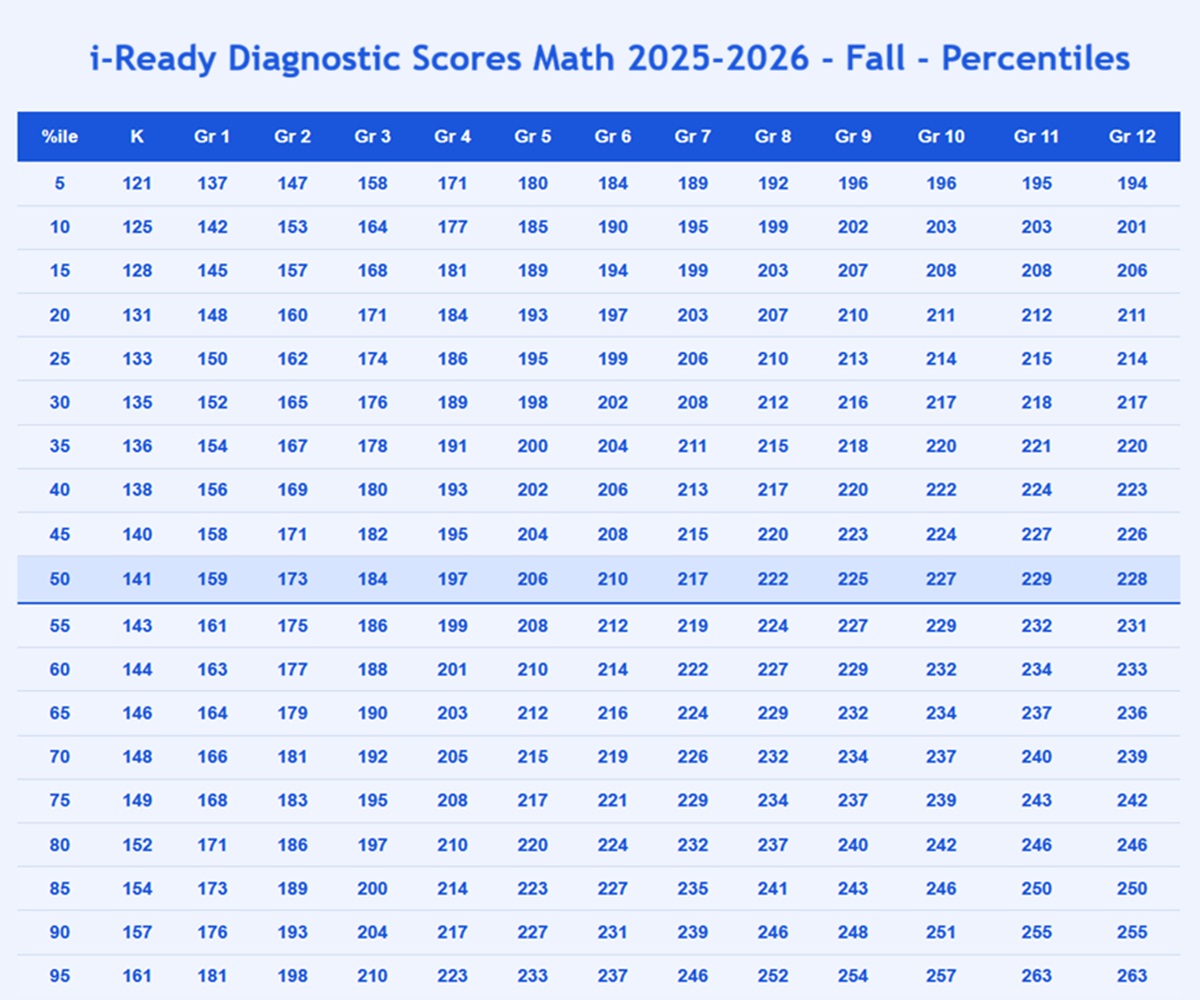
iReady Diagnostic Math Scores by Grade 2020-2026
How to Improve Your Child’s iReady Score
Because iReady Diagnostic is adaptive and measures genuine academic understanding across multiple domains, short-term test preparation has little effect. The most effective path to score improvement is real learning — building the skills the test measures. Here are the strategies most consistently supported by research and by educators who use iReady effectively:
| Strategy | What to Do | Impact |
|---|---|---|
| Complete iReady lessons consistently | Many schools assign iReady online lessons alongside the diagnostic. These lessons are calibrated directly to the student’s diagnostic results. 45+ minutes of lessons per week correlates significantly with growth. | ⭐⭐⭐⭐⭐ |
| Focus on the lowest domain | Identify which domain sub-score was lowest and target practice there. General review of everything is far less efficient than targeted work on the specific gap. | ⭐⭐⭐⭐⭐ |
| Daily reading practice | 20–30 minutes of daily reading at an appropriate challenge level is the single most research-supported way to improve Reading scores. Use the Lexile range (if provided) to select appropriate books. | ⭐⭐⭐⭐⭐ |
| Math fact fluency (Grades 2+) | Students who lack multiplication and division fact fluency spend cognitive resources on calculation that should go toward reasoning. 10–15 minutes daily of fact practice pays compound dividends. | ⭐⭐⭐⭐⭐ |
| Khan Academy (free) | Khan Academy’s grade-by-grade Math and Reading/ELA courses align closely with the skills iReady assesses. It is adaptive, free, and available 24/7. Start with the grade level where the student has gaps. | ⭐⭐⭐⭐ |
| Phonics for early grades (K–2) | For Kindergarten through Grade 2, phonics skills are the strongest predictor of Reading outcomes. If the Phonics domain score is low, structured phonics practice at home — letter-sound correspondence, blending, word families — is the highest-leverage activity. | ⭐⭐⭐⭐⭐ |
| Talk to the teacher | Teachers can share the specific iReady lesson topics assigned, which grade-level skills are being targeted, and exactly what would help most at home. This is always the highest-value first step. | ⭐⭐⭐⭐ |
One thing to avoid: coaching students to answer questions intentionally wrong to get an easier path through the assessment. This depresses the scale score, leads to below-level instructional assignments, and denies the teacher accurate data about where the student actually needs support. The only person harmed by a deliberately low iReady score is the student themselves.
iReady Inform: The 2026–2027 Rebrand — What It Means for Scores and Reports
In November 2025, Curriculum Associates announced that the iReady Diagnostic will be officially renamed iReady Inform beginning with the 2026–2027 school year. The announcement came directly from CEO Kelly Sia, who explained that the new name better reflects the assessment’s purpose: “to equip teachers, families, and students with the information they need to guide learning.” The shift from “Diagnostic” to “Inform” emphasizes the actionable, instructional purpose of the assessment rather than its clinical or diagnostic function.
The name change began rolling out gradually during the 2025–2026 school year and will be fully in place by the start of 2026–2027. During the transition, some schools and materials may use both names.
| What Changes | What Stays the Same |
|---|---|
| The name: “iReady Diagnostic” → “iReady Inform” | The 100–800 scale score system — identical |
| Shorter test option available from 2026–2027 (fewer questions, same score quality) | Placement levels, percentiles, and domain scores — unchanged |
| Updated report branding with iReady Inform logo and terminology | Typical Growth and Stretch Growth targets — unchanged |
| School year 2025–2026: transition period (both names may appear) | Historical scores remain fully comparable to new scores |
| Emphasis shifts toward “informing instruction” language in reports | Adaptive assessment methodology — unchanged |
The shorter test option introduced alongside the rebrand is designed to respond to educator feedback about testing time. Curriculum Associates was explicit that this shorter format preserves the quality and reliability of the data — it achieves efficiency by removing redundant questions, not by reducing measurement accuracy. Dr. Kristen Huff, head of measurement at Curriculum Associates, confirmed that the shorter iReady Inform assessment still delivers actionable, rich data at the domain level. Schools may choose whether to use the standard or shorter format.
Useful Resources and Links
- iReady Inform (formerly iReady Diagnostic) — Official Curriculum Associates Page — Full product information, report samples, and research documentation.
- iReady Inform Announcement — Official Rebrand Page — Everything Curriculum Associates has published about the transition from iReady Diagnostic to iReady Inform.
- iReady Diagnostic Resources for Educators — Score interpretation guides, technical documentation, and family-facing materials.
- iReady — Wikipedia — A general encyclopedic overview of the iReady platform, its history, and how it is used in schools.
- Khan Academy — The best free resource for supplementing iReady skill practice at home. Grade-aligned, adaptive, and available in multiple languages.
- ReadyScores.com — Detailed iReady Diagnostic score charts with percentiles by grade for Math and Reading, Fall/Winter/Spring, for 2025–2026 and 2026–2027.
30 Frequently Asked Questions About iReady Diagnostic Scores
Answers to the most common questions from parents, students, and teachers about iReady Diagnostic Scores (iReady Inform Scores) for 2025-2026 and 2026-2027.
What is a good iReady Diagnostic score overall?
A good iReady Diagnostic score is any score at or above the 50th national percentile for the student’s grade and testing season, meaning the student is performing at or above the national average. More meaningfully, a good score is one that reflects genuine growth from one testing season to the next — a student moving from the 35th to the 48th percentile over the course of a year is making excellent progress even if they have not yet reached the 50th percentile.
What is Considered a Good iReady Diagnostic Score for Kindergarten?
A good iReady Diagnostic score for Kindergarten is a scale score at or above the 50th national percentile for the testing season — approximately 345–365 in Math and 355–380 in Reading in Fall, rising by Spring. Because Kindergarten is the very beginning of formal schooling, the most important benchmark is not where a child starts but whether they are making consistent growth toward grade-level expectations by Spring. Wide variation in Fall scores is completely normal in Kindergarten and is not cause for alarm.
What is Considered a Good iReady Diagnostic Score for 1st Grade?
A good iReady score for 1st Grade is at or above the 50th national percentile: approximately 376–386 in Math and 393–415 in Reading for Fall testing, with scores rising toward Spring. First grade is a foundational year for phonics and early number sense — students who score below the 25th percentile in Reading in Fall may benefit from targeted phonics support, as early phonics gaps compound significantly in 2nd and 3rd grade if not addressed.
What is Considered a Good iReady Diagnostic Score for 2nd Grade?
A good iReady Diagnostic score for 2nd Grade is at or above the 50th national percentile: approximately 402–418 in Math and 430–447 in Reading for Fall testing. Second grade is when fluent decoding and basic computation become consolidated — students who are still working at 1st grade-level skills in either subject are at risk of falling further behind and should receive additional instructional support.
What is Considered a Good iReady Diagnostic Score for 3rd Grade?
A good iReady score for 3rd Grade is at or above the 50th national percentile: approximately 428–444 in Math and 450–462 in Reading for Fall testing. Third grade is a critical transition year — multiplication, division, and fractions in Math, and comprehension of complex texts in Reading, are introduced for the first time. Students who score two or more grade levels below in 3rd grade Reading should be identified for early intervention before the research-documented “reading cliff” at the end of 3rd grade.
What is Considered a Good iReady Diagnostic Score for 4th Grade?
A good iReady Diagnostic score for 4th Grade is at or above the 50th national percentile: approximately 452–470 in Math and 462–475 in Reading for Fall testing. Fourth grade deepens fraction understanding and multi-digit operations in Math, and introduces analysis of more complex literary and informational texts in Reading. Gaps in these areas become more difficult to close in later grades, making 4th grade a key intervention window.
What is Considered a Good iReady Diagnostic Score for 5th Grade?
A good iReady score for 5th Grade is at or above the 50th national percentile: approximately 470–487 in Math and 475–485 in Reading for Fall testing. Fifth grade is the critical gateway to middle school mathematics, with fraction operations and decimal arithmetic forming the foundation for everything that follows. Students who enter 6th grade significantly below grade level in Math face compounding difficulty across middle school, making 5th grade one of the highest-leverage intervention years.
What is Considered a Good iReady Diagnostic Score for 6th Grade?
A good iReady Diagnostic score for 6th Grade is at or above the 50th national percentile: approximately 483–501 in Math and 482–492 in Reading for Fall testing. Sixth grade introduces ratios, negative numbers, and the foundations of algebra in Math — a significant conceptual leap. Students scoring below the 25th percentile in Fall of 6th grade may benefit from a targeted pre-algebra review of fraction and decimal concepts before engaging with 6th grade content.
What is Considered a Good iReady Diagnostic Score for 7th Grade?
A good iReady score for 7th Grade is at or above the 50th national percentile: approximately 493–512 in Math and 488–498 in Reading for Fall testing. Seventh grade is heavily focused on proportional reasoning and rational number operations in Math — both essential prerequisites for algebra readiness. Students scoring at the 75th percentile or above in 7th grade Math are on a strong trajectory toward successful high school mathematics coursework.
What is Considered a Good iReady Diagnostic Score for 8th Grade?
A good iReady Diagnostic score for 8th Grade is at or above the 50th national percentile: approximately 501–524 in Math and 493–505 in Reading for Fall testing. Eighth grade introduces linear equations, functions, and geometric transformations — the foundations of high school algebra. Students scoring significantly above the 75th percentile in 8th grade Math are likely ready for Algebra 1 or beyond and should be considered for advanced coursework placement.
What is the iReady score scale?
The iReady scale score runs from 100 to 800 and is designed as a continuous K–12 developmental scale, meaning each point represents the same amount of academic learning regardless of the student’s grade. Most K–8 students score between approximately 300 and 600. The scale is intentionally designed so that a score of 450 in Math means the same thing whether earned in 4th grade or 6th grade — making it ideal for measuring long-term growth across multiple years.
What do the iReady placement levels mean?
iReady placement levels describe a student’s performance relative to their current grade-level expectations: “Above Grade Level,” “On Grade Level,” “One Grade Level Below,” and “Two or More Grade Levels Below.” These labels are based on the scale score in relation to grade-level benchmarks and are used to guide instructional grouping and lesson assignment. A student placed “Two or More Grade Levels Below” is not failing — it means they currently have foundational gaps that require targeted, differentiated instruction to close.
Does iReady affect grades or report cards?
No — iReady Diagnostic scores do not appear on report cards and do not affect a student’s academic grades in any subject. iReady is a diagnostic tool used by teachers to plan instruction, not an evaluative tool used to judge students academically. However, some schools track whether students completed all required Diagnostic sessions (typically three per year) and may note non-participation in student records.
How long does the iReady Diagnostic take?
The standard iReady Diagnostic takes approximately 45 to 60 minutes per subject, with most students answering 40 to 50 questions. Younger students in Kindergarten and Grade 1 often take the assessment over two shorter sessions. Beginning in 2026–2027, a shorter version is available that reduces testing time while maintaining data quality. Students who complete the test in under 30 minutes may have rushed, which can reduce accuracy and lead to assignments below their actual level.
How often is iReady given?
Most schools administer iReady Diagnostic three times per year: Fall (beginning of year, establishing a baseline), Winter (middle of year, checking progress), and Spring (end of year, measuring full annual growth). Some schools test twice per year (Fall and Spring only). Curriculum Associates’ research supports three administrations as the optimal frequency for actionable data without excessive testing burden.
What is Typical Growth on iReady?
Typical Growth is the scale score gain that a typical student at the same grade and starting score achieves over a given measurement period, based on Curriculum Associates’ longitudinal research across millions of iReady users. It is not the same for all students — students who start below grade level are expected to grow more than students who start above, because greater gains are both needed and achievable with targeted instruction. Meeting Typical Growth means a student has kept pace with expectations; exceeding it means they are making faster-than-expected progress.
What is Stretch Growth on iReady?
Stretch Growth is an ambitious but research-validated growth target that, if achieved for two consecutive years, puts a student on a trajectory toward grade-level proficiency on state assessments. It is higher than Typical Growth and is particularly meaningful for students who are currently below grade level. Curriculum Associates research shows that students who meet Stretch Growth for two consecutive years significantly increase their probability of reaching proficiency on state assessments.
Why did my child’s iReady score go down?
A genuine drop in scale score between testing periods is uncommon but possible if a student was unwell, anxious, rushing, or disengaged during the assessment. More commonly, what parents perceive as a drop is actually a lower percentile rank despite a similar or higher scale score — because the national average rises from Fall to Winter to Spring as students learn. Always compare the actual scale scores (not the percentile ranks) when measuring growth between seasons.
What is the difference between iReady Diagnostic and iReady Inform?
iReady Inform is the new name for iReady Diagnostic, announced by Curriculum Associates in November 2025 and fully implemented from the 2026–2027 school year onward. The name changed to better reflect the assessment’s primary purpose — informing instruction rather than simply diagnosing gaps. The core assessment, scoring system, and all report components remain identical. A score from the iReady Diagnostic era is fully comparable to a score from the iReady Inform era.
What grades use iReady?
iReady Diagnostic (iReady Inform) is designed for use in Grades K through 12 in both Math and Reading. It is most commonly used in Grades K through 8, where it is the primary diagnostic assessment in tens of thousands of schools across the United States. High school adoption is less common but growing, particularly for students who require support accessing grade-level content. Whether a school uses iReady at any particular grade level is a district decision.
Is iReady available in Spanish?
Yes — iReady Diagnostic is available in Spanish for Mathematics in Grades K–12 and for Reading in Grades K–6 (Spanish Reading is on a separate measurement scale from English Reading). The Spanish Math assessment is on the same scale as the English Math assessment, allowing for consistent score interpretation. This makes iReady particularly valuable for multilingual learner programs where native-language assessment data is needed alongside English performance data.
What is the iReady Lexile range?
The iReady Lexile range is a Reading score reported alongside the scale score on the Reading Diagnostic report. Expressed as a range such as 750L–1000L, it describes the text complexity level a student can comfortably read and comprehend. Parents can use this range immediately and practically — search any book title on lexile.com to find its Lexile level, then select books within the child’s range for independent reading and books slightly above the range for instructional reading with teacher support.
How does iReady compare to NWEA MAP?
Both iReady Diagnostic and NWEA MAP Growth are widely used adaptive diagnostic assessments for K–8 Math and Reading, but they use different scoring scales and are not directly comparable. iReady scores range from 100–800; NWEA MAP uses a RIT scale of approximately 100–300. Both produce scale scores, national percentile ranks, and domain sub-scores. The choice between them is typically made at the district level. Many districts use one or the other; a smaller number use both for different purposes.
How are iReady scores used by teachers?
Teachers use iReady Diagnostic results to form small instructional groups based on shared needs, assign differentiated online lessons, identify students for enrichment or intervention, monitor growth from Fall to Spring, and communicate with parents at conferences. Domain-level sub-scores are particularly useful for identifying the precise skill area where instruction should focus. At the school level, aggregate iReady data is used for program evaluation, resource allocation, and instructional coaching conversations.
Can students prepare for iReady?
The best preparation for iReady is genuine, ongoing engagement with school curriculum throughout the year — the adaptive nature of the test makes traditional cramming ineffective. The most helpful practical steps are ensuring students are well-rested, not rushed, and understand that the test is designed to get harder as they do well. Reducing test anxiety is often more valuable than any last-minute academic preparation. Students should be encouraged to try their absolute best on every question and to take their time.
What happens if a student doesn’t finish iReady?
Most schools allow students to pause and resume an incomplete iReady session in a subsequent sitting, with progress saved. If a session is substantially interrupted or a student answers carelessly, the resulting score will not accurately reflect their ability and should be interpreted with caution. Teachers typically flag incomplete or suspiciously short sessions and may request a retest. Parents should notify the teacher if they believe a session was taken in poor conditions.
What is the highest possible iReady score?
The iReady scale technically extends to 800, but in practice K–8 students very rarely score above approximately 600. A score above 600 would represent performance far beyond even the 99th percentile for 8th graders and would imply mastery of content well into high school. There is no published “perfect” score — the scale is a continuum, not a test with a fixed maximum score to achieve.
What is a good iReady Math score?
A good iReady Math score is one at or above the 50th national percentile for your child’s grade and testing season. In practical terms: approximately 376 for Grade 1 Fall, 428 for Grade 3 Fall, 470 for Grade 5 Fall, and 501 for Grade 8 Fall (50th percentile benchmarks). A score at the 75th percentile or above is considered strong, and consistent growth toward or above these benchmarks across the school year is the most meaningful indicator of solid Math learning.
What is a good iReady Reading score?
A good iReady Reading score is at or above the 50th national percentile for your child’s grade and season. In practical terms: approximately 393 for Grade 1 Fall, 450 for Grade 3 Fall, 475 for Grade 5 Fall, and 493 for Grade 8 Fall. Reading growth tends to be more gradual than Math growth — small, consistent gains between testing seasons are healthy and meaningful. The Lexile range on the Reading report is a particularly useful tool for driving further improvement through appropriately leveled independent reading.
Is iReady free for students and parents?
iReady is a paid platform licensed by schools and districts from Curriculum Associates — students access it through a school-issued login at no cost to families. Parents cannot purchase individual access to the iReady Diagnostic independently. If your child’s school does not use iReady, the closest publicly available alternatives for diagnostic assessment include Khan Academy’s free adaptive coursework and, in some districts, publicly accessible MAP Growth tools.
What resources are best for improving iReady scores?
The most effective resources for improving iReady scores are: (1) the iReady online lessons themselves, which are calibrated directly to each student’s diagnostic results; (2) Khan Academy, which offers free, grade-aligned K–12 Math and Reading/ELA practice; (3) daily independent reading at the Lexile range shown on the Reading report; and (4) structured phonics or math fact fluency practice for students with specific foundational gaps. Consulting the classroom teacher about which domain scored lowest is always the best first step.
</
Sources:
Curriculum Associates
iReady Login
i-Ready on Wikipedia
Other i-Ready Resources
i-Ready Scores and Grade-Level Benchmarks
i-Ready Reading Score Chart
i-Ready Math Score Chart
Guide to i-Ready Diagnostic Results
Answers to Common i-Ready Questions
Calculate an i-Ready Score and Percentile
Track i-Ready Reading and Math Growth
i-Ready Instructional Levels by Grade
Understand i-Ready Grade Placement Levels
Good i-Ready Scores for Each Grade
Understanding Your Child’s i-Ready Diagnostic Report
Helping a Child Who Scored Below Grade Leveldiv>