i-Ready Levels A, B and C: The Early Grades Explained
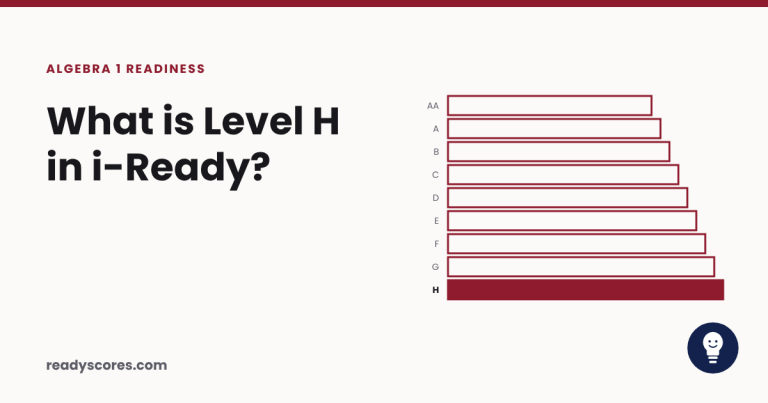
Levels AA, A, B and C in i-Ready cover kindergarten through grade 3. AA is kindergarten, A is first grade, B is second grade and C is third grade.
These four bands do one job between them: turn a child who cannot read into a child who reads without thinking about it. Everything above them assumes that job is finished, which is why a gap left here is the most expensive kind on the whole ladder.
| Level | Grade | What reading is mostly about |
|---|---|---|
| AA | Kindergarten | Hearing sounds in words, letter names and sounds |
| A | Grade 1 | Blending sounds into words, common words on sight |
| B | Grade 2 | Longer words, and reading smoothly enough to follow meaning |
| C | Grade 3 | Comprehension becoming the main event |
What each band is actually doing
Level AA is about sound before it is about print. Hearing that cat and cap differ at the end, that stop starts with an s sound. This is phonological awareness, it is almost entirely oral, and it is the strongest early predictor of later reading there is.
Level A is where sounds and letters meet. Blending them into words, and starting to recognise the high-frequency words that do not behave phonetically. Reading at this stage is effortful and should be.
Level B is about fluency. The same skills, faster, until decoding stops consuming all the attention. A Level B child who reads accurately but very slowly has not finished the band, whatever their accuracy looks like.
Level C is the handover. Decoding is expected to be automatic and comprehension becomes the main thing being measured. By the end of Level C a child should be reading to learn, which is what Level D assumes from the first page.
Grade 3 is the hinge, and what actually changes there is the shift from learning to read to reading to learn.
Why a gap here matters more than one higher up
A missing fraction concept at Level E is a hole you can go back and fill. A decoding weakness left unresolved at Level C does not stay a reading problem. It turns into a science problem, a maths word problem problem, and a child who stops volunteering in class, because every subject now arrives through text.
That is also why these gaps get harder to spot after Level C. Nobody is listening to a fourth grader read aloud. The symptom moves, and the cause stays where it was.
The band is not the grade, and the letter is not the score
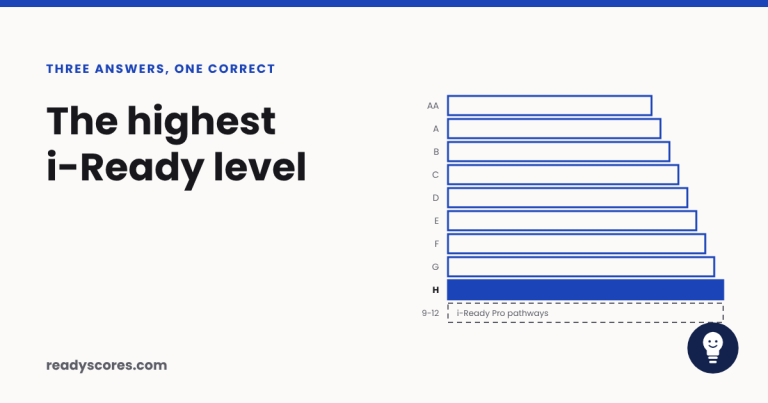
A kindergartener in Level A is working above their grade. A second grader in Level A is working below it. Both are ordinary results and the full AA to H ladder shows how bands map to grades.
Each band also covers a range of scale scores on the roughly 100 to 800 scale, so two children in the same letter can be some way apart. The diagnostic score ranges list the figures, the reading chart by grade breaks them out, and the calculator will place a score.
As a mother, the five minutes that told me more than the report
When my daughter was in Level B her report looked fine and I would have left it there. What changed my mind was a teacher suggesting I ask her to read me something she had not seen before, and time it roughly in my head.
She was accurate and she was slow. Painfully slow on anything unfamiliar. Accuracy had been masking it, because every individual word was right.
Fluency is the thing that does not show up in a conversation with a seven year old and does not always show up in a band either. The test for it costs five minutes and a book she has not met.
Before school starts, many districts run a readiness check at entry, which measures something different again: what a kindergarten screener actually looks at is a flag for a closer look rather than a placement.
What to do with an early-band result
Listen to your child read something unfamiliar aloud. Accuracy and speed are different skills and the second one is the one that quietly fails.
Take phonological awareness seriously at Level AA even though it feels like a game. It is the strongest predictor in the set.
Watch direction rather than the letter, since young children move quickly and unevenly. The growth tracker compares a child to their own earlier self, which at this age is the only comparison worth making.
And if a report comes back below where you expected, young children produce noisy results more than older ones do. The ordinary explanations are worth working through, and the placement bands show how far from grade level the label actually means.
Common questions
What grades are i-Ready Levels AA, A, B and C?
AA is kindergarten, A is grade 1, B is grade 2 and C is grade 3. Together they cover the whole early elementary sequence.
What is Level AA in i-Ready?
Level AA is the kindergarten band. It focuses on phonological awareness, which is hearing and manipulating sounds in spoken words, along with letter names and sounds.
Is Level C good for a 2nd grader?
Yes. A second grader in Level C is working a year above their enrolled grade. For a third grader it is on grade level.
My child reads accurately but scored low. Why?
Accuracy and fluency are different skills and i-Ready measures both. A child who reads every word correctly but slowly uses most of their attention on decoding, leaving little for comprehension, and that shows up as a low score despite accurate reading.
How long should a child stay in each early level?
Roughly a school year each, but movement at this age is uneven and often happens in jumps rather than steadily. A child can sit in the same band for two diagnostics and then move a whole level in one term, which is why direction over three sittings tells you more than any single result.