Cursive Alphabet Chart: How to Write Every Letter in Cursive (2026)
Cursive Alphabet Chart: Why It Still Matters, Why Children Should Learn It, and How to Write Every Letter in Cursive
The cursive alphabet is still important. Even in a world of phones, tablets, and keyboards, cursive writing still has a place in education, signatures, handwritten notes, historical documents, and personal communication. Many schools continue to teach it, and many states now require or strongly encourage cursive instruction again.
Cursive Alphabet Chart
A good cursive alphabet chart should show every capital and lowercase letter clearly, with the letters sitting correctly on the baseline and using consistent spacing and proportions.
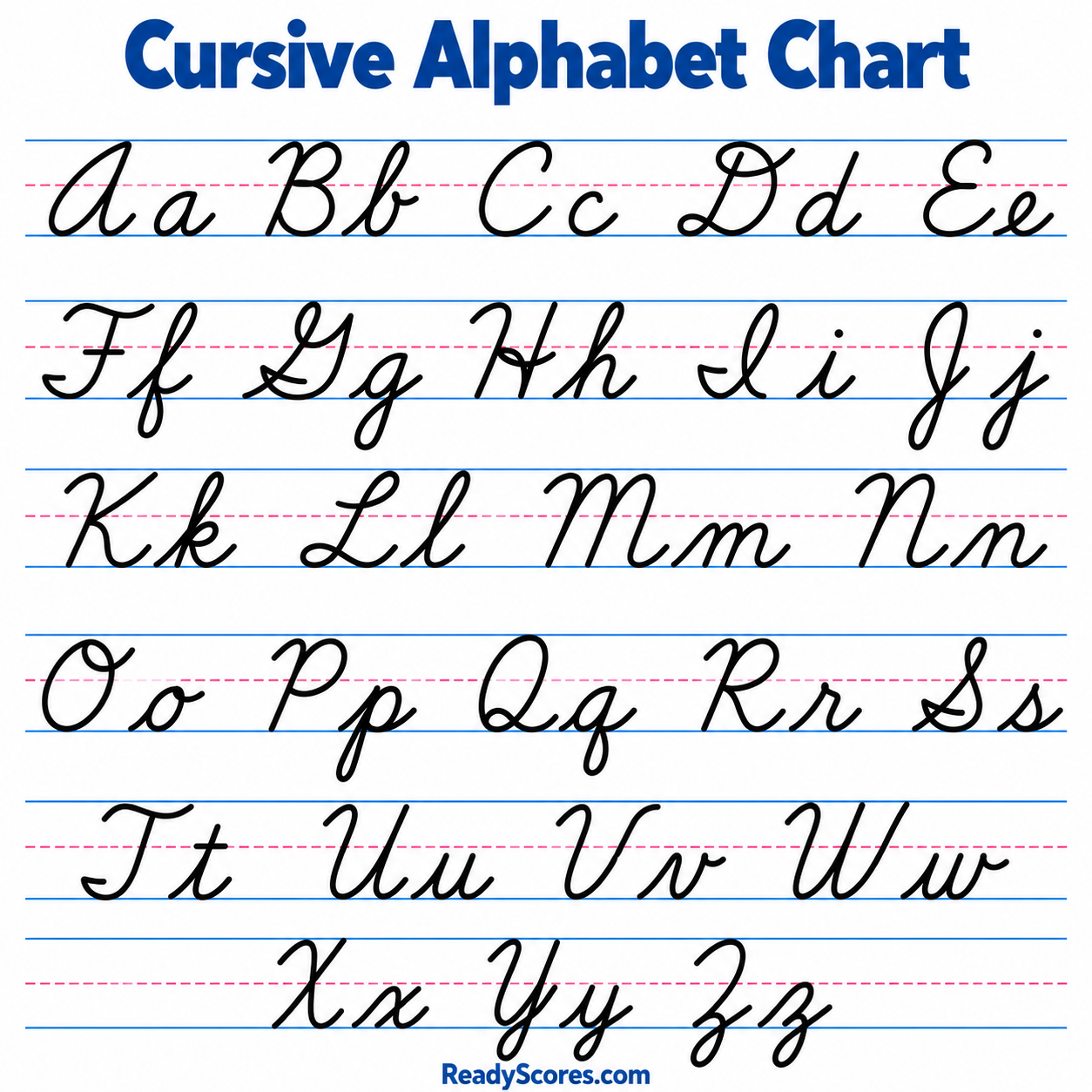
If you want to see the full alphabet first, visit the Cursive Alphabet guide and the Cursive Alphabet Chart at LetterAccents.com.
Those pages show more cursive alphabet charts, individual letters, and guides for writing both uppercase and lowercase letters. Children often learn by copying. If a chart is messy, uneven, or poorly aligned, it can teach bad habits from the very beginning. A clean chart makes cursive easier to understand and easier to practice.
A standard chart usually includes all 26 uppercase letters, all 26 lowercase letters, and writing lines that help students see where the letters should sit, rise, or dip below the baseline.
What Is the Cursive Alphabet?
The cursive alphabet contains the same 26 letters as the regular English alphabet.
The difference is in the style.
Instead of forming each letter separately like print handwriting, cursive is written in a more flowing and connected way. Most lowercase letters join to the next one, which creates a continuous motion across the page.
That is the core idea.
Flow. Movement. Connection.
What Does Standard Cursive Look Like?
There is no single universal cursive style used in every classroom.
Several systems have influenced how cursive is taught in the United States, including Zaner-Bloser, D’Nealian, and older styles such as Palmer. The exact shape of some capital letters may vary between systems, especially letters like F, G, Q, T, and Z.
Still, standard cursive usually shares the same features:
- Letters are formed with smooth strokes.
- Most lowercase letters connect to the next letter.
- Letters rest properly on the baseline.
- Some letters rise tall above the middle line.
- Some letters descend below the baseline.
- The writing often has a slight rightward slant.
Is Cursive Still Used Today?
Yes.
Absolutely.
Cursive is still used for signatures, greeting cards, handwritten notes, personal letters, school assignments, and journaling. It is also essential for reading many old handwritten materials, including family records, diaries, archival documents, and historical texts.
A child who cannot read cursive may look at a handwritten document and struggle to understand it, even if the language itself is familiar.
Why Was Cursive Taught Less for a While?
For several years, many schools focused more heavily on typing and digital literacy.
That shift was understandable.
Computers became central to school and work, and classroom time was limited. In many districts, cursive received less attention, especially after academic standards placed more emphasis on keyboarding and less emphasis on handwriting styles.
But the decline did not last forever.
Why Is Cursive Coming Back?
More states now require or encourage cursive again.
Teachers and parents have pushed for it.
There are practical reasons for this. Students still need to sign their names. They should be able to read handwritten documents. Many educators also believe children should be able to write in more than one form by hand.
Cursive is part of basic literacy.
Which States Require Cursive?
Cursive requirements vary by state, and the exact total depends on whether you count formal laws, statewide curriculum standards, or both.
In practice, many states now require or strongly support cursive instruction.
These commonly include:
- Alabama
- Arizona
- Arkansas
- California
- Delaware
- Florida
- Georgia
- Idaho
- Illinois
- Indiana
- Iowa
- Kentucky
- Louisiana
- Maryland
- Massachusetts
- Mississippi
- Missouri
- New Hampshire
- New Jersey
- North Carolina
- Ohio
- Oklahoma
- Pennsylvania
- South Carolina
- Tennessee
- Texas
- Utah
- Virginia
- West Virginia
State rules can change, and some states teach cursive through formal law while others include it through statewide standards.
So check locally too.
Why Should Your Child Learn Cursive?
There are many good reasons.
Some are practical.
Some are educational.
And some are simply about being fully literate in the modern world.
1. Your Child Will Be Able to Read Cursive
This is the most obvious reason.
If a child learns cursive, that child can also read it. This matters for reading older documents, family letters, handwritten school materials, and original historical texts.
2. Your Child Can Develop a Signature
A signature is still important.
Children grow up. They will eventually sign forms, school papers, identification documents, and official papers. Cursive provides the natural foundation for a recognizable personal signature.
3. Cursive Can Become Faster Than Print
Because cursive connects many letters, it can become efficient once the movements are learned.
Not at first.
At first it feels slower.
But over time, many writers find connected cursive movement faster than lifting the pen after every printed letter.
4. It Builds Handwriting Fluency
Cursive is about rhythm.
And repetition.
When children practice cursive, they learn how letters flow into one another. That can improve overall handwriting control and confidence.
5. It Supports Fine Motor Skills
Writing by hand requires finger control, hand stability, spacing judgment, and coordinated motion.
Cursive adds a flowing pattern to those skills, which can help children become more comfortable controlling the pen across the page.
6. It Gives Children Another Useful Writing Style
Print and cursive do not have to compete.
A child can learn both.
That is ideal.
Being able to print clearly and write cursively gives a child more flexibility.
How to Write in Cursive
The best way to learn cursive is to begin slowly.
Do not rush.
Start by learning the basic shape of each letter. Then practice the strokes. Then practice the joins between letters. Finally, move to short words and sentences.
One step at a time.
Learn the Baseline
Every good cursive chart depends on the baseline.
This is the bottom line where most letters rest. Some letters rise above it. Some dip below it. But all letters must relate properly to it.
That is why alignment matters so much.
Use Consistent Height
Lowercase letters should be similar in size.
A lowercase a should not suddenly be much taller than a neighboring e or o. Consistent size makes handwriting cleaner and easier to read.
Use a Consistent Slant
Most cursive writing leans slightly to the right.
The exact angle is less important than keeping it consistent across the word.
Learn Entry and Exit Strokes
Many cursive letters begin with a small entry stroke and end with a connecting exit stroke.
That is how words flow.
The end of one letter becomes the bridge to the next.
Practice Similar Letters Together
This helps a lot.
Instead of learning only in alphabetical order, many children learn faster by grouping similar shapes:
- a, c, d, g, o, q
- i, t, u, w
- e, l, h, b
- m, n
- p, y, j
Similar movement builds confidence.
How to Write Every Letter in the Cursive Alphabet
LetterAccents.com has individual pages for every letter.
All 26.
Each page can help readers learn how to form the uppercase and lowercase letter correctly, and explains that you can see the animation and image showing how to write the letter properly.
Cursive A
Learn Cursive A and see how to write both the capital A and lowercase a in cursive.
Cursive B
Visit Cursive B to learn the uppercase and lowercase forms and how the strokes connect.
Cursive C
Use Cursive C to practice one of the most useful curved base shapes in cursive writing.
Cursive D
The Cursive D page shows how to write the tall ascender and rounded lowercase shape.
Cursive E
Practice Cursive E and study the movement in both uppercase and lowercase.
Cursive F
See Cursive F for one of the letters that varies more between cursive styles.
Cursive G
Learn Cursive G and practice the descending loop below the baseline.
Cursive H
Use Cursive H to learn the tall loop and lowercase connection.
Cursive I
See Cursive I for both capital and lowercase forms, including the dotted lowercase i.
Cursive J
Practice Cursive J and learn its descending stroke and dot placement.
Cursive K
The Cursive K guide helps with one of the letters some learners find unusual at first.
Cursive L
Visit Cursive L and practice the tall loop that is common in cursive writing.
Cursive M
See Cursive M to practice repeated curved strokes and smooth rhythm.
Cursive N
Learn Cursive N and compare it with the closely related lowercase m.
Cursive O
Use Cursive O to practice rounded movement and proper exit stroke.
Cursive P
Visit Cursive P to study the form of both the capital and the descending lowercase p.
Cursive Q
Learn Cursive Q, especially since the capital Q can look very different from printed Q.
Cursive R
Practice Cursive R and pay attention to the entry movement and connection.
Cursive S
See Cursive S for a letter that often varies by style and benefits from visual guidance.
Cursive T
Use Cursive T to learn the uppercase form and the crossed lowercase t.
Cursive U
Practice Cursive U and build comfort with its repeated up-and-down movement.
Cursive V
Learn Cursive V and see how it connects into the next letter.
Cursive W
Visit Cursive W to practice a slightly extended version of the same flowing stroke pattern.
Cursive X
See Cursive X for one of the more distinctive lowercase shapes.
Cursive Y
Learn Cursive Y and practice the descending tail below the baseline.
Cursive Z
Finish with Cursive Z, another letter whose cursive form can look quite different from print.
See the Full Cursive Alphabet
If you want the entire alphabet together in one place, use the
Cursive Alphabet Chart.
If you want the full section with charts and letter guides, visit
Cursive Alphabet.
You can see more cursive alphabet charts there as well.
Which Cursive Letters Are Easiest for Beginners?
Some letters are easier than others.
Lowercase c, a, i, u, e, and l are often good starting letters because their movements are simpler and appear again inside other letters.
This helps children learn patterns instead of memorizing every letter as a completely separate symbol.
Which Cursive Letters Are Hardest?
For many learners, uppercase letters are harder.
Especially F, G, Q, T, and Z.
Those capital forms can look much less familiar than printed letters, which is why animations and visual guides are especially useful.
How Often Should a Child Practice Cursive?
Short sessions work best.
Ten minutes is enough.
A child does not need an hour of cursive practice every day. Short, regular practice is usually more effective. Practicing for 10 to 15 minutes several times a week is often enough to make real progress.
How to Practice Cursive Effectively
A simple method works well:
- Look at the model letter.
- Trace it.
- Copy it while looking.
- Write it from memory.
- Use it in a short word.
That sequence is powerful.
It gradually moves the child from imitation to real writing skill.
Cursive vs Print
Print separates letters.
Cursive connects them.
Both matter.
Print is often easier for very young beginners. Cursive may later become more fluid and efficient. There is no reason a child cannot learn to read and use both.
Cursive vs Calligraphy
These are different things.
Cursive is a handwriting style used for regular writing. Calligraphy is decorative writing, usually done more slowly and artistically.
A person does not need to learn calligraphy to write good cursive.
Common Cursive Mistakes
Watch out for these:
- Letters floating above the baseline
- Letters sinking below the baseline when they should not
- Uneven lowercase height
- Changing the slant too much
- Writing too fast too early
- Leaving too much space between letters
- Loops that are too large or too tight
- Forgetting to dot i and j
- Forgetting to cross t
Slow and neat is better than fast and messy.
Why Reading Cursive Matters Too
Learning cursive is not only about writing.
It is about reading too.
Students who can read cursive can access handwritten letters, older records, original historical sources, and handwritten notes more easily. That is part of being literate in a fuller sense.
Frequently Asked Questions About the Cursive Alphabet
How many letters are in the cursive alphabet?
There are 26 letters in the English cursive alphabet, each with an uppercase and lowercase form.
Is cursive still taught in school?
Yes. Many states now require or encourage cursive again, and many schools teach it during elementary grades.
Is cursive mandatory everywhere?
No. There is no nationwide federal requirement, but many states include it in law or statewide academic standards.
Why should children learn cursive?
Children should learn cursive so they can read handwritten documents, develop a signature, gain another form of handwriting, and write more fluently once they become comfortable with the letter connections.
Where can I see a full cursive alphabet chart?
See the Cursive Alphabet Chart at LetterAccents.com.
Where can I learn each individual cursive letter?
Visit the main Cursive Alphabet section and the individual A–Z pages listed throughout this article.
The Bottom Line
Cursive is still useful.
Still relevant.
And still worth learning.
Children benefit from being able to read and write more than one handwriting style. Cursive helps with signatures, handwritten communication, historical literacy, and overall writing fluency.
To explore more, start with
Cursive Alphabet
and the
Cursive Alphabet Chart,
then open the individual letter guides from
Cursive A
through
Cursive Z.
One letter at a time.
That is how cursive becomes easy.